
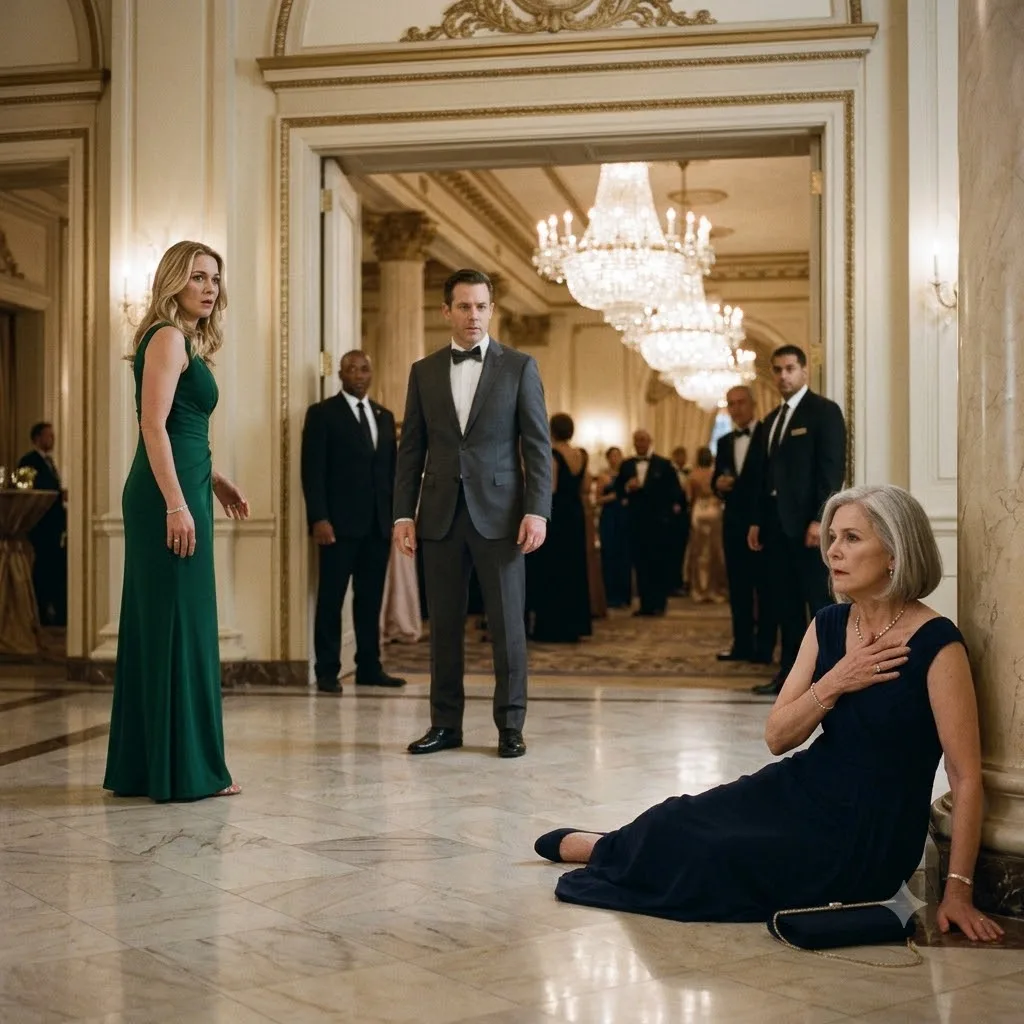
At the hospital, the pain in my wrist came in waves.
The first wave was sharp enough to make me nauseated.
The second was worse because it arrived after the adrenaline faded.
By then the ballroom, the applause, and Kendra’s face had begun replaying in my head with an almost mechanical precision.
The nurse asked me how I had fallen.
“My daughter-in-law hit me.”
The words sounded strange in a hospital room.
I had known Kendra for more than twelve years.
I had sat beside her at holiday dinners.
I had bought her wedding shower gifts.
I had held her hand in a hospital waiting room when Julian had a minor surgery.
I had defended her more than once when other relatives called her difficult.
Now her name sat on a medical form beside the reason for my visit.
The nurse did not react dramatically.
She simply asked the next question.
“Did you lose consciousness?”
“No.”
“Did you strike your head?”
“I don’t think so.”
“Are you safe going home tonight?”
That question caught me.
I had not expected it.
“Yes.”
Then I thought about Julian.
I thought about the way he had looked at Kendra first.
I thought about his first concern being her career.
“Yes,” I repeated.
“I live alone.”
The nurse nodded.
That answer used to make me feel lonely when I said it.
That night, it felt like protection.
The police officer who had taken my initial statement at the hotel came to the hospital later.
He asked whether I wanted to add anything while the details were fresh.
I told him about the invitation.
I told him about the email.
I told him about the announcement.
Then I told him the part that hurt more than the slap.
“My son knew she planned to say it.”
The officer stopped writing for a second.
“He told you that?”
“Yes.”
“Did he say he believed you had agreed?”
“No.”
“What did he say?”
“He said they thought I wouldn’t make a scene once everyone applauded.”
The officer’s expression remained professional, but something in his eyes changed.
He wrote it down.
I watched the pen move.
That small motion mattered to me.
For years, I had treated family cruelty as something too private to record.
Hurt feelings happened.
People said things they regretted.
Adult children made selfish choices.
In-laws misunderstood each other.
You did not document those things.
You absorbed them.
But the moment the officer wrote Julian’s words into his notes, I felt a boundary shift.
This was not a misunderstanding floating inside a family argument.
It had a time.
A place.
Witnesses.
A video camera.
A statement.
A printed email.
Facts were beginning to exist outside anyone’s preferred version of events.
My phone had been buzzing inside my purse since the ambulance ride.
I ignored it until the officer left.
Then I looked.
There were eleven missed calls.
Six from Julian.
Three from a number I knew belonged to Kendra.
Two from Marjorie.
There were also messages.
Julian’s first one said:
Please call me.
The next:
Mom, I’m at the hospital parking lot.
Then:
They won’t let Kendra come back here with me.
Please talk to me.
Then:
I’m sorry.
The word sat on the screen.
I did not know what it meant.
Sorry that she hit me?
Sorry that I had fallen?
Sorry that the plan had failed?
Sorry that I had called police?
Sorry that witnesses had seen?
Sorry that he had admitted he knew?
There are apologies that begin repair.
There are also apologies people offer because consequences have finally become visible.
I was not ready to decide which one this was.
Kendra’s messages were shorter.
This has gone too far.
Then:
You know I didn’t mean to hurt you.
Then:
Please don’t ruin everything over one mistake.
I read that one twice.
One mistake.
The invitation.
The false claim of sponsorship.
The announcement.
The attempt to corner me with applause.
The argument.
The slap.
The request that I stay quiet afterward.
Which one was the mistake?
I did not answer.
Marjorie’s message said:
I heard something happened.
Are you safe?
I replied to her.
At hospital.
I’m safe.
I’ll call tomorrow.
She answered almost immediately.
I’m here.
That was all.
No demand for details.
No instruction.
No guilt.
Just four words that gave me more comfort than all of Julian’s messages combined.
A doctor examined my wrist and sent me for imaging.
I will not dramatize the medical part because the emotional injury mattered more than the technical diagnosis that night.
The important thing was that my wrist had been hurt in a fall caused by a strike, and the injury made ordinary tasks suddenly difficult.
Opening my purse hurt.
Signing paperwork hurt.
Taking off my bracelet hurt.
Even pulling my coat around my shoulders required help.
I had spent years protecting my independence with money, planning, and stubbornness.
In one angry second, Kendra had made me dependent on strangers to fasten my sleeve.
That humiliation settled deeper than I expected.
Near midnight, the hospital staff told me I could leave.
Julian was still in the parking lot.
I knew because he kept texting.
I considered asking a nurse to help me arrange a ride home.
Then I remembered that Marjorie lived twenty minutes away.
I called her.
She answered on the first ring.
“I’m coming.”
“You don’t have to.”
“I know.”
There was a pause.
“That’s why it counts.”
I almost laughed.
Instead, I cried.
Not loudly.
Just enough that I had to turn my face toward the wall.
Marjorie arrived wearing jeans, a sweater, and house slippers inside winter boots because she had changed in a hurry.
She did not ask me to explain anything until we were inside her car.
Then she looked at my wrist.
“What happened?”
“Kendra hit me.”
Her hands tightened around the steering wheel.
“Julian?”
“He defended her.”
Marjorie closed her eyes for one second.
“I’m sorry.”
That apology felt different.
It did not ask me to do anything.
It did not try to control what happened next.
It simply acknowledged pain.
When we reached my house, Julian’s car was parked at the curb.
Marjorie saw it first.
“Do you want me to stay?”
“Yes.”
The answer came faster than I expected.
We walked toward the porch.
Julian got out of his car.
He looked exhausted.
“Mom.”
I kept walking.
“Can we talk?”
“Not tonight.”
“Please.”
I stopped at the bottom step.
Marjorie stood beside me.
Julian looked at her, then back at me.
“Kendra is devastated.”
I stared at him.
It was after midnight.
My wrist hurt.
I had spent hours answering questions in a hospital because his wife had struck me.
And somehow he still led with Kendra’s feelings.
I said nothing.
He recognized the mistake too late.
“I mean—obviously you’re hurt.
I know that.”
“Do you?”
“Mom.”
“Go home, Julian.”
He stepped closer.
“I need you to understand what happened.”
“I was there.”
“Kendra panicked.”
“She slapped me.”
“She was humiliated.”
“She lied about me in front of seventy people.”
“She thought you were going to help.”
“I said no six weeks ago.”
“She thought you’d come around.”
“I told you no too.”
His jaw tightened.
“You did, but she was under pressure because deposits were already paid.”
I felt something cold move through me.
“Deposits were already paid when?”
He looked away.
“When we talked.”
“Six weeks ago?”
“No.”
“Then when?”
He did not answer.
I understood.
The financial problem had grown after my refusal.
Instead of reducing the event, Kendra had continued spending as though my answer were temporary.
Maybe that explained the desperation.
It did not excuse anything.
“How much does she owe the hotel?”
“I don’t know the exact number.”
“She announced twenty thousand.”
“That’s what’s left across everything.”
I looked at him.
“You knew she planned to tell everyone I had agreed.”
“Yes.”
“You knew I had not.”
He swallowed.
“Yes.”
“And you let her do it because you thought I would be too embarrassed to correct her.”
He did not defend himself this time.
“Yes.”
Marjorie shifted beside me.
Julian stared at the porch railing.
I thought about every birthday cake I had baked for him when he was a child.
Every scraped knee.
Every school conference.
Every late-night call when he was away at college and overwhelmed.
Parenthood teaches you to remember your child in layers.
The man standing in front of me was forty-two.
But part of my mind kept seeing the seven-year-old who used to crawl into my bed after thunderstorms.
That is one reason adult children can hurt their parents so deeply.
You are not only reacting to what they do now.
You are reacting with the entire history of loving them.
“Why?”
My voice cracked.
Julian looked up.
“Why did you think that was acceptable?”
“I didn’t think it was acceptable.”
“You allowed it.”
“I thought it would resolve the money problem.”
“There is no money problem for me.”
He looked confused.
I continued.
“Kendra’s event budget is not my emergency.”
“I know.”
“No. You know now because it failed.”
His face tightened.
“That’s not fair.”
I almost smiled.
“Fair?”
“Mom, I’m trying to apologize.”
“Then apologize.”
He opened his mouth.
I waited.
“I’m sorry I didn’t stop her.”
“For what?”
He looked frustrated.
“You know for what.”
“No. I want to hear you say what you did.”
Marjorie glanced toward me.
I knew I was pushing.
I also knew I had spent too many years accepting vague apologies that left responsibility blurry.
Julian took a breath.
“I knew you had said no.”
I nodded.
“I knew Kendra was going to announce that you had agreed.”
I said nothing.
“I thought you wouldn’t contradict her in front of everyone.”
He looked sick now.
“I thought once the event was over, we could work something out.”
There it was.
Not only the announcement.
The plan after the announcement.
Once the event was over.
Once the money had been spent.
Once the public claim had been made.
Once I had been socially trapped.
Then we could work something out.
I felt suddenly tired.
“You were going to negotiate with me after spending my money in public.”
“Not your money.”
“Then whose?”
He had no answer.
I climbed the steps.
“Mom.”
I turned.
“If you want a relationship with me after tonight, do not ask me to withdraw the report.
Do not ask me to pay one dollar.
Do not tell me to protect Kendra from consequences she created.”
He looked down.
“And do not come into my house tonight.”
His face changed.
That was the first consequence that seemed to reach him personally.
“Okay.”
I unlocked the door with my left hand.
Marjorie followed me inside.
I closed it.
Then I locked it.
For a long time, neither of us spoke.
Marjorie made tea.
I sat at my kitchen table and looked at the same place where Kendra had spread out her gala plans six weeks earlier.
The table looked ordinary.
That offended me too.
I wanted some visible sign that something important had happened there.
A crack.
A stain.
Anything.
Instead, the wood reflected the kitchen light exactly as it had before.
“Do you want me to stay here tonight?”
Marjorie asked.
I nodded.
“Yes.”
She slept in the guest room.
I barely slept at all.
Every time I closed my eyes, I saw the stage.
Not the slap.
The applause.
That was what my mind returned to.
The applause had been the weapon before the hand.
By morning, my cheek no longer stung, but I still felt the pressure of seventy strangers approving a promise I had never made.
At seven-thirty, I made coffee one-handed.
At eight, Julian called again.
I let it go to voicemail.
At eight-ten, Kendra called.
I ignored it.
At eight-fifteen, the hotel event coordinator emailed me.
The message was formal.
She said the hotel had documented my prior written notice and that my status remained that of a guest, not the contracted client.
I read that sentence several times.
Then I printed the email.
I put it in the same folder as the first one.
Two pieces of paper.
Nothing dramatic.
But both carried dates.
Both existed before anyone could revise the story.
At nine, the hotel manager called.
He asked how I was feeling.
I told him I was home.
Then he said the banquet captain had already provided a statement about what he had witnessed in the foyer.
I thanked him.
He also confirmed security had preserved the relevant footage at the police request.
I did not ask to see it.
I did not need to.
I had been there.
I knew what happened.
That distinction became important over the next several days because everyone else seemed desperate to convert a simple sequence of facts into a debate about intention.
Kendra did not mean to hurt me.
Julian did not mean to pressure me.
They did not mean for the announcement to sound like a lie.
They did not mean for the invitation to imply legal responsibility.
They did not mean for the situation to become public.
Intent became the blanket they tried to throw over everything.
But facts remained underneath.
I said no.
They knew I said no.
Kendra publicly announced yes.
Julian let her.
When I corrected the lie, Kendra hit me.
The hotel had a witness and video.
I had the email.
The rest was commentary.
By lunchtime, two relatives had called.
That told me the story was already traveling.
My sister-in-law, Teresa, began cautiously.
“Evelyn, I heard there was an incident.”
“There was.”
“I just want to make sure I understand before people start choosing sides.”
I closed my eyes.
“Choosing sides?”
“You know how families get.”
“No, Teresa.
I know how facts work.”
She went quiet.
I told her what happened.
I did not add adjectives.
I did not call Kendra a monster.
I did not call Julian weak.
I did not mention every insulting conversation from the previous six weeks.
I gave her the sequence.
Kendra asked me for $20,000.
I said no.
The invitation named me as host without permission.
I notified the hotel in writing.
Kendra announced in front of seventy guests that I had agreed to pay.
I corrected her.
She took me into the foyer.
She hit me.
I fell.
The hotel called medical help.
I asked for police.
Julian admitted he knew she planned the announcement and thought I would be too embarrassed to object.
Teresa was silent for a long time.
Then she said, “That’s not what I heard.”
I almost laughed.
“What did you hear?”
“That Kendra thanked you for helping, you stood up and embarrassed her, and then there was some kind of shoving in the foyer.”
“Who told you that?”
She hesitated.
“Julian.”
My stomach dropped.
Not because the lie surprised me.
Because it meant my son had already begun softening the truth.
“Did he tell you she hit me?”
“He said things got physical.”
“Did he tell you who hit whom?”
“No.”
I looked at my injured wrist.
“Then now you know.”
Teresa exhaled.
“Evelyn, I’m sorry.”
I thanked her.
Then I added something I would not have said a day earlier.
“If Julian tells you anything else about that night, ask him whether he knew I had said no before the gala.”
She promised she would.
After we hung up, I sat alone in the kitchen.
The betrayal changed shape.
At first, I had believed Julian’s worst decision was allowing the announcement.
Now I saw the next danger.
He might not lie outright.
He did not need to.
He could blur.
He could use passive language.
Things got physical.
There was an incident.
Mom got upset.
Kendra was under pressure.
All of those phrases were technically connected to what happened.
None of them carried responsibility.
I called Julian.
He answered immediately.
“Mom?”
“What did you tell Teresa?”
He was quiet.
“That there was an incident.”
“Did you tell her Kendra slapped me?”
A pause.
“I told her things got out of hand.”
“That is not what I asked.”
“Mom, I’m trying not to make this worse.”
“By making it vague?”
“I’m trying to protect everyone.”
“Who is everyone?”
He did not answer.
“Because you are not protecting me.”
He exhaled sharply.
“This is exactly what I was afraid of.
Now the entire family is going to be talking about it.”
“Then tell them the truth.”
“It’s not that simple.”
“It is very simple.”
“No, it isn’t.
Kendra’s business depends on reputation.
People at that gala were potential clients.”
“Then perhaps she should not have lied to a room full of potential clients.”
“That’s cruel.”
I stared at the wall.
The word stunned me.
“Cruel?”
“You know what I mean.”
“No.”
“Mom, she’s terrified.”
“I was on a marble floor.”
“I know.”
“You looked at the ballroom before you looked at me.”
Silence.
He remembered.
I heard it in the silence.
“That’s not fair.”
“It happened.”
“I was in shock.”
“So was I.”
He lowered his voice.
“What do you want from me?”
The question broke something open.
Not because I did not know.
Because he should have.
“I want you to stop asking what I need to do to reduce consequences for Kendra.”
“I’m not.”
“You asked me not to file a report while I was still on the floor.”
“I panicked.”
“You told Teresa things got physical instead of saying your wife hit your mother.”
“I was trying to keep the family calm.”
“You knew about the announcement.”
He stopped.
I continued.
“And now you want to know what I want.”
“Yes.”
“I want the truth to stop being negotiable.”
He said nothing.
“I want you to say what happened without editing it for the person you want to protect.”
He was quiet for so long that I wondered if the call had dropped.
Then he said, “I don’t know if I can do that without ending my marriage.”
The sentence surprised me.
Not because I wanted his marriage to end.
I did not.
Because for the first time, he admitted the real conflict.
He was not confused about what had happened.
He was afraid of what honesty would cost him.
I softened slightly.
“That is your problem to solve.”
“I know.”
“No. Listen to me.
I am not asking you to leave Kendra.
I am not asking you to punish her.
I am not asking you to choose me over your wife.”
“Then what are you asking?”
“I am asking you not to require me to lie so you can avoid choosing anything.”
He breathed out.
I heard traffic in the background.
He must have been in his car.
“I’m sorry.”
This time, the apology sounded different.
Still incomplete.
But closer.
I did not reward it.
“Then act sorry.”
I ended the call.
That afternoon, I opened the folder where I kept the invitation, the hotel emails, and the hospital paperwork.
I added a handwritten page.
Not because anyone had told me to.
Because I had learned how quickly memory can be challenged when other people dislike what it proves.
I wrote down the order of events.
The approximate time Kendra took the microphone.
The exact words I remembered.
The way Julian looked down.
The foyer argument.
The slap.
The fall.
The banquet captain arriving.
Julian’s statement about believing I would avoid a scene.
I wrote until my hand cramped from using the left one.
Then I stopped.
For the first time in my life, documentation did not feel cold.
It felt like self-respect.
The next morning, Kendra sent a longer message.
I almost deleted it without reading.
Instead, I opened it.
She wrote that she was sorry the evening had ended badly.
She wrote that she had been under intense financial and professional pressure.
She wrote that the announcement had been intended as a loving public acknowledgment, not manipulation.
She wrote that she had believed I would ultimately support the event because family had always supported one another.
She wrote that the slap was unacceptable but happened after I humiliated her in front of people who could determine her future.
Then she wrote:
I hope, once emotions settle, you can acknowledge your part in how this escalated.
I set the phone down.
Marjorie was sitting across from me.
“What?”
I handed her the phone.
She read the message.
Then she looked up.
“She apologized for the ending.”
“Yes.”
“Not for the plan.”
“No.”
She handed the phone back.
“What are you going to say?”
“Nothing.”
That surprised her.
“You’re not answering?”
“No.”
“Good.”
I smiled.
Marjorie knew how unusual that was for me.
I had spent most of my life answering.
Explaining.
Softening.
Making sure people did not feel rejected.
That morning, silence belonged to me for the first time.
I was not using it to avoid conflict.
I was using it to refuse manipulation.
Later that day, an officer called to clarify one detail from my statement.
After we finished, I asked a question.
“Do I need to contact Kendra?”
“No.”
“Do I need to respond to messages?”
“No.”
“Then I won’t.”
When I hung up, I felt lighter.
The legal process would follow its own path.
The hotel would handle its contract.
Kendra would handle her business.
Julian would handle his marriage.
For the first time, I saw how many problems I had been trained to carry simply because other people were uncomfortable carrying their own.
That evening, I stood in front of my bathroom mirror.
There was no dramatic bruise across my face.
Nothing that would satisfy people who need visible damage before they believe harm.
My wrist was supported.
My movements were careful.
But most of the injury was invisible.
Betrayal usually is.
I thought about the applause again.
Then I thought about the email in my folder.
The room had believed Kendra for perhaps ten seconds.
The paper had told the truth for five days.
I finally understood why Julian’s face had drained when he read the date.
The document did more than protect me from a bill.
It destroyed the story they would have needed afterward.
They could call me difficult.
They could call me cold.
They could call me unforgiving.
But they could not honestly say I had agreed.
And Julian knew it.
The next morning, he came to my house alone.
He did not knock repeatedly.
He did not call from the driveway.
He rang the bell once and waited.
I opened the door but did not invite him in.
He looked at my wrist.
Then he looked at me.
“I told Teresa the truth.”
I said nothing.
“I told her Kendra hit you.”
Still I waited.
“I told her I knew about the announcement.”
That was different.
I stepped onto the porch and closed the door behind me.
Julian swallowed.
“I need to tell you something else.”
My stomach tightened.
He looked toward the street.
“The announcement wasn’t the first time Kendra said we should make you feel like you’d already agreed.”
I felt the air change.
“What does that mean?”
He rubbed both hands over his face.
“It means I should have stopped this weeks ago.”
For the first time since the gala, the silence between us did not feel like avoidance.
It felt like a door opening.
And I was not sure I wanted to know what was behind it.

One Comment on “PART >> 2 My Daughter-in-Law Tried to Make Seventy Guests Shame Me Into Paying $20,000—Then She Hit Me When I Said No”