My daughter-in-law stood beneath a spotlight in an emerald gown and told seventy people that I had agreed to pay the remaining $20,000 for her luxury birthday gala.
Then the room erupted in applause.
My own son looked down at his plate.
That was how I knew he already knew it was a lie.
For a few seconds, I heard every sound in that ballroom separately.
A fork struck china near the stage.
Someone behind me laughed with the easy delight people reserve for another person’s generosity.
Champagne glasses lifted, chairs shifted, and a woman at the next table leaned toward her husband as if she had just witnessed a touching family moment.
I sat perfectly still.
Kendra smiled at me from the stage.
She was forty that night, polished from head to toe, her dark hair pinned into an elegant twist and the emerald gown chosen to photograph beautifully under the hotel lights.
Behind her, a wall of white flowers framed a gold sign with the name of her staging business.
Every detail had been designed to make the evening look less like a birthday party and more like the launch of a woman who wanted investors, clients, and admiration all at once.
I had been told I was attending as family.
Apparently, I had also been cast as a sponsor.
Someone called out from the back of the room.
“How generous!”
Another person clapped harder.
I turned my head just enough to look at Julian.
My son’s shoulders had tightened.
He still would not meet my eyes.
That hurt more than Kendra’s lie.
If he had looked shocked, I might have believed she had surprised him too.
If he had frowned or stood up, I might have thought he was trying to understand what had happened.
But Julian’s gaze stayed fixed on the white tablecloth in front of him, and I recognized the posture immediately.
It was the posture he had used as a boy when he knew he had broken something and hoped silence would make the problem disappear.
I was sixty-nine years old that night.
I had spent most of my life avoiding scenes, arguments, and public confrontations.
I had raised Julian to believe that dignity mattered, that private disagreements should remain private, and that you did not embarrass family for sport.
Kendra knew that about me.
Julian knew it even better.
And suddenly I understood why they had chosen a ballroom full of people.
The applause was not gratitude.
It was pressure.
Six weeks earlier, Kendra had come to my house on a Sunday afternoon carrying a leather folder and the kind of smile she used when she wanted something to sound already decided.
I had made coffee.
She had declined it.
Instead, she spread pages across my dining table.
There were photographs of hotel ballrooms, lighting layouts, floral designs, sample menus, wine packages, and a proposed backdrop bearing the name of her boutique staging company.
I looked at the papers.
“This is your birthday party?”
Kendra smiled.
“It’s more than a birthday party.”
She tapped a page showing a ballroom washed in soft green light.
“It’s a relaunch.”
Her staging business had been uneven for several years.
Some months she had enough work to sound confident.
Other months she complained that potential clients did not understand the level she wanted to reach.
She believed people needed to see her vision in a space that looked expensive enough to make them trust her.
I understood ambition.
What I did not understand was why her ambition had arrived on my dining table with a price attached to it.
She turned to the budget page.
“The full event is going to be around twenty-eight thousand.”
I almost laughed because I thought she was exaggerating.
She was not.
The hotel ballroom, professional lighting, live band, premium wine, floral installations, photographer, catering, printed materials, decorative rentals, and a few other expenses I no longer remember added up quickly.
Kendra spoke as if each item were unavoidable.
I waited until she finished.
“What are you asking me for?”
She folded her hands.
“Twenty thousand.”
I looked at her.
“Dollars?”
Her smile tightened.
“Evelyn.”
“I want to be sure I heard you correctly.”
She leaned back in her chair.
“It would be an investment.”
“In what?”
“My business.”
“Then where is the business plan?”
That irritated her.
She wanted to talk about image, not numbers.
She wanted to talk about visibility, not repayment.
She wanted me to believe that being photographed beside the right flowers in the right ballroom could turn one expensive evening into a new chapter of professional success.
I asked whether she had contracts from clients who would attend.
She said potential clients had expressed interest.
I asked whether the $20,000 would be a loan.
She said she did not want to make family support feel transactional.
I asked whether she intended to repay it.
She said that was not the point.
That answered the question.
“No.”
She blinked.
I kept my voice calm.
“I’m happy to contribute to a family dinner.
I’ll give you a birthday gift.
I’m not paying twenty thousand dollars for a gala.”
Her expression changed so quickly that I almost felt embarrassed for her.
“You can afford it.”
“I can also afford to say no.”
She looked toward the kitchen as if Julian might appear and rescue the conversation.
He was not there.
Kendra tried again.
“You have savings.”
“Yes.”
“You’re retired.”
“Yes.”
“You’re comfortable.”
“Yes.”
“And Julian is your only child.”
“Yes.”
She waited.
I waited too.
Finally, she said what she had been building toward.
“So what are you saving it for?”
I remember that sentence because it told me something important.
To Kendra, money I did not spend was money waiting for someone else to claim.
I had worked for decades.
I had saved carefully.
I had lived below my means when I was younger because I had watched my own mother become financially dependent after my father died.
I had promised myself that if I reached old age, I would do it with enough independence that no one could decide what I was allowed to spend, where I was allowed to live, or whether I was a burden.
My pension, Social Security, and savings were not a pile of money without a purpose.
They were the purpose.
They were security.
I said no again.
Kendra gathered her papers more sharply than necessary.
“You’re making this sound frivolous.”
“I’m saying it isn’t my expense.”
“You always say family helps family.”
“Helping is not the same as agreeing to whatever someone asks.”
She stood.
“I thought you would be proud of me.”
“I am proud when you build something responsibly.”
Her face hardened.
“So you think I’m irresponsible.”
“I think asking a retired woman for twenty thousand dollars for one evening is something you should be prepared to hear no about.”
She left without finishing the conversation.
That night, Julian called.
I knew immediately that Kendra had gone home angry because he began with the soft tone he used when he wanted to manage everyone’s feelings.
“Mom, can we talk about the party?”
“We can.”
“Kendra feels like you dismissed what she’s trying to do.”
“I declined to fund it.”
“She thinks you don’t believe in her business.”
“I didn’t say that.”
“You know she’s been struggling.”
“Yes.”
“And this could really help.”
“Then she should decide whether it’s a business expense she can afford.”
Julian sighed.
“Twenty thousand isn’t the same to you as it is to them.”
There it was again.
Not my money.
Their measurement of my money.
I looked around my living room, at the lamp I had owned for fifteen years and the sofa I had reupholstered instead of replacing.
I had never lived like a wealthy woman, even when my accounts became comfortable enough that I no longer worried about every grocery bill.
“What does that mean?”
He hesitated.
“You know what I mean.”
“No. Say it.”
He did not.
I let the silence stretch.
Finally he said, “I just think you could help if you wanted to.”
“I could.”
“And?”
“And I don’t want to spend twenty thousand dollars on this.”
He was quiet again.
I should have recognized the first warning in that silence.
Instead, I told myself the conversation was over.
For the next few weeks, Kendra stopped mentioning the money directly.
Julian became unusually careful whenever the party came up.
He asked whether I had decided what to wear.
He mentioned the hotel.
He told me Kendra had invited people connected to local real estate firms and design companies.
I assumed they had found another way to pay.
That assumption lasted until five days before the gala.
My friend Marjorie sent me a photograph.
We had known each other for almost twenty years, and she had the useful habit of asking questions other people considered impolite.
Her message said:
Did you decide to sponsor Kendra’s event after all?
Below it was a picture of the printed invitation.
I enlarged the image.
At the bottom, beneath the hotel address and dress code, were six words that made my stomach tighten.
Hosted with gratitude by Evelyn Parker.
I read it twice.
Then a third time.
I had not agreed to host anything.
I called Julian first.
He did not answer.
I called Kendra.
She let it ring.
I stared at the invitation and felt the old reflex rising in me—the desire to avoid drama, to wait until everyone was calmer, to tell myself there might be some innocent explanation.
Then I remembered the dining table.
Twenty thousand dollars.
You can afford it.
What are you saving it for?
I called the hotel.
The event coordinator answered after a short transfer.
I gave her the date and Kendra’s name.
I explained that I had received an invitation identifying me as a host and needed to clarify whether my name appeared on any contract.
There was a pause while she checked the reservation.
Then she said, carefully, “Ms. Parker, you are not the signer on the banquet agreement.”
I closed my eyes.
“Is my name listed as financially responsible?”
“No.”
“Is my credit card attached to the account?”
“Not according to what I can see.”
I felt relief, but not enough.
“I need this in writing.”
She hesitated.
I understood why.
Hotels do not want to step into family disputes.
So I made my request narrow and factual.
“I am not asking you to interpret anything.
I am asking you to confirm that I did not sign the contract and that I have not accepted financial responsibility.”
She gave me an email address.
I wrote immediately.
I am attending strictly as an invited guest.
I authorized no sponsorship.
I signed no banquet contract.
I accept no financial responsibility.
Then I waited.
The reply arrived less than an hour later.
The hotel confirmed that the active agreement remained under the contracted client account and that my email would be noted.
I printed it.
Then I printed another copy.
One went into a folder at home.
The other went into my purse.
I told myself I was being overly cautious.
I hoped I was.
That evening, Julian finally called back.
I asked him why the invitation said I was hosting.
He answered too quickly.
“It’s just wording.”
“Whose wording?”
“Kendra’s designer probably did it.”
“Then it needs to be corrected.”
“The invitations are already out.”
“I did not agree to host.”
“Mom, no one is going to send you a bill because of a line on an invitation.”
“That isn’t what I asked.”
He sighed.
“Please don’t turn this into a bigger thing than it is.”
The sentence stayed with me.
I had not created the problem.
Yet somehow, if I insisted on correcting it, I would be the person making it bigger.
“Did you know my name was on the invitation?”
He paused.
Not long.
Long enough.
“I saw it.”
“And you didn’t tell me.”
“I didn’t think it mattered.”
“It matters to me.”
He changed the subject.
That was warning number two.
On the night of the gala, I nearly stayed home.
I stood in my bedroom wearing a navy dress and looked at the printed hotel email inside my purse.
I considered calling Marjorie, ordering takeout, and spending the evening somewhere no one could put me beneath a spotlight.
Then I thought about what staying home might allow.
If Kendra told people I had sponsored the event and I was absent, the story could settle into place without resistance.
So I went.
The hotel ballroom was beautiful.
That annoyed me more than I expected.
Kendra had good taste.
The flowers were elegant rather than excessive.
The lighting made the room warm and flattering.
The band was good enough that people stopped talking when they began the first set.
It would have been easy to enjoy the evening if I had not known my name had been printed on an invitation without permission.
At the registration table, a young woman smiled at me.
“Ms. Parker, thank you so much for making tonight possible.”
I stopped.
“What did you say?”
Her smile faltered.
“I’m sorry?”
“What were you told I made possible?”
She glanced toward the ballroom.
“I just meant—Kendra said you were very supportive.”
I nodded slowly.
“Thank you.”
I did not correct her there.
Not yet.
I found my table.
Julian was already seated.
He stood to kiss my cheek.
“You came.”
“I said I would.”
His eyes dropped to my purse.
It was such a small movement that I might have missed it if I had not spent five days watching for signs.
“What’s wrong?”
“Nothing.”
“Kendra seems nervous.”
“It’s her big night.”
He smiled.
It did not reach his eyes.
Dinner passed in a strange mixture of ordinary conversation and private tension.
People complimented Kendra’s work.
A real estate agent asked me whether I was excited about her business growth.
A woman from a design firm told me it was wonderful to see family investing in creative entrepreneurship.
Each comment tightened something inside me.
I asked the second woman a careful question.
“What makes you say investing?”
She looked confused.
“Oh.
I assumed.”
“Why?”
She gestured lightly toward the stage.
“Kendra said tonight was a family-backed relaunch.”
I looked at Julian.
He had heard.
He took a drink of water.
I knew then that the invitation had not been an isolated mistake.
It was part of the story Kendra was telling.
I could still have left.
I could have stood, collected my purse, and walked out before dessert.
Instead, I stayed.
Not because I wanted a confrontation.
Because I wanted to know how far she intended to go.
After dessert, the lights dimmed slightly.
Kendra stepped onto the stage with a microphone.
She thanked the hotel staff.
She thanked the florist.
She thanked the band.
She thanked her business mentor.
She thanked Julian.
Then she paused.
I felt Julian’s body change beside me.
His back stiffened.
His eyes lowered.
Kendra smiled directly at our table.
“And there is one more person I need to thank.”
My pulse slowed rather than quickened.
That surprised me.
Sometimes the body understands danger by becoming very still.
Kendra continued.
“Please join me in thanking my mother-in-law, Evelyn Parker, who has offered to cover tonight’s entire remaining twenty-thousand-dollar celebration balance.”
For half a second, no one moved.
Then the room exploded with applause.
I looked at Julian.
He looked down.
The truth arrived complete.
This was not only Kendra’s gamble.
My son knew.
Maybe he had not invented the plan, but he knew what was coming and had chosen to let it happen.
I imagined what they expected.
I would smile awkwardly.
I would wave.
I would say nothing because seventy people were watching.
Later, if I refused, Kendra could say I had embarrassed her, misled the hotel, or changed my mind.
Public gratitude would become evidence of private consent.
They had mistaken my dislike of scenes for an inability to defend myself.
I folded my napkin.
I placed it on the table.
Then I stood.
The applause continued for another few seconds.
Kendra waited for me to smile.
I did not.
“No.”
The word was not loud.
It did not need to be.
The nearest tables stopped first.
Then the silence spread outward.
Kendra’s smile froze.
I looked toward the stage.
“I was asked to pay.”
My voice carried farther than I expected.
“And I said no.”
No one clapped now.
A woman near the front lowered her champagne glass.
Someone whispered.
Kendra stepped away from the microphone.
Her face had changed.
The polished hostess vanished.
She came down from the stage quickly, crossed the floor, and reached me before Julian moved.
Her fingers closed around my upper arm.
“Walk with me.
Right now.”
I looked at her hand.
“Let go.”
She did.
I could have refused to follow.
Instead, I went with her into the marble foyer because even then, absurdly, I wanted to keep the ugliest part of the conflict away from her guests.
The ballroom doors closed behind us.
The music had stopped.
The foyer felt too bright.
Kendra turned on me.
“You just destroyed my professional reputation!”
“I corrected something false.”
“You humiliated me.”
“You announced a lie about me in front of seventy people.”
“It’s only twenty thousand dollars!”
The words echoed off marble.
I stared at her.
There are moments when a sentence reveals more than the person intended.
Only twenty thousand dollars.
Not her twenty thousand.
Mine.
“And the answer remains no.”
Her face twisted.
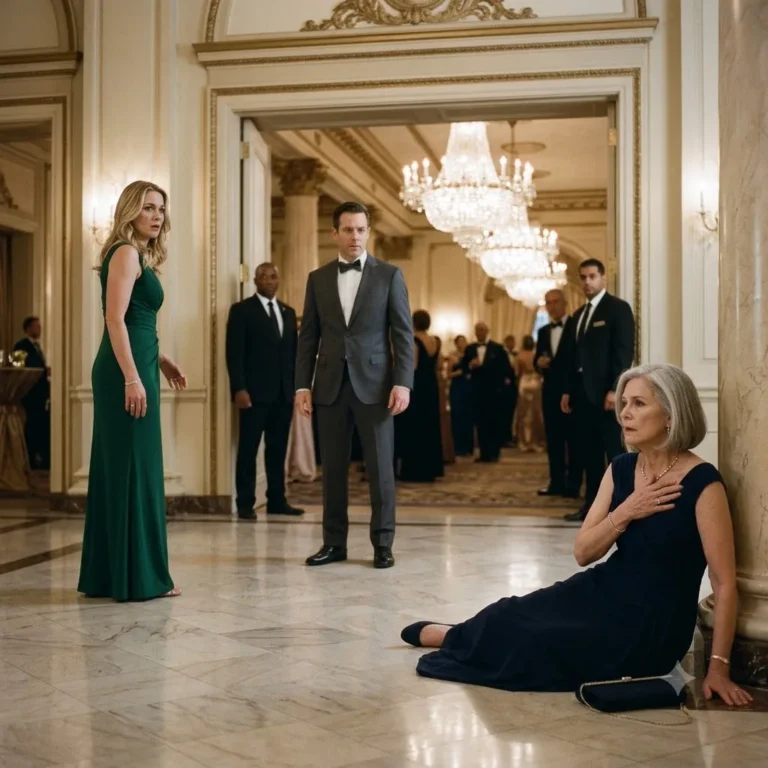
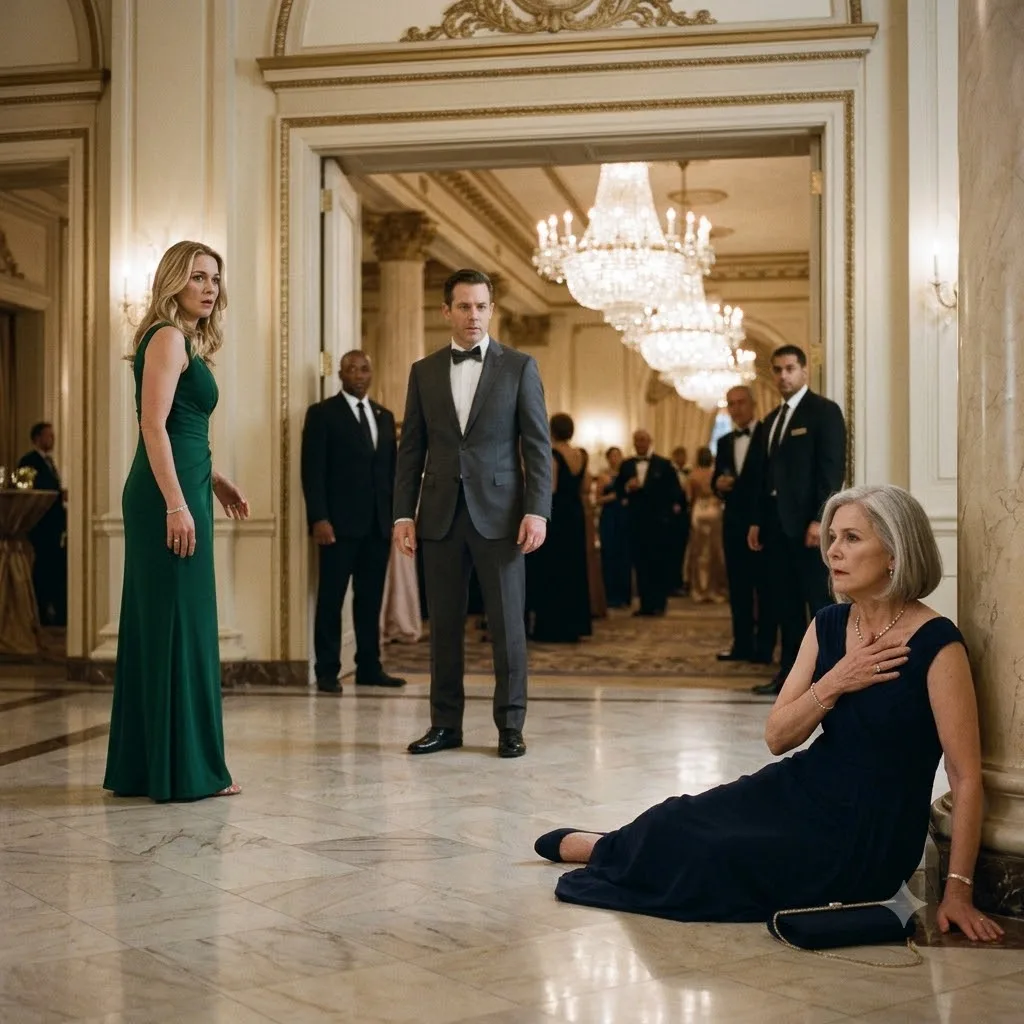
Then she slapped me.
Once.
Hard.
My head turned.
My shoulder clipped the edge of an upholstered bench.
I lost my balance and went down onto my right side.
My right wrist folded beneath me.
Pain shot from my hand toward my forearm.
For a second, I could not breathe.
Then I heard someone run.
A banquet captain appeared from the side corridor.
“Ma’am?”
Kendra stepped back.
Her expression changed from fury to shock, as though she could not believe what her own hand had done.
The ballroom doors opened.
Julian came through.
He stopped three feet away.
First he looked back toward the ballroom.
Then he looked at Kendra.
Only then did he look at me.
That order would stay with me longer than the pain.
He knelt.
“Mom… Kendra didn’t mean it.”
I pulled my arm away when he reached for me.
“She’s under terrible pressure.”
I stared at him.
My wrist was already swelling.
The banquet captain spoke into a radio.
A hotel manager arrived with security less than a minute later.
He crouched at a careful distance.
“Ms. Parker, do you want medical assistance?”
“Yes.”
Kendra shook her head.
“This is getting ridiculous.”
I looked directly at the manager.
“And call the police.”
Kendra went still.
Julian’s face changed.
“Mom.”
I did not look at him.
“Please.”
That made me turn.
He lowered his voice.
“If you file a report, you’ll destroy her career.”
I could not believe what I was hearing.
I was sitting on a marble floor with a swelling wrist after his wife had struck me, and my son was already calculating the cost to her reputation.
“You’re asking the person who was hit to protect the person who hit her.”
He opened his mouth.
Nothing came out.
The hotel manager asked Kendra to step away.
Security positioned themselves between us without touching her.
The banquet captain stayed nearby.
People inside the ballroom had begun talking again, but the sound was different now.
Muted.
Nervous.
The illusion of the evening had broken.
The ambulance arrived first.
Then the police.
I gave my name.
I described the announcement.
I described the argument.
I described the slap.
The banquet captain told the officer he had seen the strike and my fall.
The hotel manager said the foyer cameras covered the area and that the footage would be preserved.
Kendra kept insisting it had been a private family disagreement.
The officer did not argue with her.
He simply took notes.
As the paramedics helped me toward the exit, I saw Julian standing near the ballroom doors.
He looked older than he had an hour earlier.
I stopped.
“Did you know she was going to announce that I agreed to pay?”
He stared at the floor.
I waited.
Finally, he whispered, “She thought you would go along with it.”
“That wasn’t my question.”
He closed his eyes.
“Yes.”
The word landed harder than the slap.
I asked one more question.
“What did you think?”
His answer came slowly.
“I thought once everyone clapped, you wouldn’t want to make a scene.”
There it was.
My son knew exactly which part of me they planned to use.
My restraint.
My manners.
My lifelong habit of swallowing discomfort so other people would not be embarrassed.
I reached into my purse with my left hand.
The movement was clumsy because my right wrist hurt too much to help.
I pulled out the printed email.
I handed it to him.
“What’s this?”
“Read the date.”
He did.
His face drained of color.
The email was five days old.
It said I was attending strictly as an invited guest.
It said I had authorized no sponsorship.
It said I had signed no banquet contract.
It said I accepted no financial responsibility.
And beneath my message was the hotel’s written reply confirming that the active agreement remained under the contracted client account.
Julian looked up.
I saw the moment he understood.
The story they had planned to tell—that I had agreed and then backed out under pressure—already had a timestamped problem.
The truth existed before the applause.
And it was in writing.
The paramedic touched my elbow gently.
“Ms. Parker, we need to go.”
I took the paper back from Julian.
Then I put it into my purse.
For most of my life, I had believed keeping the peace was proof of strength.
As the ambulance doors closed, I began to understand something else.
Sometimes peace is only silence that benefits the person doing the harm.
And I was done paying for that kind of peace.