
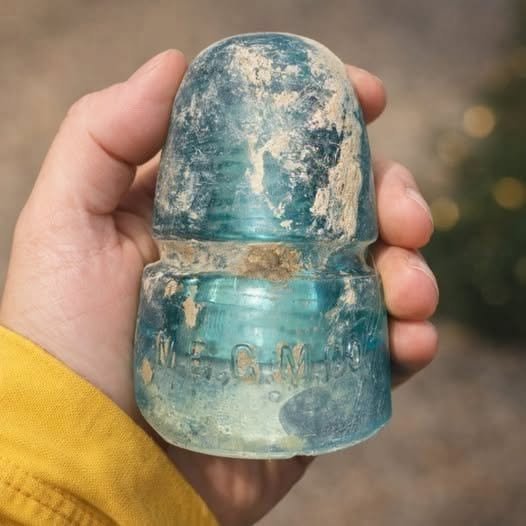
Have you ever looked up at an old telephone or utility pole and noticed a small glass or porcelain object attached near the wires?
They can look like little glass mushrooms, cups, knobs, or stacked discs. Because they are so common, most people barely notice them. But when someone finally takes a closer look, a natural question comes up: What are those things actually for?
The answer is surprisingly simple. They are electrical insulators, and they have played an important role in the development of electrical and communication networks.
Why Are Insulators Needed?
Utility poles are designed to support wires and keep them safely above the ground. But simply attaching an electrical wire directly to a wooden or metal structure would create a serious problem.
Electricity can travel through conductive materials and can also find unintended paths toward the ground. An insulator helps separate the energized wire from the structure supporting it.
In simple terms, the insulator creates a barrier between the wire and the pole.
This helps keep electrical current where it belongs and reduces the possibility of unwanted electrical paths, damage, and dangerous arcing.
Why Were Glass and Porcelain Used?
Older utility systems commonly used materials such as glass and porcelain because they have strong insulating properties.
Glass was especially common on earlier communication lines because it could be manufactured in large quantities and withstand outdoor conditions. Porcelain also became widely used, particularly in electrical applications where strength and durability were important.
These materials could remain outdoors for many years while providing the electrical separation needed by the system.
That is one reason you can still find old insulators attached to poles in rural areas, older neighborhoods, and places with historic utility infrastructure.
The Unusual Shape Has a Purpose
The distinctive shapes of these objects aren’t simply decorative.
Many insulators have curves, grooves, ridges, and umbrella-like sections. These features help increase the distance electricity would have to travel across the surface of the insulator.
Engineers refer to this as creepage distance.
The design also helps rainwater run away from the important electrical surfaces rather than creating an easy continuous path. Keeping moisture and contamination from creating unwanted electrical paths is an important part of reliable outdoor electrical equipment.
So those strange-looking curves are actually examples of practical engineering.
They Helped Connect Earlier Generations
Insulators were especially important during the growth of telegraph and telephone networks.
Long before modern wireless communication and fiber-optic systems, wires stretched across towns, farms, railways, and long-distance routes. Those wires needed to remain electrically separated from the poles supporting them.
Insulators made that possible.
They helped communication signals travel along their intended wires while reducing unwanted electrical contact with the supporting structures.
This seemingly simple technology contributed to the expansion of communication networks during the late 19th and early 20th centuries.
What If an Insulator Becomes Damaged?
Like any outdoor component, an insulator can eventually deteriorate.
Cracks, chips, pollution, dust, salt deposits, moisture, and severe weather can affect its performance. A damaged or contaminated insulator may increase the possibility of electrical leakage or arcing.
That is why utility infrastructure requires inspection and maintenance.
Modern utility systems use many different types of insulators, depending on the voltage level, equipment, environment, and design of the network.
Are Glass Insulators Still Used?
Older glass and porcelain insulators can still be found on some utility and communication infrastructure, although modern systems also use newer materials and designs.
Composite materials and advanced ceramics are common in many contemporary electrical applications because they can offer useful combinations of strength, weight, weather resistance, and electrical performance.
Even so, those old glass pieces remain a visible reminder of earlier generations of electrical and communication technology.
Some have also become interesting collectibles because different manufacturers, colors, shapes, and markings can reveal something about the history of a particular utility or telephone system.
Why Do People Find Them So Fascinating?
Perhaps the most interesting thing about these objects is how easily they disappear into the background.
People have driven and walked beneath utility poles for generations without knowing what those unusual glass shapes were doing there.
Then someone notices one and asks a simple question: “What is that?”
The answer opens a small window into the history of engineering.
Something that looks like an ordinary piece of glass turns out to be part of the infrastructure that helped communities communicate and safely distribute electricity.
A Small Piece of Engineering With a Big History
The next time you see an old glass or porcelain object sitting on a utility pole, you don’t have to wonder anymore.
It isn’t a decoration or a random piece of hardware.
It is an insulator, designed to help separate electrical conductors from the structures that support them.
These modest objects may not attract much attention, but they represent an important principle of electrical engineering: sometimes the simplest-looking components are among the most essential.
For more than a century, generations of these small devices have quietly helped keep wires where they belong—and helped build the connected world we know today.