
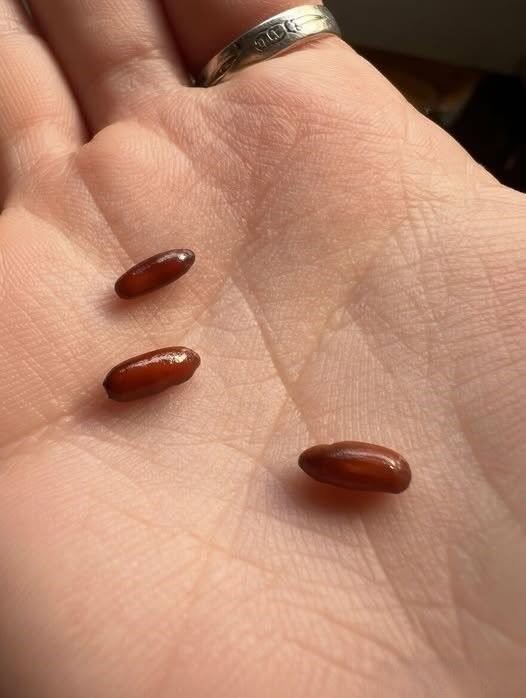
Finding an unfamiliar object in an unexpected place can be surprisingly unsettling. Something as small as a few reddish-brown, shiny capsules on a bed can immediately make you wonder where they came from and what they might be.
Before jumping to unusual conclusions, however, it helps to take a calm look at the details.
In many cases, objects with this appearance may simply be softgel capsules, which are commonly used for vitamins, supplements, and other everyday products. Their smooth surface, oval shape, translucent color, and slightly flexible texture can make them look unusual when they are separated from their original container.
Why They Can Look Unfamiliar
Softgel capsules come in many colors and sizes. Some are clear or yellow, while others can appear amber, orange, reddish-brown, or dark brown.
They are usually smooth and somewhat glossy because of their outer covering. Many also have a visible seam around the edge where the capsule was sealed.
When several identical capsules are found together, their uniform appearance can be an important clue. Unlike random household debris, manufactured capsules generally have a consistent size, shape, and finish.
That doesn’t prove what they are, but it gives you a useful starting point.
How Could They Have Ended Up on a Bed?
Small objects can travel around a home more easily than we realize.
A capsule may fall from a bottle, slip from a pocket or bag, become caught in clothing, or simply move when bedding is changed. Because softgels are lightweight and relatively quiet when they fall, someone may never notice that one has been dropped.
There can also be several ordinary explanations when more than one is found.
Perhaps a bottle was opened near the bed. Someone may have taken a supplement before going to sleep. A capsule could have been carried into the room on clothing or belongings and later fallen onto the bedding.
What initially appears mysterious can sometimes be explained by a very small event that simply went unnoticed.
Look for Simple Clues First
If you want to identify an unfamiliar capsule, start with observation rather than assumptions.
Check whether the objects are:
- Similar in size and shape
- Smooth and glossy
- Slightly flexible rather than completely rigid
- Marked by a small seam
- Similar in color to common vitamin or supplement softgels
Then look around the room.
Check nightstands, drawers, bags, clothing, shelves, and other areas where a bottle or container might have been placed. You may find the source without having to do anything complicated.
If there is packaging nearby, compare the capsules with the product information rather than relying only on appearance.
What About Insect Eggs?
One of the first thoughts people may have when they find unfamiliar objects in a bedroom is whether they could be related to insects.
Appearance alone, however, isn’t enough to make that determination.
Many insect eggs are quite different from manufactured softgels in size, shape, texture, and arrangement. Some are tiny, some occur in clusters, and others have distinctive surfaces or structures.
If you are concerned about insects, look at the bigger picture rather than focusing on one object.
Repeated findings, visible insects, unusual marks, or other signs around the home would provide more useful information than the appearance of a few isolated objects.
If those signs are present, a qualified pest professional can help determine what is happening.
Could They Be Seeds or Something Else?
Seeds can also come in a wide variety of colors and shapes, so it is understandable that they might cross your mind.
The difference is usually found in the details.
Seeds tend to have natural variations in shape and texture, while manufactured capsules are generally more uniform. A hard, dry object with a natural surface is quite different from something smooth and slightly flexible.
There are many other harmless possibilities as well, including small pieces of candy or other household items.
The important point is that appearance by itself rarely provides enough information for a definite identification.
Don’t Guess if You’re Unsure
If you still don’t know what the objects are, there’s no need to handle them unnecessarily.
You can use a tissue or disposable gloves to pick them up and place them in a clean, sealed container or bag.
If you suspect they may be medication or a supplement, don’t consume an unidentified capsule. Instead, check the original packaging if available or ask a pharmacist to help identify it.
If you’re concerned that the object could be something other than a household product, professional identification is a much better option than guessing.
When Should You Investigate Further?
Most isolated discoveries of unfamiliar household objects have ordinary explanations.
Still, it makes sense to investigate further when the same unexplained objects continue appearing or when there are other signs suggesting a household issue.
For example, repeated findings accompanied by visible insects or other unusual evidence may justify contacting a pest-control professional.
Likewise, if an unidentified capsule could have been accidentally mixed with medication or supplements, keep it away from children and pets and seek appropriate professional advice.
A little caution is sensible. Panic isn’t necessary.
Why Unexpected Objects Can Feel So Alarming
There’s also a psychological reason these discoveries can feel more serious than they really are.
Our brains are constantly looking for patterns and potential problems. When something appears in a familiar place but doesn’t belong there, the mind immediately tries to explain it.
A bedroom is particularly personal. It is normally a predictable environment, so an unfamiliar object on the bed can feel surprisingly intrusive.
The first thought may not always be the most accurate one.
Taking a moment to stop, observe, and gather information can help replace uncertainty with a much more reasonable explanation.
A Calm Approach Works Best
If you discover a few unusual reddish-brown capsules at home, start with the simplest possibilities.
Look at their shape and texture. Search for nearby packaging. Consider whether someone in the household uses vitamins or supplements. Check whether the objects appear manufactured and identical.
If you still have questions, keep the items safely contained and ask someone qualified to identify them.
There’s no need to assume the worst simply because something looks unfamiliar.
Sometimes a strange discovery is nothing more than an everyday object that ended up in an unexpected place.
And that may be the most reassuring lesson of all: when something looks mysterious, a little careful observation can often turn a worrying moment into a perfectly ordinary explanation.