TARGET CONFIRMED. BEGIN APPROACH PLAN.
I stared at those four words until they stopped looking like English.
My father’s funeral.
The worst day of my life.
The day I had stood beside his grave while rain soaked through my black coat and people kept telling me he was “at peace.”
Mark had been there.
Watching.
Not grieving.
Not comforting.
Studying.
Rachel put one hand on my shoulder.
“You don’t have to look at any more tonight.”
“Yes, I do.”
“Claire.”
“No.”
I turned toward her.
“If I stop every time something hurts, I’ll never reach the truth.”
She said nothing.
That was one of the things I had learned to appreciate about Rachel.
She knew when advice became interference.
Detective Harris sent the photograph through a secure evidence link.
I opened it.
There I was.
Twenty-seven years old.
Black dress.
Hair wet from rain.
My face swollen from crying.
My mother stood beside me.
Behind us, half hidden near a line of parked cars, was Mark.
Younger.
Thinner.
Watching me.
I zoomed in.
No doubt.
Same eyes.
Same mouth.
Same man.
My husband had seen me before I ever saw him.
Eighteen months later, he “accidentally” spilled wine beside me at a charity fundraiser.
I remembered laughing.
I remembered him offering me a napkin.
I remembered thinking fate had put us at the same table.
Fate.
What a beautiful word for a trap when you don’t know it is one.
Rachel said quietly, “Claire, the police recovered several folders from Building B.”
“What kind?”
“Surveillance.”
My throat tightened.
“Of me?”
“Yes.”
“How long?”
“Years.”
I swallowed.
“Before the funeral?”
“Some.”
My hands went cold.
“Before Dad died?”
“Yes.”
I sat down.
Not because I wanted to.
Because my knees stopped negotiating.
Detective Harris called again an hour later.
Thomas Carter Jr. had been formally detained.
Samantha and Ethan were safe.
Mark had suffered a fractured rib, a concussion, and a deep cut above one eye.
Nothing life-threatening.
I should have felt relief.
Instead I felt emptiness.
That frightened me.
Five years of marriage.
A child.
A home.
Birthdays.
Arguments.
Sunday mornings.
Christmas cards.
Anniversary dinners.
And when I heard my husband had survived an attack from his own father, all I felt was tired.
Rachel watched me.
“You can feel more than one thing.”
“I don’t know what I feel.”
“That’s allowed.”
I looked at the photo from the funeral again.
“He knew what he was doing from the beginning.”
“Yes.”
“Then how do I know any moment was real?”
Rachel didn’t answer.
Because lawyers know better than most people that some questions do not have useful answers.
At 11:18 p.m., Mark called from the hospital.
I stared at the screen.
Rachel asked, “Do you want me here?”
“Yes.”
I answered.
Neither of us spoke.
Finally Mark said:
“Claire.”
His voice sounded weak.
Not charming.
Not confident.
Not angry.
Just weak.
I had never heard him that way.
“I know about the funeral.”
Silence.
Then:
“I thought they found that.”
“They did.”
“I’m sorry.”
“You were watching me bury my father.”
“Yes.”
“You already knew who I was.”
“Yes.”
“You knew what I inherited.”
“Yes.”
Another silence.
I could hear hospital equipment in the background.
“You planned to meet me.”
“Yes.”
“Why the fundraiser?”
“My father knew you were attending.”
“Of course he did.”
“He wanted me to establish contact.”
I closed my eyes.
“Was spilling the wine planned?”
A pause.
“No.”
That almost made me laugh.
The one thing I thought was fate had apparently been the only genuine accident.
“When did you decide to marry me?”
“Claire—”
“When?”
“About four months after we met.”
“Because your father wanted you to?”
“At first.”
The words still cut.
“At first?”
“I told him marriage would make access easier.”
My stomach turned.
“You discussed me like a business plan.”
“Yes.”
“And then?”
“I fell in love with you.”
I laughed.
It came out cold.
“No.”
“I did.”
“No, Mark.”
“Claire, I know what I did.”
“You don’t get to use love as mitigation.”
“I’m not.”
“You forged my signature.”
“Yes.”
“You helped hide money.”
“Yes.”
“You lied about Samantha.”
“Yes.”
“You let me believe I had destroyed my career because I wanted to be a mother.”
His breathing broke.
“I know.”
“No. You encouraged it.”
“I know.”
“You told me we didn’t need my salary.”
“I know.”
“Your mother told me women regretted missing their children.”
“I know.”
“Your family isolated me because I was easier to steal from that way.”
Silence.
Then:
“Yes.”
There it was.
No excuse.
No defense.
Just yes.
For the first time in five years, Mark told me the truth without decorating it.
It did not save him.
Truth given only after discovery is not honesty.
It is surrender.
I asked:
“Did you know your father might hurt me?”
“No.”
“Did you know about the insurance?”
“I told you. I knew it existed.”
“Did you know he had changed the beneficiary?”
“No.”
“Do you expect me to believe you?”
“No.”
That answer stopped me.
Mark continued.
“You shouldn’t believe me.”
I looked at Rachel.
She was listening silently.
“I’m giving everything to the investigators.”
“What everything?”
“Emails. Accounts. Passwords. Dad’s private server.”
Rachel immediately started writing.
Mark continued.
“I know where the backup records are.”
My heartbeat changed.
“Why tell me now?”
“Because he took Ethan.”
“You suddenly discovered morality?”
“No.”
At least he was not pretending.
“I discovered consequences.”
I stared at the wall.
“And our son wasn’t enough?”
Mark began crying quietly.
“He should have been.”
My anger sharpened.
“Yes. He should have.”
“I kept telling myself I could fix things later.”
“Later.”
“I thought once Dad had control of North Lake, I could separate from the family.”
“And me?”
“I wanted you.”
“You wanted both.”
“Yes.”
“The money and me.”
“Yes.”
“Samantha and me.”
He went silent.
“That too?”
“Yes.”
I laughed bitterly.
“You didn’t want a family, Mark. You wanted every door open.”
He breathed in.
Then said:
“You’re right.”
That was worse than arguing.
I had spent years imagining what victory in an argument with Mark would feel like.
Turns out there is no victory when the person finally agrees that he destroyed you.
There is only clarity.
“Why did you ask for the divorce at four-thirty that morning?”
He was silent for a long time.
Then:
“Dad told me the forged North Lake transfer was becoming vulnerable.”
My chest tightened.
“He knew someone was looking?”
“Yes.”
“Who?”
“A bank compliance officer flagged old documents.”
“So you needed me to sign the separation agreement.”
“Yes.”
“To waive claims.”
“Yes.”
“Before I discovered the ownership problem.”
“Yes.”
I closed my eyes.
The divorce had never been an emotional decision.
It had been a cleanup operation.
“And breakfast?”
“What?”
“Your family arriving at eight.”
Mark exhaled.
“That was Mom’s idea.”
“Why?”
“They wanted witnesses.”
My blood chilled.
“Witnesses for what?”
“That you were unstable.”
Rachel looked up sharply.
I whispered, “Explain.”
“If you got angry. Screamed. Broke something. Took the baby and left…”
My heart stopped.
“They were going to use it against me in custody.”
“Yes.”
I gripped the phone so tightly my hand hurt.
The eggs.
The dry toast.
The mother-in-law arriving at eight.
Natalie’s messages.
Don’t embarrass me.
Everything had been staged.
And I had ruined their plan by doing the one thing they never expected.
I stayed calm.
I turned off the stove.
Packed one suitcase.
And left.
My silence had saved me before I even understood there was a war.
Mark whispered:
“When you didn’t react, Mom panicked.”
I almost smiled.
Good.
“When did she realize I might investigate?”
“When I told her you went to Mrs. Henderson.”
“So you guessed correctly.”
“Yes.”
“And then the study was searched.”
“Yes.”
“By you?”
“No.”
“Who?”
“My father.”
Another piece.
“How did he enter?”
“He had a key.”
I closed my eyes.
Of course he did.
I had lived inside a house that was never truly mine.
“Anything else you want to confess before somebody else discovers it?”
Mark was silent.
Then:
“Yes.”
I waited.
“The night your father died…”
My entire body froze.
“What?”
“I was at the hospital.”
I stopped breathing.
“You were there?”
“Yes.”
“Why?”
“My father sent me.”
“For what?”
“To find out whether Robert had spoken to anyone.”
My hand went numb.
“Did you see my father?”
“No.”
“You swear?”
“Yes.”
“You expect me to trust that?”
“No.”
He kept saying that.
Not because he had changed.
Because trust was no longer useful to him.
“I saw you,” Mark continued.
My throat tightened.
“At the hospital?”
“Yes.”
“You were there?”
“You were asleep in a chair outside his room.”
I closed my eyes.
I remembered that chair.
Plastic.
Gray.
Uncomfortable.
I had slept maybe forty minutes.
My father died before sunrise.
Mark had walked past me.
Years before he introduced himself.
“You saw me twice before we met.”
“More.”
My eyes opened.
“How many times?”
“I don’t know.”
“Try.”
“Maybe seven.”
My stomach turned.
“Seven?”
“Coffee shop. Outside your office. Grocery store. The funeral. Hospital.”
I could barely breathe.
“And you still call what happened later love?”
“I know how it sounds.”
“No, Mark. You know how it is.”
He said nothing.
Then:
“I’m sorry.”
“Stop saying that.”
“I don’t know what else to say.”
“Nothing.”
I ended the call.
For ten minutes I sat in silence.
Then I walked into the guest room.
My son was asleep.
His tiny chest rose and fell beneath a blue blanket.
I placed one finger against his palm.
He closed his hand around it.
And suddenly I understood what had been bothering me since the beginning.
Everyone kept calling this my father’s unfinished fight.
It wasn’t.
My father was dead.
This was mine now.
Not because I wanted revenge.
Because I had a son who deserved to grow up without inheriting a family’s secrets as if they were property.
At 6:40 the next morning, investigators arrived at Mrs. Henderson’s house.
By noon, warrants had been executed.
Accounts frozen.
Corporate records seized.
Electronic devices collected.
Thomas Carter Jr. remained in custody while prosecutors reviewed charges related to Samantha’s detention, financial fraud, forgery, threats, and the historical evidence connected to my father’s crash.
Evelyn was located at a hotel near the airport.
She had packed two suitcases.
She was arrested before she reached the lobby.
When I heard, I felt nothing.
Then Natalie called.
I almost ignored it.
But I answered.
She was crying.
“Claire, please tell them Mom didn’t do this.”
I stared out the window.
“Natalie.”
“She made mistakes.”
“She tracked me before I met your brother.”
“She was protecting the family.”
“She planned to use my pregnancy as leverage.”
Silence.
“She didn’t mean—”
“Stop.”
Natalie cried harder.
“You don’t understand her.”
“No. I finally do.”
“She loves her children.”
“So do I.”
That ended the argument.
Because love does not excuse what you do to someone else’s child.
Three days later, Peter completed the first North Lake ownership analysis.
The forged transfer was invalid.
My father’s fifty-percent interest remained mine.
But it went further.
Thomas Sr.’s transfer to Thomas Jr. had also been improperly executed.
The ownership structure was tied up in litigation.
For once, the money did not matter.
What mattered was control.
No Carter could destroy the records.
No one could quietly dissolve North Lake.
Everything would be examined.
Harbor Medical.
The vendor companies.
The payments.
The accident.
Every ledger.
Every transfer.
Every signature.
Every lie.
Then David Shaw flew in under protection and turned over his section of the ledger.
Harold Kemp agreed to speak after investigators contacted him.
The picture grew larger.
Much larger.
And uglier.
Some accusations would take years to prove.
Some might never be.
I learned something important during those weeks:
Justice is not the same as certainty.
Real investigations do not end with one dramatic confession.
They move through documents.
Witnesses.
Hearings.
Challenges.
Appeals.
Years.
I stopped needing every answer immediately.
I already had the answer that mattered.
I had not imagined what they did to me.
And I was no longer under their control.
Six weeks after that morning in the kitchen, I returned to the house.
Not to live there.
To collect the rest of my belongings.
Mark was not there.
By then, a temporary custody order limited his access to supervised visits while the investigation continued.
I walked into the kitchen.
Same tile.
Same refrigerator.
Same stove.
For a moment, I could smell bacon again.
Burnt coffee.
Baby formula.
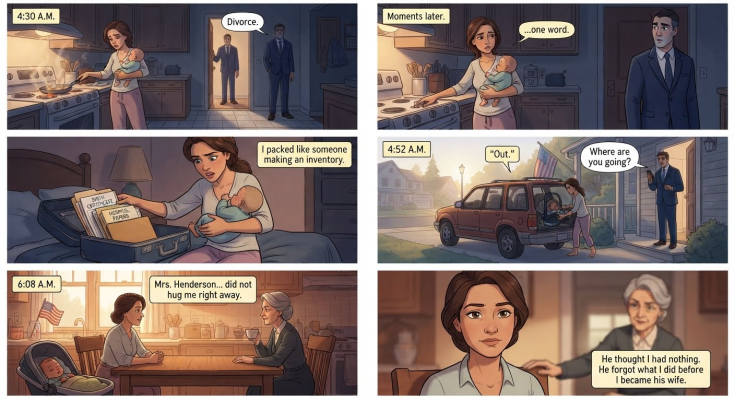
I remembered myself standing barefoot at 4:30 a.m., exhausted, holding my son while my husband said:
“Divorce.”
I wanted to reach backward through time and touch that woman’s shoulder.
Not to warn her.
To thank her.
Because she did not cry.
She did not beg.
She turned off the stove.
That tiny action changed everything.
I opened the cabinet above the refrigerator.
Inside was the serving bowl Evelyn always insisted I use.
I stared at it.
Then laughed.
Really laughed.
The sound echoed through the empty house.
I left the bowl exactly where it was.
Some things did not deserve to be carried into a new life.