Melissa said nothing.
“You said Dad would choose you.”
Daniel shut his eyes.
Ethan looked at him.
“And you did.”
My son started crying.
Ethan didn’t.
That might have been the hardest moment of the entire night.
Because children often imagine that when an adult finally cries, something has been repaired.
Ethan understood that Daniel’s tears changed nothing.
The police arrived twelve minutes later.
Two officers entered through the broken doorway.
Paramedics followed.
I explained why the door was d@maged before Daniel could.
One officer, Sergeant Lisa Warren, immediately separated everyone.
Ethan was taken into the living room with a paramedic and another officer.
Daniel and Melissa were questioned separately.
I stayed in the dining room with Chloe and the extended family.
The turkey remained untouched.
Gravy had formed a skin.
Candles burned lower.
Thanksgiving had become an evidence scene.
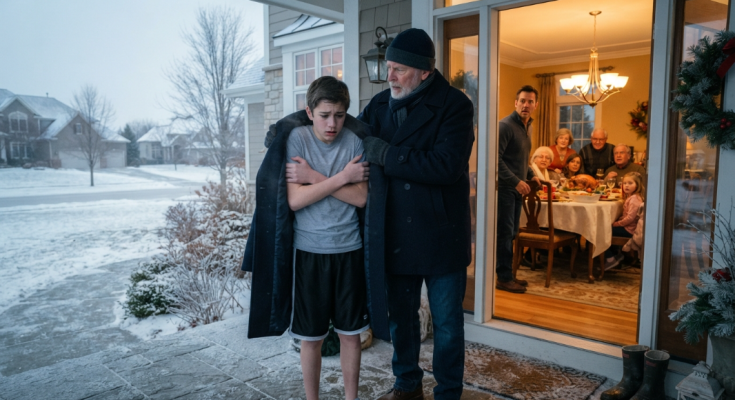
A paramedic later told Sergeant Warren that Ethan’s body temperature was below normal and that his fingers and toes showed signs of cold exposure. He needed evaluation at the hospital.
That was enough to change the direction of the investigation. The officers photographed his clothing, the outside of the house, the locked coat closet and the storage bin holding my unopened letters.
They copied the files from the tablet.
Ethan also showed them text messages.
Those were even harder to read.
Melissa had written:
You haven’t earned dinner.
Another:
Don’t call your grandfather unless you want to lose your bedroom too.
And one from Daniel:
Just apologize to her. I can’t keep fighting about you.
I read that message three times.
Not for you.
About you.
My son had turned his own child into an inconvenience.
Sergeant Warren eventually asked me whether Ethan could stay with me if child protective services approved an emergency placement.
“Yes,” I said immediately.
Daniel heard.
“Dad.”
I turned around.
He was standing near the stairs with an officer beside him.
“You can’t take him.”
“I don’t decide that.”
“Please.”
“No.”
His face coll@psed.
“He’s my son.”
“And you were his father.”
Daniel stared at me.
I wished I could take those words back. Not because they weren’t true.
Because saying them made me understand exactly how far things had gone.
Daniel asked to speak privately.
The officer allowed us to stand near the kitchen where he could still watch us.
My son wiped his face.
“You think I wanted this?”
“I don’t know what you wanted.”
“She said Ethan was trying to ruin our marriage.”
“And you believed her?”
“At first, no.”
“Then?”
Daniel looked toward the dining room.
“Every argument became about him. She’d say he disrespected her. She’d say I always chose him over her. She threatened to take Chloe and leave.”
“So you chose your marriage.”
“I thought if Ethan just followed the rules—”
“You thought your fourteen-year-old son should manage your wife’s emotions for you.”
Daniel flinched.
“I thought it would calm down.”
“How long?”
He said nothing.
“How long did you keep telling yourself that?”
“Months.”
“And today?”
His mouth opened.
Nothing came out.
“You watched him walk outside.”
Daniel started crying again.
“I thought she’d let him back in.” “You were sitting ten feet from the front window.”
“I know.”
“You saw what he was wearing.”
“I know.”
“You continued eating.”
That broke him.
He bent forward and covered his face.
But I had no comfort left to offer.
Not then.
Maybe not ever.
At the hospital, Ethan was treated for mild hypothermia and released later that night.
A child welfare worker named Monica Reyes met us there.
She interviewed Ethan privately.
Then she interviewed me.
By two in the morning, an emergency safety arrangement had been approved allowing Ethan to leave with me while the investigation continued.
We stopped at a twenty-four-hour diner during the drive home.
Ethan ordered pancakes, scrambled eggs, bacon, toast, and hot chocolate.
When the waitress walked away, he looked embarrassed.
“That’s too much, isn’t it?”
The question hurt more than I expected.
“No.”
“I probably won’t finish it.”
“You don’t have to.”
He stared at me.
“You won’t be mad?”
“About food?”
He nodded.
I reached across the table.
“Ethan, in my house, you don’t earn meals. You don’t lose meals. Food isn’t a reward and it isn’t a punishment.” He looked down quickly.
A tear landed on the paper placemat.
“I knew that,” he whispered.
But he hadn’t.
Not anymore.
That’s what nine months had done.
The legal process afterward was neither quick nor simple.
There was no dramatic courtroom confession.
No judge slammed a gavel and fixed everything in an afternoon.
There were interviews.
Medical reports.
Social workers.
Lawyers.
School records.
Family court hearings.
Therapy appointments.
Daniel and Melissa hired different attorneys.
The recordings mattered.
The texts mattered.
The hospital report mattered.
Most importantly, Ethan’s consistent account mattered.
Investigators discovered that several teachers had noticed changes.
His grades had dropped.
He had started hoarding snacks in his backpack.
He sometimes wore the same clothes repeatedly.
A school counselor had contacted Daniel twice.