
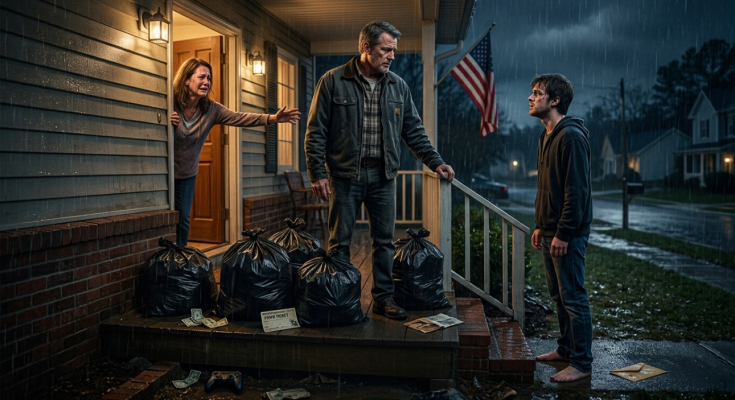
Ten years after the night of the black trash bags, the auto shop was quiet. It was late on a Friday afternoon, the sun casting long, golden bars of light across the concrete bay floor.
I sat in the office chair, my knees aching a little more than they used to, watching Daniel through the glass. He was underneath a truck, his boots sticking out, teaching a nineteen-year-old apprentice how to check a differential seal. His voice was patient, firm, and clear—the voice of a man who knew exactly how much strength it took to do things the right way.
The garage door chimed as a young man walked in.
He couldn’t have been more than twenty. He was wearing an oversized hoodie, his hands shoved deep into his pockets, eyes darting nervously around the shop. He looked exhausted, frantic, and entirely out of place.
“Can I help you?” Daniel asked, sliding out from under the truck and wiping his greasy hands on a blue shop rag.
The kid swallowed hard. “I… I saw the sign outside. Saying you were hiring a shop hand.”
Daniel looked at him—really looked at him. He saw the dark circles under the boy’s eyes, the slight tremble in his fingers, and the desperate way he glanced toward the street as if someone were coming after him.
“You got any experience?” Daniel asked gently.
“No,” the kid whispered, lowering his head. “My dad threw me out two days ago. Said he was done with my games. I don’t have anywhere to sleep tonight, man. I just… I need a break.”
The garage went dead quiet, save for the hum of the overhead fluorescent lights.
Through the office window, I watched my son. For a fraction of a second, I wondered if he would hand the kid twenty bucks, or tell him to move along, or call the police.
Instead, Daniel walked over to the workbench, picked up a clean pair of heavy work gloves, and held them out.
“There’s a cot in the back office,” Daniel said, his voice quiet and solid as iron. “You can sleep there tonight. But five o’clock tomorrow morning, we open the bays. You’ll sweep the floors, haul the scrap metal, and learn how to hold a wrench. No lying, no excuses, and no third chances.”
The kid looked at the gloves, his eyes suddenly filling with tears. He took them with trembling hands. “Thank you. I swear I’ll pay you back.”
“Don’t thank me,” Daniel said, putting a firm hand on the boy’s shoulder. “Thank my father. He’s sitting right inside that office.”
The kid looked through the glass at me, confused, but nodded gratefully before Daniel led him toward the back room.
A few minutes later, after the shop doors were locked and the lights were turned off, Daniel walked into the office. He pulled his jacket off the rack, grabbed his keys, and looked at me with a soft, knowing smile.
“Ready to go, Dad? Mom’s got dinner waiting.”
I stood up, took my coat, and walked out into the cool evening air beside my son.
The story didn’t end when Daniel saved himself. It ended when he became the kind of man who could stand in the doorway for someone else—offering not an easy out, not a handout, but a way through the fire.
We walked down the sidewalk together toward home, stepping forward side by side under the quiet city sky.



One Comment on “PART 11- I packed all of my 22-year-old son’s clothes into black trash bags and threw him out onto the street”