
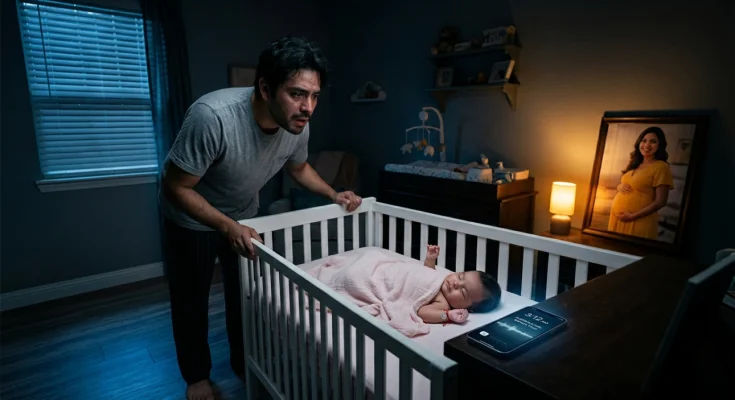
My thumb trembled over the speaker as Marina’s voice filled the quiet room.
“My love… if you’re hearing this, it’s because nobody told you the truth.”
Her voice sounded weak—thin, like she was speaking from the bottom of a well—but it was unmistakable. The slight catch in her breath when she was tired. The warmth she always carried even when she was hurting.
“I didn’t bleed out by accident, Ignacio,” she whispered on the recording. “The doctors told you it was a sudden hemorrhage. Tell them to check the chart they buried. Tell them to check the second bag they hung after the delivery.”
I gripped the edge of the crib so hard my knuckles turned white. Down inside it, April let out a tiny, soft sigh, her little chest rising and falling evenly. No tears. Just watching me.
“I was scared,” Marina went on, her voice cracking. “Not of dying. Of leaving you alone with a secret I couldn’t carry into the operating room without breaking you first. When the pain started getting worse in the third trimester, they told me it was normal. Then at the hospital, a nurse came in while you were getting coffee. She looked at my file… and she told me something went wrong during my routine checkup three weeks earlier.”
My breath caught in my throat. “What went wrong?” I whispered to the empty room.
“The baby wasn’t the reason I was slipping away,” Marina’s voice said, steady now, almost fierce. “April was the only reason I made it to the delivery table. If I hadn’t held on until she was out… they wouldn’t have had enough time to figure out what was happening to me. She bought me those last minutes, Ignacio. She fought to get here so I could say goodbye to you.”
A sharp, hot sting burned behind my eyes. My chest felt like it was being crushed from the inside out.
“And the bracelet…” Marina murmured, a faint, tired smile in her tone. “If you’re listening to this, it means you finally walked in there without anger. I hid it in the lining of my hospital bag—the one you swore nobody touched. Because I knew if you ever found out the truth, you’d blame yourself for not pushing the doctors harder. Don’t blame yourself. Just love her. Please. She’s the piece of me that refused to let go.”
The audio clicked off.
The room went dead silent again, save for the soft hum of the hallway light and the steady, rhythmic breathing of the baby in front of me.
I looked down at the little red string on her wrist. At the tiny St. Christopher medal catching the dim light. Then I looked at her face—really looked at her—for the first time in six weeks.
She reached up one tiny hand and wrapped her fingers around my thumb. Her grip was so light, yet so strong it knocked the air right out of my lungs.
“April,” I whispered.
The word felt heavy, foreign, and sacred all at once.
For the first time since the hospital hallway, the rage inside me didn’t burn—it broke. And as tears finally spilled down my face onto the blanket, I pulled Marina’s phone into my pocket, leaned over the crib, and whispered back, “I’m here, little girl. Daddy’s right here.”
I didn’t sleep a minute after that.
I sat in the rocking chair beside the crib until the gray light of dawn bled through the curtains, holding April against my chest. Every breath she took felt like a miracle I had nearly thrown away. Marina’s old phone sat heavy in my pocket, the recording saved in three different places before the sun even came up.
At 8:00 AM sharp, I called my mother-in-law to stay with April. When she saw me holding the baby—really holding her, kissing the top of her soft head—the older woman broke down crying in the doorway.
“You finally see her,” she whispered.
“I finally heard Marina,” I answered.
An hour later, I was standing in the lobby of St. Jude’s General, wearing the same wrinkled shirt from the night before, Marina’s phone clutched in my fist.
The woman at the records desk gave me a polite, practiced smile. “How can I help you today, sir?”
“I need the complete, unredacted medical chart for Marina Morales,” I said, keeping my voice low and steady. “Delivered October 14th. Maternity Ward, Room 408. Including the pharmacy logs and the nursing notes from between 2:00 AM and 5:00 AM.”
Her smile faltered for half a second. She typed something into her computer, frowned, and clicked a few times. “I show a discharge summary and a standard mortality report already released to the family.”
“That summary is incomplete,” I said, leaning over the counter. “I want the raw intake logs from her checkup three weeks prior, and I want the batch number on the second IV bag hung after delivery.”
Before she could answer, a man in a tailored charcoal suit stepped out from the administrative corridor behind her. Dr. Vance. The chief of obstetrics. The same man who had stood in that bleached hallway six weeks ago, placed a cold hand on my shoulder, and told me we did everything we could.
“Mr. Morales,” Vance said smoothly, gesturing toward a private office down the hall. “Why don’t we step inside? Grief makes us look for answers where there aren’t any.”
“I’m not grieving blind anymore, Doctor,” I replied, not moving an inch.
Vance’s jaw tightened almost imperceptibly. He glanced at the receptionist, then back at me. “Marina suffered a catastrophic, unpredictable postpartum hemorrhage. It is a tragedy, Ignacio. Don’t torture yourself digging through paperwork.”
“Then you won’t mind showing me the chart,” I said.
I unlocked Marina’s phone, turned the volume all the way up, and hit play right there in the middle of the lobby.
“Tell them to check the chart they buried. Tell them to check the second bag they hung after the delivery…”
The receptionist froze. Two nurses walking past stopped dead in their tracks. And Dr. Vance’s face drained of every drop of color.
Before he could reach for the phone or usher me out of earshot, a soft, trembling voice spoke up from behind the reception glass.
“I still have the copy.”
Everyone turned. It was Elena, one of the night-shift nurses who had been on duty the night Marina died. She was pale, gripping a manila folder against her scrubs like a shield.
“Elena, don’t—” Vance started, his voice sharp with warning.
“I couldn’t sleep either,” she said, looking straight at me, tears shining in her eyes. “When they pulled the original file from the system the next morning, I printed the backup before the audit lock went through. The checkup three weeks before delivery showed severe placental abruption markers that were missed—and signed off on by Dr. Vance’s resident. And after the delivery…” She swallowed hard. “They hung the wrong blood type on the second transfusion bag. By the time anyone caught it, her organs were already shutting down.”
The lobby went dead silent. You could hear the hum of the fluorescent lights overhead.
I stared at Dr. Vance—at the man I had thanked through tears six weeks ago—and felt a cold, clear certainty settle into my bones. Not the blind rage that had poisoned me at home. Something sharper. Something unstoppable.
“Call my lawyer,” I told Elena, taking the folder from her hands. “And tell him we’re bringing the state medical board with us.”
Three months later, the hospital settled out of court before the case ever reached a jury, and Dr. Vance’s license was suspended pending a criminal negligence investigation.
None of it brought Marina back. Nothing ever could.
But that afternoon, I stood in the warm sunlight of our living room, adjusting the tiny red bracelet with the St. Christopher medal on April’s chubby wrist. She giggled, grabbing at my beard with both hands, her eyes shining with the exact same warmth I thought I had lost forever.
I looked up at the photo of Marina in her yellow dress hanging on the wall, smiled through the ache in my chest, and whispered, “She’s safe, my love. And she knows who saved her.”