
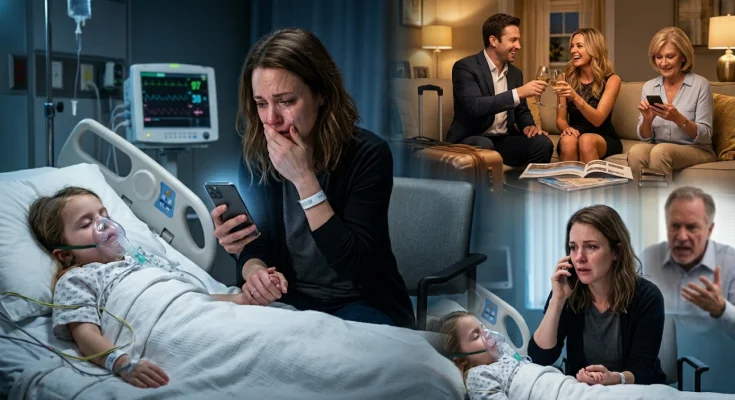
The first night in the ICU, I learned that hospital machines have their own language.
They whispered, blinked, sighed, and beeped in rhythms I could not understand but became obsessed with anyway. Every green line on the monitor felt like a rope tied around my heart. Every dip made my stomach drop. Every nurse who stepped into the room made me sit straighter, searching her face before she said a word.
My daughter Layla was four years old, and pneumonia had folded her small body into something too still.
She lay in the hospital bed with an oxygen mask covering half her face, her dark curls tangled against the pillow, one hand taped carefully around an IV. The mask fogged faintly each time she breathed. In. Out. In. Out. I counted without meaning to. I had been counting since the ambulance.
The room smelled like antiseptic, plastic tubing, and the bitter coffee a nurse had pressed into my hands around three in the morning. I had not drunk it. It sat cold on the narrow windowsill beside a vase with no flowers in it.
The pediatric ICU had dim lights at night, as if darkness could be softened by machines. Beyond the glass door, nurses moved in blue scrubs, shoes squeaking quietly on polished floors. Somewhere down the hall, a baby cried in short, exhausted bursts. Every sound made me feel both less alone and more terrified.
I texted my mother first.
Layla is in the hospital. Pneumonia. ICU. Please call me.
Then my father.
Dad, we’re at St. Anne’s. Layla is very sick. I need you.
Then my brother Jason, even though we had barely spoken in months because he was consumed by wedding planning and the kind of self-importance that made seating charts sound like war strategy.
Layla’s in ICU. Please tell Mom and Dad if they don’t see my messages.
I watched the three texts sit there.
Delivered.
Not read.
At first, I made excuses for them.
It was late. Maybe Mom had gone to bed with her phone charging in the kitchen like she always threatened to do when she wanted people to admire her discipline. Maybe Dad had taken his sleeping pill. Maybe Jason was at some wedding tasting where people pretended chicken could be meaningful.
By morning, no one had answered.
Layla stirred once around seven. Her eyes opened halfway, unfocused and glossy.
“Mommy?” she whispered through the mask.
I stood so fast the chair scraped the floor. “I’m here, baby.”
“My chest hurts.”
“I know.” I stroked her hair carefully, avoiding the monitor wires. “The medicine is helping.”
“Can we go home?”
The question split me down the middle.
“Soon,” I lied, because mothers are sometimes required to build bridges out of words they do not believe.
She drifted off again.
A nurse named Tasha brought me a fresh coffee and a muffin wrapped in plastic. She had kind eyes and a pen clipped to her collar shaped like a tiny giraffe.
“You need to eat something,” she said.
“I will.”
She glanced at the untouched coffee on the sill.
“People always say that here.”
I tried to smile, but my face had forgotten how.
Around noon, I called my mother.
It rang six times and went to voicemail.
“Mom, it’s me.” My voice sounded strange, flat and small. “Layla is still in ICU. Please call me back.”
I called Dad. Voicemail.
Jason. Voicemail.
I left messages for all three.
By evening, I had developed a new habit. Look at Layla. Look at the monitor. Look at my phone. Repeat until time became meaningless.
No messages.
No missed calls.
No one came.
That realization did not arrive dramatically. It seeped in slowly while I sat on the little plastic couch under the window, staring at the parking lot below. Cars came and went. Families arrived carrying overnight bags and stuffed animals. A grandfather in a brown coat hurried through the rain with a bouquet tucked under one arm. A woman stood beside the entrance crying into someone’s shoulder.
People came.
Just not mine.
I had not thought we were estranged. That was the part that kept snagging in my mind.
We were not warm exactly, but we were functional. I called Mom every other Sunday. I helped Dad renew his insurance forms because his back pain made him impatient with paperwork. I sent Jason and his fiancée Amber twelve hundred dollars the month before when their wedding venue had some “urgent deposit issue.” I did not ask for it back. I did not even mention it when my own car needed new tires.
That was what I did.
I filled gaps.
I answered calls.
I showed up.
At two in the morning, Layla’s fever spiked again. Nurses moved quickly. The doctor came in. I stood in the corner with both hands pressed to my mouth while they adjusted oxygen and medication. Layla whimpered once, weakly, and I felt something primal tear through me.
When things settled, Tasha touched my shoulder.
“She’s holding steady,” she said. “Scary, but steady.”
I nodded.
Then she asked gently, “Do you have someone coming to sit with you?”
I looked at my phone.
Still nothing.
“No,” I said.
It was the first time I said it out loud.
No.
The word hung in the room, heavier than grief.
Two full days passed before my mother finally texted.
I was holding Layla’s hand, watching her sleep more peacefully than she had since we arrived. The oxygen mask was still there, but her breathing had eased. Her tiny fingers were warm again.
My phone buzzed against my thigh.
Mom.
For one stupid, hopeful second, my heart lifted.
I opened the message.
Can you help with your brother’s honeymoon fund? $5,000 should do.
I stared at it until the screen dimmed.
No How is Layla?
No Are you still at the hospital?
No We’re coming.
Just five thousand dollars for Jason’s honeymoon while my daughter lay beneath a thin hospital blanket fighting for air.
The phone went dark in my hand.
Something inside me went with it.
Not a break. A closing.
A door I had been holding open for years finally swung shut, and the sound it made was quieter than I expected.
I turned off my phone, placed it face down beside the cold coffee, and looked at my daughter.
Her lashes trembled in sleep. Her little chest rose and fell beneath the wires.
“I’m done,” I whispered.
Layla did not wake.
But I did.