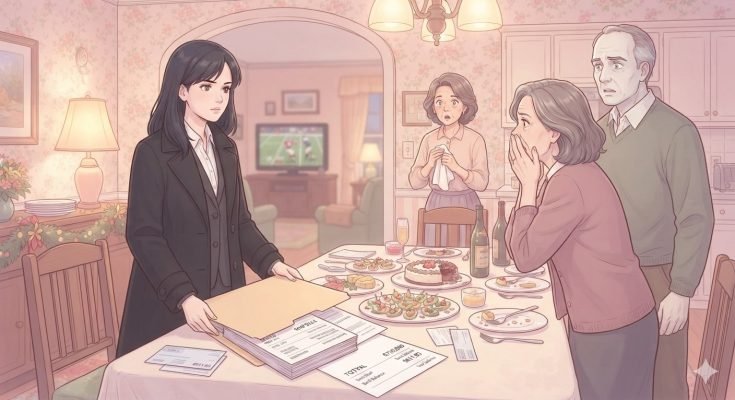
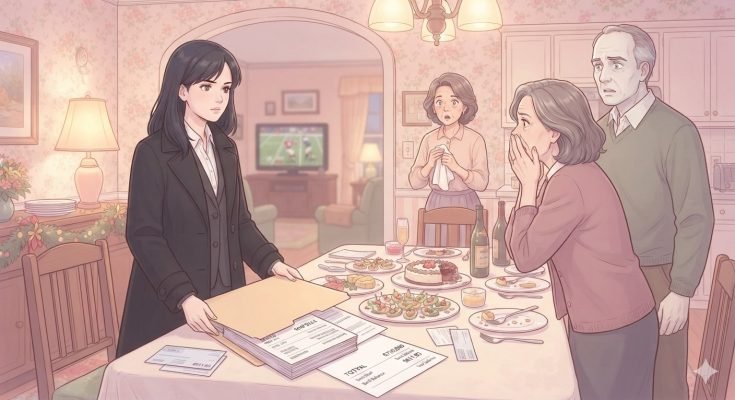
The turkey had been sitting for twenty minutes, untouched, because Maren’s father wanted to make a toast before anyone picked up a fork. He did this every year. Usually it was three sentences about gratitude and football scores. This year he raised his glass a little higher than usual.
“To this house,” he said. “Forty-one years, and next spring it’s finally, completely, one hundred percent ours.”

Maren’s hand stopped halfway to her water glass.
She was forty-two years old, sitting at the same oak table she’d eaten Thanksgiving dinner at since she was six, and she had just heard her father describe a house she had been paying the mortgage on for the last eleven years as something that was about to become, for the first time, his.
“Next spring,” she repeated. Not a question. Just testing the words in her own mouth.
Her mother, Carol, didn’t look up from the cranberry sauce. Her brother, Dale, was already reaching for the mashed potatoes like nothing had been said at all. Dale’s wife, Priya, glanced at Maren for exactly one second too long, then busied herself refilling her son’s milk.
“Refinance comes through in April,” her father, Walt, said, settling back into his chair like the subject was closed. “Dale’s been working with the bank on it. Should save us a good chunk on the interest.”
Maren set her glass down without drinking from it.
“I didn’t know you were refinancing,” she said.
“It’s not a big thing,” Carol said quickly. “Just paperwork.”
But it was a big thing, and Maren knew it the way you know a floor is uneven before you can say exactly which board is off. Because the house at 214 Larkspur Court in Bend, Oregon, was not something her parents had been slowly paying down themselves for forty-one years. It was something Maren had been paying down for the last eleven of those years, ever since her father’s back gave out and the roofing business he’d run for two decades folded within eighteen months.
She had set it up carefully, almost invisibly. A standing transfer of $4,800 a month straight to the mortgage servicer, timed to land two days before the due date. She’d never once made her parents ask. She’d never once brought it up at a family dinner. When her father used to call and say things were tight, she’d just say, “Don’t worry about the house, Dad. Worry about you,” and let him believe whatever version of that sentence let him sleep at night.
Eleven years. Fifty-two hundred, then fifty-eight hundred once the property taxes climbed, then the standing $4,800 for the last four years after they refinanced once already, back in 2022, to a lower rate. Maren had done the math exactly once, sitting at her kitchen table in Portland with a calculator and a legal pad, mostly because her accountant asked why a chunk of her monthly outflow had no clear label. The total, as of this November, came to $718,400. She’d rounded it up to $720,000 in her head ever since, the way you round up an age you’re not proud of yet.
Not one person at this table knew the exact number. Not even Carol, who Maren had always assumed at least suspected the shape of it, even if she didn’t know the total.
“Whose name is on the deed?” Maren asked.
The table went quiet in the specific way a room goes quiet when a question has arrived at the wrong moment for the wrong person to answer it.
“Ours,” Walt said. “Mine and your mother’s. Same as it’s always been.”
“And after the refinance?”
Walt looked at Dale. It was brief, almost nothing, the kind of glance you’d miss if you weren’t watching for it — but Maren had spent her whole childhood reading her father’s face across this exact table, and she caught it.
“Dale’s helping us restructure some things,” Carol said, in the too-even voice she used when she’d rehearsed an answer. “For the estate. So there’s less to deal with later. You know how these things get complicated.”
“Complicated how?”
“Maren.” Her mother’s tone sharpened, just slightly. “It’s Thanksgiving.”
Maren looked at her brother. Dale was forty-five, ran a small property management company out of Bend that mostly handled vacation rentals for out-of-state owners, and had, as far as Maren knew, never once contributed to their parents’ mortgage, medical bills, or the roof replacement she’d quietly wired $14,000 for in 2021 after a hailstorm. Dale had, however, always been the one who “helped with paperwork.” He’d helped with their mother’s car loan. He’d helped when their father’s small business line of credit needed a cosigner review. He was good at helping in ways that seemed to leave him standing a little closer to the center of things each time.
“It’s just some restructuring for tax purposes,” Dale said, not quite meeting her eyes. “Nothing’s changing for anybody.”
“Nothing’s changing,” Maren repeated.
“Right.”
“Then why does Dad think the house becomes fully paid off in April, when I’ve had a standing payment going to that mortgage every single month since 2015?”
The words came out flatter than she meant them to. Not a shout. Not even really an accusation yet — more like she was reading a line off a page she hadn’t fully believed until she said it out loud, in front of witnesses, at a table with green bean casserole cooling in the middle of it.
Carol’s fork went down against her plate with a small, sharp sound.
“You weren’t supposed to say the number,” she said. Then, realizing what she’d just confirmed, she closed her eyes for a second, like she could take the sentence back into her mouth if she tried hard enough.
Maren felt something in her chest go very still.
“Say what number,” she said quietly. “Mom. What number.”
Nobody answered right away. Walt was staring at the tablecloth. Dale had gone back to his potatoes with unusual focus, as if the answer to a decade of unexplained silence could be found somewhere inside a scoop of butter and starch. It was Priya, of all people — the sister-in-law who almost never weighed in on anything Rutherford-family-related — who finally spoke, quietly, mostly to her water glass.
“I told you this would come out eventually,” she said to Dale. Not unkindly. More like something she’d said before and been ignored.
“Come out?” Maren looked from Priya to her brother to her parents, and for the first time in her adult life felt genuinely, physically unsure of what kind of family she was sitting inside of. “What is there to come out? I paid the mortgage. That’s not a secret, that’s a bank statement. What am I not understanding right now?”
Walt finally looked up. Whatever calculation had been happening behind his eyes seemed to resolve into something like resignation.
“Maren,” he said, “the house was never going to you and Dale even. That got decided a long time ago.”
“Decided by who?”
“By all of us,” Carol said. “Years ago. It made more sense for Dale to—”
“I’ve been paying for a house,” Maren said, very slowly, as if she needed to hear herself say each word to believe it was true, “that was never going to be split with me. For eleven years.”
Nobody said no.
That was the part that would stay with her longest — not the reveal itself, not yet, but the silence that followed the question, the particular silence of four people who had all, at some point, agreed to let her keep paying without telling her why it might not matter.
“I think,” Maren said, standing up and folding her napkin with a care that felt almost violent in how controlled it was, “you all need to tell me exactly what got decided. Tonight. Before I leave this table.”