My Husband Said I Would Embarrass Him at His Gala. He Forgot to Ask Who Owned the Room.
“You’ll only embarrass me wearing that dress.”
My husband said it from the marble foyer of our Greenwich home as casually as if he were commenting on the weather.
I stood upstairs in front of our bedroom mirror, one hand resting against the navy silk at my waist.
Three years earlier, Spencer Conway had stood behind me while I wore that exact same dress.
He had wrapped both arms around me and kissed my shoulder.
“You’re the most beautiful woman in the room, Phoebe.”
Back then, I believed him.
That night, he sounded embarrassed that I existed.
I should have been angry.
Instead, I became very still.
Because there is a particular kind of silence that happens when a woman finally hears the truth inside all the excuses she has been making for a man.
For years, I had called Spencer’s coldness stress.
I called his impatience ambition.
I called the nights he came home after midnight pressure.
I called the phone he turned facedown privacy.
I called the way he stopped touching me exhaustion.
Anything was easier than calling my marriage what it had become.
Then I heard our housekeeper, Elena, speak from the foyer.
“Mr. Conway, should I tell Mrs. Conway that the car is ready?”
Spencer did not hesitate.
“There’s no need.”
A pause followed.
“I’m going with Paisley tonight.”
Something inside me went quiet.
Not shattered.
Not exploded.
Quiet.
I walked toward the staircase.
And that was when I saw her.
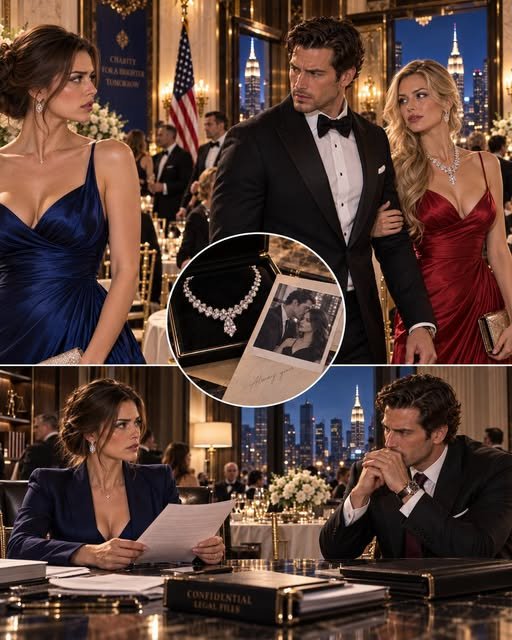
Paisley Daley stood beneath the chandelier I had chosen for our home, wearing a champagne-colored gown covered in tiny crystals.
Her blond hair fell over one shoulder in soft waves.
One hand rested possessively around Spencer’s arm.
She looked completely comfortable.
That was the first thing I noticed.
Not nervous.
Not ashamed.
Comfortable.
As though she had stood in my foyer a hundred times before.
Paisley tilted her face toward my husband.
“Do I look beautiful?”
Spencer looked at her.
Really looked at her.
I could not remember the last time he had looked at me that way.
“You’re perfect.”
Paisley smiled.
Then she turned toward the staircase.
Toward me.
Her eyes moved from my face to my dress and back again.
“So,” she said softly.
“You’re the wife.”
The wife.
Not Phoebe.
Not Mrs. Conway.
Not even Spencer’s wife.
The wife.
A category.
An inconvenience.
A woman whose place she clearly believed she had already taken.
I continued down the stairs.
Spencer’s jaw tightened.
“Phoebe.”
He said my name like a warning.
I stopped on the last step.
“You’re taking Paisley to the Apex gala?”
He sighed.
Not guilty.
Annoyed.
That hurt more.
“Tonight matters.”
“I know.”
“There will be CEOs there.”
“I know.”
“International investors.”
“I know.”
“Political families.”
“I know, Spencer.”
His eyes dropped to my navy gown.
“This isn’t some neighborhood charity dinner.”
Paisley laughed softly.
Spencer continued.
“People in that room can determine the future of my company.”
Then he looked at me with the expression a person uses when trying to explain something complicated to someone they consider simple.
“You’re not prepared for a room like that.”
I looked at him.
The irony was almost beautiful.
But Spencer did not know that yet.
Paisley touched the diamond necklace at her throat.
“The guest list is extremely exclusive.”
She smiled.
“It’s really meant for real people.”
I could have embarrassed her.
I could have told her to leave my home.
I could have screamed at my husband.
I could have thrown the necklace into the driveway.
Instead, I asked one question.
“Are you attending as Spencer’s employee?”
Paisley’s smile changed.
Spencer answered.
“Paisley is attending as my partner tonight.”
My partner.
He said it directly in front of his wife.
And then I noticed the necklace.
I had seen it two weeks earlier.
The jewelry box had been sitting open on Spencer’s desk when I walked into his study.
The diamonds had caught the afternoon light.
When Spencer saw me looking at them, he snapped the box shut.
“A gift for an investor’s wife,” he said.
I had believed him because believing him was easier than becoming suspicious of every beautiful thing that entered our house.
Now those diamonds were resting against Paisley’s skin.
I looked at her.
“Was that necklace a gift?”
Paisley touched it again.
Her smile became almost tender.
“A private one.”
I turned toward Spencer.
“You told me that was for an investor’s wife.”
His face hardened.
“Not now, Phoebe.”
“You lied to me.”
“I said not now.”
Paisley stayed silent.
She did not need to speak.
Her satisfaction filled the entire foyer.
I asked Spencer one final question.
“Why did you lie?”
His answer arrived with no hesitation.
“Because I don’t have to explain every decision I make with my money.”
My money.
Two ordinary words.
But those words changed everything.
Because Spencer believed the house was his.
The cars were his.
The life was his.
The invitations were his.
The connections were his.
He believed I had simply been lucky enough to marry into all of it.
He had no idea that long before I became Mrs. Spencer Conway, there had been another name attached to mine.
A name I had deliberately buried.
Harrell.
And in the financial world Spencer was desperate to enter, Raymond Harrell was not simply rich.
He was the kind of man rich people called when they needed money.
He was my father.
Spencer had spent six years believing he was the powerful person in our marriage.
What he never bothered to ask was why every important door seemed to open just before he reached it.
And that night, standing beneath my chandelier while another woman wore the diamonds he had lied to me about, I finally understood something my father had warned me about years earlier.
Spencer did not love powerless women.
He loved women he believed he could control.
So I let him leave.
Because some men only understand what they had after the door closes behind them.
And Spencer was about to discover that I had been holding far more doors open than he ever knew.
PART ONE — THE DRESS HE WAS ASHAMED OF
Paisley walked past me first.
As she did, she leaned close enough that I could smell her perfume.
“Try not to wait up.”
She whispered it.
But not quietly enough.
Spencer heard every word.
He did nothing.
That was the moment my marriage ended for me.
Not the necklace.
Not the gala.
Not even the word partner.
It ended because my husband watched another woman humiliate me inside my own home and decided my pain was less important than inconveniencing her.
Spencer adjusted the cuff of his tuxedo.
“We’ll talk tomorrow.”
I looked at him.
“No.”
His eyes narrowed.
“No?”
“You’ll talk tomorrow.”
I stepped away from the staircase.
“I’m done explaining tonight.”
For the first time, something uncertain crossed his face.
It disappeared almost immediately.
He was too confident.
Too certain that I would still be waiting when he came home.
I had always waited.
That was my mistake.
Paisley slipped her arm through his.
“Are we going?”
Spencer looked at me for another second.
Then he turned away.
The front doors closed behind them.
A few moments later, headlights swept across the tall windows as the black SUV moved down the curved driveway.
I stood beneath the chandelier.
The house became painfully quiet.
Elena remained near the dining room.
She had worked for us for four years.
She had seen Spencer become colder.
She had seen me become quieter.
People who work inside a home often understand a marriage before the people living in it admit what is happening.
“Mrs. Conway?”
Her voice was gentle.
I looked at her.
“Would you like me to call someone?”
That question nearly broke me.
Because there was no one.
Not anymore.
I had made sure of that.
Three years earlier, I stopped answering my father’s calls.
Then my sister’s.
Then family invitations.
Christmas in Connecticut became Christmas with Spencer.
Thanksgiving became company dinners.
My birthday became whatever reservation Spencer remembered to make.
At first, my father continued writing.
Then calling.
Then sending short messages.
Happy birthday, sweetheart.
I’m here whenever you’re ready.
Your mother would want us to fix this.
Eventually, even those became less frequent.
Not because Raymond stopped loving me.
Because I had taught him that every attempt to reach me would be rejected.
And I had rejected him for one reason.
He had been right about Spencer.
I could still remember the conversation.
It happened six years earlier in my father’s library in Westport.
Spencer and I had been dating for eleven months.
I was twenty-eight.
He was thirty-four.
He was ambitious, handsome, intense, and completely different from the men I had grown up around.
The men in my father’s world spoke softly because they never needed to prove they were powerful.
Spencer entered every room as though he intended to conquer it.
I mistook hunger for strength.
Raymond did not.
“I don’t dislike him,” my father told me.
“You barely speak to him.”
“I speak to him enough.”
“You’re judging him.”
“I’m observing him.”
I rolled my eyes.
My father closed the book in his hand.
“When Spencer talks to me, he watches me carefully.”
“He respects you.”
“No.”
My father’s expression became sad.
“He measures me.”
I remember becoming angry.
“What does that even mean?”
“It means he pays very close attention to people he thinks matter.”
“That sounds normal.”
“It is.”
My father paused.
“The problem is that he barely notices anyone he thinks doesn’t.”
I defended Spencer.
Of course I did.
I loved him.
Or I loved who I believed he was.
Raymond looked at me for a long time.
“Phoebe, character is not how someone treats the most powerful person in the room.”
He placed the book on the table.
“It’s how they treat the person they believe has no power at all.”
I accused him of being arrogant.
I told him he saw manipulation everywhere because money had made him cynical.
I told him Spencer loved me.
Then I married Spencer anyway.
For the first few years, I thought I had proven my father wrong.
Spencer was attentive.
Passionate.
Protective.
He loved that I did not care about society pages.
He loved that I wore old dresses.
He loved that I never mentioned my family’s money.
At least, that was what I believed.
I never told him the full scale of the Harrell estate.
He knew my father had investments.
He knew we were comfortable.
But he thought Raymond was simply a retired businessman with several successful holdings.
That misunderstanding was partly my fault.
I encouraged it.
I wanted one relationship in my life where my last name did not enter the room before I did.
I wanted Spencer to love Phoebe.
Not the Harrell family.
Not our trusts.
Not our properties.
Not our influence.
Just me.
When Spencer’s technology logistics company almost collapsed during our second year of marriage, he refused to ask anyone for help.
He needed outside capital.
He needed it quickly.
He needed an investor willing to accept terms other firms considered too risky.
I called my father.
That was the last major favor I ever asked him for.
“I don’t want Spencer to know.”
Raymond was silent.
“I mean it, Dad.”
“You want me to invest in his company anonymously.”
“I want you to evaluate the company.”
“And if it is worth saving?”
“Help him.”
My father sighed.
“Phoebe.”
“Please.”
“Does he know you’re calling me?”
“No.”
“Does he know what you own?”
“No.”
Another silence.
“Why?”
“Because I want his success to feel like his.”
Even now, remembering myself saying those words hurts.
My father eventually agreed.
Not because he trusted Spencer.
Because he loved me.
The investment was made through Bellweather Holdings, one of the quiet private entities managed by the Harrell family office.
Spencer celebrated for three days when the capital came through.
He called it the deal that proved everyone wrong.
He said investors finally saw what he had built.
I smiled and let him believe it.
Bellweather became one of Conway Meridian’s largest outside shareholders.
Spencer never asked who ultimately owned Bellweather.
He only cared that the money arrived.
That should have taught me something.
Instead, I called it love.
Two years later, after another argument between Spencer and my father, I chose my marriage completely.
I stopped going home.
I stopped taking calls.
I wanted to prove that Spencer and I could build a life independent of my family.
And slowly, I disappeared into the role he preferred.
Quiet wife.
Beautiful home.
No questions.
No inconvenient family.
No reminder that I had ever existed before him.
Until that night.
I went upstairs.
I opened the bottom drawer of my vanity.
Beneath scarves, receipts, an old passport holder, and a photograph I had not looked at in years was a small red velvet box.
Inside was a SIM card.
It belonged to the phone number I had used before I withdrew from my family.