Our neighbor, Gary, backed his pickup truck out of his driveway without looking carefully behind him.
Jake’s bike had been sitting near the edge of our yard.
It wasn’t hidden.
It wasn’t lying in the street.
It had been there, clearly visible, for at least twenty minutes.
Gary simply didn’t see it.
Or didn’t look.
The sound of metal bending made me run outside.
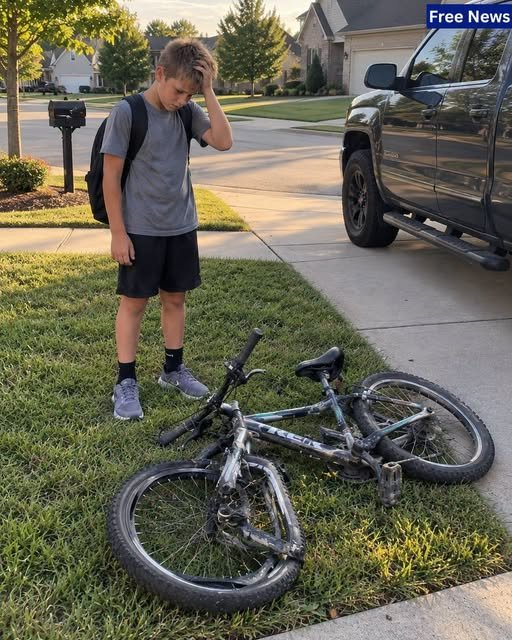
By the time I reached the driveway, the truck had already rolled over the bike.
The frame was badly bent.
The front wheel was twisted.
The handlebars were damaged.
The bike was ruined.
Jake stood there staring at it.
He didn’t yell.
He didn’t cry.
He didn’t even say anything.
He just stood there, completely shocked.
I walked over immediately.
At first, I stayed calm.
I honestly expected Gary to apologize.
I expected him to look at the damage and say something like, “I’m sorry. I’ll replace it.”
Instead, Gary looked at the destroyed bike and shrugged.
“It was parked too close to the road.”
I stared at him.
“You drove over my son’s bike.”
“Well, technically, it’s not my fault if he left it where somebody could hit it.”
I couldn’t believe what I was hearing.
“You didn’t look behind you.”
Gary shrugged again.
“Maybe he should’ve been more careful with where he parked it.”
I felt my temper rising.
I explained that Jake had spent almost a year earning the money for that bike.
I told him exactly how hard our son had worked.
I explained that this wasn’t some cheap toy he had gotten on a whim.
Gary barely softened.
He insisted the bike had been too close to his driveway and said replacing it wasn’t his responsibility.
I argued with him for nearly ten minutes.
Nothing changed.
No apology.
No offer to help.
Not even the slightest sign that he cared about what had happened to a twelve-year-old boy who had worked nearly a year to buy something for himself.
Eventually, I walked away before the argument became something worse.
I decided I would give Gary a few days.
Then I would handle it properly.
Maybe through his insurance.
Maybe through our homeowners insurance.
And if necessary, perhaps small claims court.
I wasn’t going to let Jake lose nearly a year of work because our neighbor refused to take responsibility.
That weekend, I spent a lot of time thinking about what to do next.
I looked at the bike again.
I thought about the security-camera footage.
I found the receipt.
I thought about the best way to prove what had happened and make Gary understand that he couldn’t simply destroy something and walk away.
Compared with a mortgage, an investment account, or a major family dispute, $420 might not sound like a huge amount of money.
But that wasn’t the point.
To Jake, those $420 represented eleven months and three weeks of work.
Every dollar had a story.
And I wanted Gary to understand that.
But before I got the chance to make my move, Jake came downstairs Saturday morning.
He looked unusually serious.
“Dad.”
I looked up from my coffee.
“What?”
He stood there for a moment.
Then he said something I wasn’t expecting.
“I don’t need your help with Gary anymore.”
I frowned.
“What do you mean?”
“I’ve got it handled.”
I stared at him.
“You’ve got what handled?”
“Gary.”
Apparently, Jake had been thinking about the situation all week.
Quietly.
Carefully.
He hadn’t forgotten about the bike.
He had simply been thinking about what to do.
I probably should have asked him a lot more questions right then.
Instead, I watched my twelve-year-old son pick up his spiral savings notebook and walk across our yard.
Straight toward Gary’s house.
My wife, Sarah, and I watched through the window.
Jake knocked on the door.
A few seconds later, Gary opened it.
Jake said something I couldn’t hear.
Gary’s expression changed almost immediately.
Then Jake pulled something from his pocket.
His notebook.
Sarah and I looked at each other.
“What is he doing?” she asked.
“I have no idea.”
We expected Jake to be back within five minutes.
He wasn’t.
Five minutes became fifteen.
Fifteen became thirty.
Then nearly forty-five minutes passed.
I started wondering whether I should go over there.
Sarah put a hand on my arm.
“Wait.”
So we waited.
Finally, the front door opened.
Jake walked back across the yard.
He wasn’t angry.
He wasn’t crying.
He wasn’t celebrating.
He looked calm.
When he came inside, he placed a handwritten note and a sealed envelope on the kitchen table.
Then he looked at us.
For a moment, neither of us spoke.
“What happened?” I asked.
Jake sat down.
“I showed him my notebook.”
I looked at the spiral notebook.
“The one with all your savings?”
He nodded.
Then he explained what he had done.
He hadn’t threatened Gary.
He hadn’t yelled.
He hadn’t told him he was going to court.
He hadn’t even spent most of the conversation arguing about who was legally responsible.
Instead, Jake asked Gary about his truck.
Then he asked whether Gary had ever worked hard for something he really cared about.
Gary apparently didn’t understand where the conversation was going.
Then Jake opened the notebook.
Inside were eleven months and three weeks of records.
Every lawn he had mowed.
Every small job he had completed.
Every payment.
Every dollar saved.
Five neighborhood lawns for $15 each.
Extra chores.
Weekend work.
Money he could have spent but didn’t.
Jake showed Gary what the bike had actually represented.
Then he said something that surprised me.
He told Gary that he wasn’t asking him to admit he was a terrible person.
He wasn’t asking him to feel ashamed.
He wasn’t even trying to win an argument.
He simply wanted Gary to understand what had been lost.
Then Jake apparently asked him one question.
“What do you think the right thing to do is?”
According to Jake, Gary didn’t answer immediately.
He became quiet.
Then he walked into another room.
A few minutes later, he came back carrying an envelope.
Inside was $420.
Exactly what the bike had cost.
Gary also handed Jake a note.
It was an apology.
He admitted that he should have looked behind him before backing out.
He apologized for the way he had spoken to Jake’s father.
And he apologized for acting as though the bike didn’t matter.
Jake thanked him.
Then he came home.
That was it.
No shouting.
No threats.
No lawyers.
No police.
Just a twelve-year-old boy, a notebook, and a conversation.
That afternoon, we drove back to the bike shop.
Jake bought the same matte-green model.
He had enough money to replace the bike because Gary had finally accepted responsibility.
But Jake insisted on adding $2 of his own money to cover the tax.
I asked him why.
He shrugged.
“I should have included the tax when I told him how much the bike cost.”
I smiled.
Even after everything, he wanted to be fair.
On the drive home, Jake was quiet for a while.
Then he said something I haven’t forgotten.
“Dad, arguing made him defend himself.”
I looked over at him.
“What do you mean?”
“He thought you were trying to make him admit he was wrong.”
I nodded.
Jake continued.
“But I wasn’t asking him to admit anything.”
He looked out the window.
“I just wanted him to see what happened.”
Then he said:
“When you give someone a way to make things right without embarrassing them, sometimes they choose to do the right thing.”
I didn’t know what to say.
I had spent days thinking about insurance claims, receipts, security footage, legal responsibility, and small claims court.
I had been preparing to teach Gary a lesson.
My twelve-year-old son had approached the entire situation differently.
He hadn’t ignored what Gary had done.
He hadn’t allowed himself to be walked over.
He simply chose a different way to make the other person understand.
Later that evening, I found Jake sitting at the kitchen table with his notebook open again.
He wasn’t recording his savings this time.
He was writing notes about the conversation.
What worked.
What he would do differently.
What he wanted to remember.
I asked him what he was writing.
“Just some things from today.”
Then he looked up.
“Gary asked me where I learned to think like that.”
I smiled.
“What did you tell him?”
Jake shrugged.
“I told him I watched my dad.”
That hit me harder than I expected.
I had been so focused on protecting my son that I hadn’t realized he had been watching how I handled difficult situations his entire life.
And somehow, he had taken something from those lessons that I hadn’t even known I was teaching him.
I had wanted to teach my neighbor a lesson.
Instead, my son taught me one.
Sometimes being strong doesn’t mean being the loudest person in the room.
It doesn’t mean threatening someone with court.
It doesn’t always mean proving that you’re right.
Sometimes strength is staying calm enough to help another person see the damage they’ve caused.
Jake didn’t let Gary escape responsibility.
He didn’t pretend the bike wasn’t important.
He didn’t forgive him before Gary had made things right.
He simply gave him an opportunity to choose the right thing.
And Gary took it.
The next morning, Jake rode his new bike down our street.
The sun was just coming up, and the matte-green frame caught the light as he passed the driveway where his first bike had been destroyed.
I watched him disappear around the corner.
For almost a year, I had watched my son save money because he wanted a bike.
But that weekend, I realized he had been saving something else, too.
Patience.
Discipline.
Confidence.
And the ability to solve a problem without becoming consumed by anger.
The bike had cost $420.
But what Jake learned from losing it—and then replacing it—was worth far more.
And I suspect Gary learned something too.
Sometimes people don’t need to be humiliated before they can admit they were wrong.
Sometimes they just need someone to show them what their actions really cost.
My son walked next door carrying nothing more than a twelve-year-old’s savings notebook.
He came home with a new bike.
But he also came home with something far more valuable:
The knowledge that you can stand up for yourself without becoming cruel.
And that, more than the bike itself, was the lesson I will remember.