At first, the basement seemed completely ordinary.
It was the kind of forgotten space found beneath many older homes—dimly lit, dusty, and filled with objects that had probably not been touched in years. The walls showed signs of age, the floor was uneven in places, and every movement seemed unusually loud in the silence.
Nothing suggested that anything unusual was waiting to be discovered.
Then someone noticed an old container tucked away in a corner.
What was inside immediately raised questions.
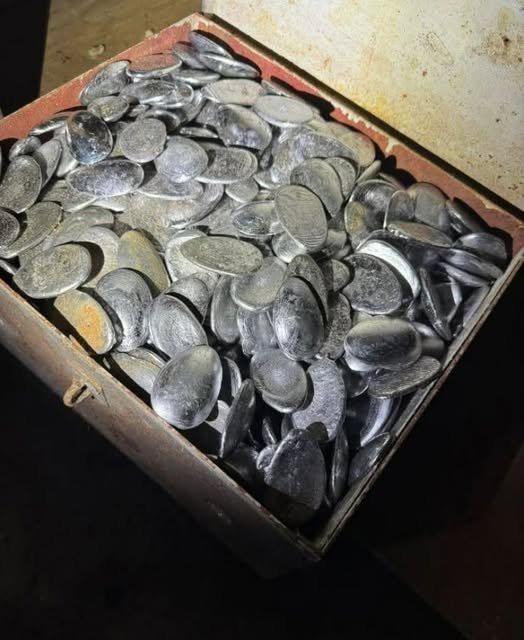
The container was filled with hundreds of small, flat objects that appeared to be made from metal. They were stacked together in large quantities, and although they showed signs of age, they appeared surprisingly uniform in shape and size.
This was not simply a handful of random pieces that had fallen behind a shelf.
Someone had apparently collected them.
And judging by where they had been placed, someone may have intentionally stored them there for a very long time.
Hundreds of Nearly Identical Pieces
The sheer number of objects was what made the discovery especially unusual.
There were not five or ten of them. There were piles.
Some were lying flat against one another, while others had shifted over the years. A few appeared slightly bent, scratched, or discolored, but most shared the same dull metallic appearance.
At first glance, they almost resembled coins.
A closer look, however, made that explanation less convincing.
They did not appear to have the familiar markings normally found on currency. There were no obvious portraits, denominations, or recognizable symbols suggesting that they had once been ordinary money.
That left an obvious question.
What were they?
The Location Made the Mystery Even Stranger
Finding an unfamiliar object in an old house is not particularly unusual.
Older properties frequently contain forgotten tools, construction materials, household items, and belongings from previous generations. Basements, attics, sheds, and crawl spaces can preserve objects for decades simply because nobody has any reason to move them.
But this discovery felt different.
The pieces had apparently been gathered together and placed inside a container rather than scattered randomly throughout the room.
That suggested organization.
Whoever put them there seemingly believed they were worth keeping.
Whether their value was financial, practical, or personal remained unknown.
The basement itself offered few clues. There was no note explaining the collection, no obvious equipment beside it, and nothing immediately connecting the strange pieces to a particular occupation or hobby.
Without context, even an ordinary object can become a mystery.
Were They Old Tokens?
One of the first theories was that the pieces might have been some type of token.
Before modern electronic payment systems became widespread, tokens were used for countless purposes.
Factories sometimes issued company tokens. Transit systems used fare tokens. Arcades, laundromats, amusement parks, parking facilities, clubs, and private businesses also relied on specially produced pieces that could substitute for money within a limited system.
Some communities even used tokens during shortages of regular currency.
If the basement objects came from one of these systems, their uniform appearance would make sense.
A person who worked at a factory, transportation company, or local business could easily have ended up with hundreds of them.
But without readable markings or additional information, the token theory remained only one possibility.
Another Possibility: Industrial Material
Others suggested a much less dramatic explanation.
The objects might simply have been industrial blanks or leftover pieces of metal.
Factories that manufacture washers, coins, buttons, electrical components, or other circular objects often produce large quantities of similarly shaped metal pieces.
Scrap material was also commonly saved rather than immediately discarded.
Years ago, people were often especially reluctant to throw away usable metal. A container filled with seemingly worthless pieces today might once have represented material that could be reused, repaired, melted down, or sold.
That could explain both the quantity and the careful storage.
Perhaps the original homeowner intended to use them someday.
Perhaps that day simply never came.
The House’s History Could Hold the Answer
When unusual objects are discovered inside an old property, the history of the people who lived there can sometimes be more useful than examining the object alone.
What jobs did previous owners have?
Was anyone employed at a factory?
Was there once a workshop on the property?
Did someone collect coins, tokens, or mechanical parts?
Was the building previously used for something other than a residence?
Answers to questions like these can completely change how a discovery is interpreted.
An object that seems mysterious today might have been perfectly ordinary to the person who placed it there decades earlier.
A retired machinist, for example, might have saved metal blanks from work.
A former business owner might have kept unused tokens after closing a shop.
A collector might have gathered items that had little monetary value but significant historical interest.
Without knowing who owned the collection, every theory remains incomplete.
Why Would Someone Hide Them?
The word “hidden” can easily make an old discovery sound dramatic, but not everything stored in an unusual place was necessarily meant to be secret.
Basements have always been practical storage areas.
People place things there because they do not need them immediately but also do not want to throw them away.
Over time, shelves become crowded. Boxes are pushed into corners. New belongings are placed in front of old ones. Eventually, objects disappear from everyday memory.
Years can turn into decades.
By the time a new homeowner discovers them, what was once simple storage can look like an intentional hiding place.
Still, the possibility that someone deliberately wanted the collection kept out of sight is difficult to ignore.
Hundreds of similar pieces represent effort.
Someone obtained them, gathered them together, and kept them.
There was almost certainly a reason.
Could They Be Valuable?
That question naturally comes up whenever something unusual is discovered in an old home.
Age alone, however, does not make an object valuable.
Collectors usually consider several factors, including rarity, condition, material, historical significance, identifiable markings, and demand.
A box containing hundreds of identical old objects might sound valuable, but if millions were originally manufactured, each piece could be worth very little.
On the other hand, an obscure token connected to a long-closed business or historic local event could potentially interest collectors.
The safest approach with unidentified old objects is to avoid cleaning or modifying them aggressively before learning what they are.
Removing corrosion, polishing surfaces, or using chemicals can sometimes destroy markings or reduce collectible value.
Photographs, measurements, visible symbols, weight, and information about where the items were discovered can often help specialists identify them.
Small Details Could Solve the Mystery
The smallest markings might provide the biggest clues.
A number stamped along an edge could indicate a manufacturer.
A symbol might identify a company.
A hole through the center could suggest a mechanical purpose rather than currency.
Even the exact metal used could narrow the possibilities considerably.
Copper, brass, aluminum, steel, lead, and other materials were chosen for very different applications.
Dimensions are equally useful.
Something that looks like a coin in a photograph could actually be a washer, electrical component, gaming token, machine blank, or manufacturing scrap.
Context matters.
Old Houses Are Full of Forgotten Stories
Discoveries like this are one reason older homes continue to fascinate people.
A house does more than shelter the families who live inside it. Over time, it becomes an accidental archive of their lives.
Objects are left behind in cabinets.
Names are written beneath wallpaper.
Old photographs slip behind drawers.
Tools remain in sheds long after the person who used them is gone.
Letters disappear into boxes.
And occasionally, someone opens a forgotten container and finds something that makes absolutely no sense to the modern observer.
The object may be ordinary.
The unanswered story behind it is what makes it fascinating.
Sometimes the Story Matters More Than the Object
Perhaps these strange metallic pieces were once valuable.
Perhaps they were industrial leftovers.
Perhaps they were tokens from a business that disappeared generations ago.
Or perhaps they belonged to a personal project that was never completed.
Without additional evidence, there is no reason to pretend the answer is certain.
But one thing seems clear: the collection meant enough to somebody that it was kept together instead of being discarded.
Years later, the person is gone, the explanation has disappeared, and only the objects remain.
That is what gives discoveries like this their unusual power.
They remind us that the homes we inherit, renovate, purchase, and explore were once filled with other people’s routines, plans, jobs, hobbies, and secrets.
Most of those stories disappear quietly.
Every once in a while, however, something is left behind.
And suddenly, a dusty basement becomes a mystery.