
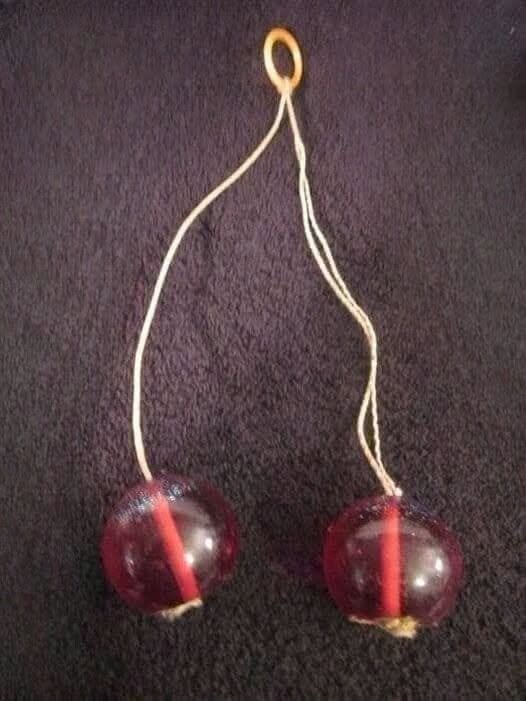
At first glance, the object appears almost impossible to identify. It consists of two small, rounded pieces connected by cords, with no buttons, labels, or moving mechanical parts to explain what it does.
When photographs of similar objects appear online, people often suggest imaginative possibilities. Some believe they are old-fashioned toys, sewing accessories, exercise equipment, or parts removed from a larger machine.
The real answer is much less complicated. It is a simple manual massaging tool designed to apply pressure to different areas of the body.
Before battery-powered massage devices became widely available, people frequently used uncomplicated tools like this to soothe tired muscles. Its basic construction made it inexpensive, portable, and easy to operate.
How the Massager Works
The rounded ends are the main working parts of the device. A person holds the connecting cords or handles and positions the rounded pieces against an area of the body that feels tense.
By pulling gently and moving the tool back and forth, the user can roll or press the rounded sections over the muscles. The amount of pressure depends on how firmly the cords are held.
Depending on its shape and size, the massager may be used on areas such as:
- The shoulders
- The back of the neck
- The arms and hands
- The upper or lower back
- The legs and feet
Its operation does not require electricity, batteries, or special instructions. The user controls both the movement and intensity.
Why Is It So Difficult to Recognize?
The object can be confusing when it is photographed without context. If it is shown lying on a table, there is nothing to demonstrate its size or how it is meant to be held.
Its design also comes from a period when household and personal-care products were often much simpler. Instead of plastic controls and electronic settings, manufacturers relied on basic materials and practical shapes.
People who grew up seeing manual massage tools may recognize one immediately. Younger viewers, who are more familiar with electric massage guns, vibrating cushions, and heated devices, may have no idea what it is.
That difference helps explain why photographs of ordinary vintage objects can inspire hundreds of incorrect guesses.
A Product Designed for Simplicity
The most interesting feature of the massager is its simplicity. There are no complicated components that can malfunction, and the tool can be stored easily in a drawer or travel bag.
Older versions may have been made from wood, rubber, dense plastic, or another durable material. The cords needed to be strong enough to withstand repeated pulling, while the rounded ends were shaped to move across the body without sharp edges.
Some models included textured surfaces or small bumps intended to provide a different sensation. Others used smooth, ball-shaped pieces that could roll more comfortably over clothing.
Although the design may appear primitive compared with modern equipment, it offered several practical advantages:
- It was affordable
- It required no electrical power
- It was easy to transport
- The user controlled the pressure
- It could be used almost anywhere
These qualities allowed the product to remain useful even after more advanced devices entered the market.
Does a Manual Massager Provide Benefits?
Gentle massage may offer temporary comfort after physical activity, repetitive work, or a long period spent sitting. Some people find that controlled pressure helps them relax and reduces the sensation of everyday muscle tightness.
However, a manual massager should not be treated as a cure for an injury or medical condition. It cannot replace an examination by a qualified healthcare professional.
Pain that is severe, persistent, unexplained, or accompanied by swelling, weakness, numbness, fever, or loss of movement should receive appropriate medical attention.
People should also avoid applying heavy pressure over injured skin, swollen tissue, prominent bones, varicose veins, or sensitive areas. Anyone with a medical condition that affects the muscles, nerves, bones, blood vessels, or skin should seek professional advice before using a massage tool.
Comfort should always guide the amount of pressure. Massage should not produce sharp pain or make existing symptoms worse.
How to Use It Carefully
A person using this type of device should begin with light pressure. The rounded ends can be positioned over clothing and moved slowly across a tense muscle.
Short sessions are usually more sensible than applying intense pressure for a long period. The tool should remain in motion instead of being forced repeatedly against one small spot.
Using the massager with another person may make it easier to reach the upper or middle back. Clear communication is important so the person receiving the massage can request less pressure when necessary.
Before using an older device, inspect it carefully. Frayed cords, cracked wooden pieces, rough edges, or weakened connections could cause injury. A vintage object that has deteriorated may be better preserved as a collectible rather than used.
Why Older Everyday Objects Fascinate Us
Mystery-object photographs are popular because they reveal how quickly familiar technology can disappear from daily life. An item once found in many homes may become nearly unrecognizable within a few generations.
The same thing has happened to manual kitchen equipment, early office supplies, sewing tools, farming devices, and personal-care products. When newer technology replaces them, knowledge of their purpose gradually fades.
These objects offer a small glimpse into how people handled ordinary tasks before modern electronics. They also demonstrate that an effective design does not always need complicated technology.
In this case, the strange-looking collection of cords and rounded pieces was not a mechanical component or forgotten game. It was simply a practical massager made to help people apply controlled pressure to tired muscles.
Once its purpose is understood, the design suddenly makes sense. What looked like an unsolvable puzzle turns out to be a straightforward tool from another era—proof that some of the simplest objects can create the greatest curiosity.