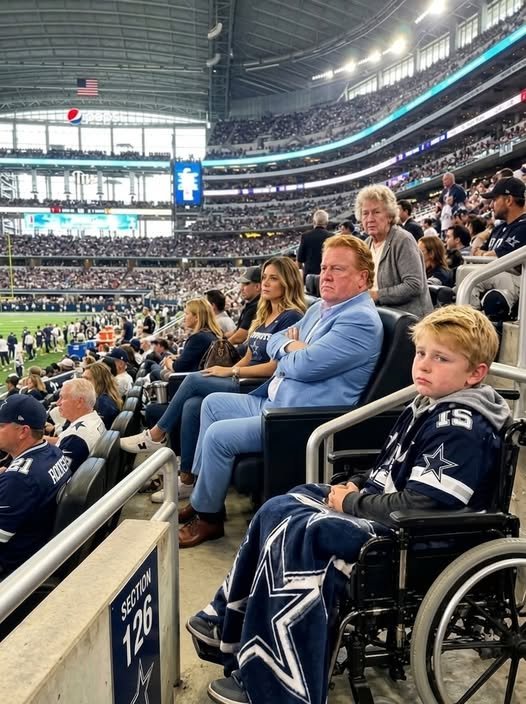

An entitled man took the accessible football seats I had bought with my last savings for my son in a wheelchair. Then a quiet elderly woman taught him a lesson. My eleven-year-old son, Caleb, had spent four months counting down to that football game. Six months earlier, he had been walking home from school when a five-year-old boy chased a ball into the street. Caleb saw a pickup coming, ran after him, and managed to push the little boy back onto the sidewalk just seconds before impact. Caleb was not fast enough to save himself. The truck hit him hard enough to fracture his spine, and after hours of surgery followed by weeks in the hospital, doctors told me they could not promise he would ever walk again. Yet Caleb never once said he regretted what he had done. “If I hadn’t pushed him, Mom, he’d be the one in this chair.” What hurt him most was losing football. He had played since he was six, and now he could not run with his friends or even climb the bleachers at school, but every Sunday he still watched his favorite team from our couch. “When I’m strong enough, can we see them for real?” So I saved every dollar I could, skipped lunches at work, sold an old bracelet, and finally spent almost everything left in my account on two accessible seats near the field. The moment we entered the stadium, Caleb’s whole face lit up. “Mom, I can smell the grass!” Then we reached our section and found a wealthy-looking couple sitting in our seats, with the woman’s designer purse placed directly in the wheelchair space. “Excuse me,” I said, showing our tickets. “These are ours.” The man barely looked at them before turning his eyes toward Caleb. “Sit somewhere else.” “My son can’t. These are accessible seats.” His eyes dropped to the wheelchair, and he shrugged. “Not my problem. I just want to see the game properly. The view from here is perfect. Lady, I spend enough money here to buy half this stadium. Your kid can watch from the concourse. I bet he doesn’t even understand the rules.” His wife actually smiled. An usher hurried over, but before he could speak, Caleb gently tugged my sleeve. “It’s okay, Mom,” he whispered. “We can watch from the hallway.” After everything he had survived, hearing him give up the one afternoon he had dreamed about for months nearly broke me. Then a calm voice came from the row behind us. “You. Stand up. Now.” A small elderly woman in a plain gray cardigan sat there with an old metal lunchbox resting on her knees. The man laughed. “Oh, God. Don’t stick your nose into other people’s business.” She rose slowly and held the lunchbox toward him. “I’ve got something better for you than this view.” “What, your sandwich?” “Just open it.” Still smirking, he flipped the latch. The laughter vanished from his face. For several seconds, he simply stared inside. Then, right beside my son’s wheelchair, the man dropped to his knees. “Oh no,” he whispered. “Please don’t do this.” He looked up at the elderly woman, suddenly terrified. “Give me one more chance.” When I saw what was in the lunchbox, I gasped. The man was going to learn the harshest lesson of his life. You won’t believe what happened next… (I know you’re curious about the next part, so please be patient and read on in the comments below. Thank you for your understanding of the inconvenience. please leave a ‘YES’ comment below and give us a “Like ” to get full story ) 👇

An Entitled Man Took My Son’s Accessible Football Seats Then an Elderly Woman Opened Her Lunchbox Six months after my eleven-year-old son was hit by a pickup truck, I spent …

An entitled man took the accessible football seats I had bought with my last savings for my son in a wheelchair. Then a quiet elderly woman taught him a lesson. My eleven-year-old son, Caleb, had spent four months counting down to that football game. Six months earlier, he had been walking home from school when a five-year-old boy chased a ball into the street. Caleb saw a pickup coming, ran after him, and managed to push the little boy back onto the sidewalk just seconds before impact. Caleb was not fast enough to save himself. The truck hit him hard enough to fracture his spine, and after hours of surgery followed by weeks in the hospital, doctors told me they could not promise he would ever walk again. Yet Caleb never once said he regretted what he had done. “If I hadn’t pushed him, Mom, he’d be the one in this chair.” What hurt him most was losing football. He had played since he was six, and now he could not run with his friends or even climb the bleachers at school, but every Sunday he still watched his favorite team from our couch. “When I’m strong enough, can we see them for real?” So I saved every dollar I could, skipped lunches at work, sold an old bracelet, and finally spent almost everything left in my account on two accessible seats near the field. The moment we entered the stadium, Caleb’s whole face lit up. “Mom, I can smell the grass!” Then we reached our section and found a wealthy-looking couple sitting in our seats, with the woman’s designer purse placed directly in the wheelchair space. “Excuse me,” I said, showing our tickets. “These are ours.” The man barely looked at them before turning his eyes toward Caleb. “Sit somewhere else.” “My son can’t. These are accessible seats.” His eyes dropped to the wheelchair, and he shrugged. “Not my problem. I just want to see the game properly. The view from here is perfect. Lady, I spend enough money here to buy half this stadium. Your kid can watch from the concourse. I bet he doesn’t even understand the rules.” His wife actually smiled. An usher hurried over, but before he could speak, Caleb gently tugged my sleeve. “It’s okay, Mom,” he whispered. “We can watch from the hallway.” After everything he had survived, hearing him give up the one afternoon he had dreamed about for months nearly broke me. Then a calm voice came from the row behind us. “You. Stand up. Now.” A small elderly woman in a plain gray cardigan sat there with an old metal lunchbox resting on her knees. The man laughed. “Oh, God. Don’t stick your nose into other people’s business.” She rose slowly and held the lunchbox toward him. “I’ve got something better for you than this view.” “What, your sandwich?” “Just open it.” Still smirking, he flipped the latch. The laughter vanished from his face. For several seconds, he simply stared inside. Then, right beside my son’s wheelchair, the man dropped to his knees. “Oh no,” he whispered. “Please don’t do this.” He looked up at the elderly woman, suddenly terrified. “Give me one more chance.” When I saw what was in the lunchbox, I gasped. The man was going to learn the harshest lesson of his life. You won’t believe what happened next… (I know you’re curious about the next part, so please be patient and read on in the comments below. Thank you for your understanding of the inconvenience. please leave a ‘YES’ comment below and give us a “Like ” to get full story ) 👇 Read More

“My Dad Gave My Brother $350K — Then Expected Me to Cover the Mortgage”My Dad Gave My Brother 350K Then Expected Me To Pay The Mortgage The Night I Put Down My Fork The night my father gave my brother $350,000, I was halfway through cutting a piece of roasted chicken. We were seated beneath crystal chandeliers in a private dining room in downtown Dallas, the kind of place where waiters materialize and disappear without drawing attention to themselves and the jazz is engineered to suggest sophistication without demanding to be listened to. Rain moved down the tall windows overlooking the city in long diagonal lines. The tablecloths were white. The flowers were fresh. The whole evening had been arranged to feel like an occasion. My brother Tyler sat across from me in a navy suit he had not paid for. He had the particular expression he wore when he was trying to conceal how pleased he was with himself, a slight downward tilt of the head, a careful modulation of his smile, as though too much visible satisfaction might invite scrutiny of whether it was warranted. I had been reading that expression my entire life. Dad rose and tapped his spoon against his glass. The table went quiet immediately. These were his people, his business associates and neighbors and longtime friends who had spent years hearing about Tyler’s potential, who had learned to orient themselves to my father’s announcements with the attentiveness of people in the presence of someone whose approval they valued. He placed one hand on Tyler’s shoulder. “My son is buying his first house,” he said. “And I’m giving him $350,000 to make it happen.” The applause came quickly and genuinely, the applause of people who had expected something worth applauding and were pleased to have their expectation fulfilled. Tyler lowered his head in the performance of modesty he had been perfecting since childhood. Mom lifted her wineglass with tears in her eyes, the specific tears she produced for moments she had decided were significant. “You deserve it,” she told him. Tyler was turning thirty. He had changed jobs four times in six years, each departure framed as a strategic pivot rather than a failure of follow-through. He had launched two businesses with funding from our father, both of which had dissolved when the initial enthusiasm encountered the ordinary demands of sustained effort. He still called our mother when a bill surprised him, which they did regularly, because Tyler had never developed the relationship with financial reality that comes from being required to develop one. But that evening he was being celebrated as though he had built the house with his own hands, from materials purchased with money he had earned through work he had done. I kept my expression neutral and continued cutting my chicken. Then Dad looked at me. “Maren,” he said, with the casual ease of a man asking someone to pass the bread, “you’ll cover this month’s mortgage, right?” The applause died so completely that I could hear ice shifting in someone’s glass across the table. I put down my knife. “What mortgage?” “The first payment. Closing expenses are always heavier than expected. Tyler needs some breathing room.” Tyler laughed, the short dismissive laugh he used for things he had decided were not worth taking seriously. “It’s just one month.” “How much?” He glanced at Dad before answering. “About seventy-eight hundred.” A waiter standing behind Mom froze with a bottle tilted over her glass, suspended in the specific paralysis of someone who is present for something they did not expect to be present for and is uncertain whether continuing their task would constitute an intrusion. Dad smiled at me the way people smile when they have already decided the outcome and are performing the courtesy of appearing to ask. “You’re doing well. It won’t hurt you.” That sentence had followed me my entire life, adapted to whatever I was being asked to absorb. Maren can handle it. Maren is responsible. Maren does not need as much. It had been applied to my transmission failing during college, which I repaired by riding two buses to work for five months while Tyler got a replacement car because young men make mistakes. It had been applied to graduation, where Tyler received a luxury watch and a paid vacation and I bought my own dress on clearance and signed my own loan documents. It had been applied to every occasion when the family’s comfort was denominated in my inconvenience. I had made the mistake of surviving without help and allowed that survival to be interpreted as evidence that I did not require any. Mom finally looked at me. “Don’t make this uncomfortable,” she murmured. I placed my fork beside my plate. “You gave Tyler three hundred and fifty thousand dollars,” I said, “and you’re asking me to pay his mortgage.” Dad’s expression tightened. “This is not the time to compete with your brother.” “I’m not competing.” “Then be happy for him.” Tyler leaned back in his chair with the ease of someone who has never had to consider whether the space he occupies is comfortable for others. “You’re acting like I asked you to buy the whole house.” Several guests looked at their plates. Others watched with the particular fascinated discomfort of witnesses to something they cannot stop observing. I folded my napkin carefully, the way she had taught me to fold things, and placed it beside my plate. Dad lowered his voice. “Family helps family.” I looked at Tyler’s expensive watch. I looked at Mom’s diamond bracelet. I looked at the champagne lined along the table. Then I thought about my first apartment, where I had slept on a mattress on the floor because I could afford rent or furniture but not both, and where I had eaten cereal for dinner on Thursdays when the week’s budget was exhausted, and where no one had thought to offer three hundred and fifty thousand dollars to make things easier. “No,” I said. Dad blinked. “What?” “No. I will not pay Tyler’s mortgage.” Mom inhaled sharply. Tyler’s face reddened in a way that had nothing to do with embarrassment and everything to do with being told no by someone he had not expected to be told no by. Dad’s voice became cold. “You’re embarrassing yourself.” I stood. My chair scraped against the marble floor, a sound that seemed too loud for the room, the sound of something being decided. “No, Dad,” I said. “I’m finally watching the right people feel embarrassed.” I walked out before anyone could answer. Outside, the rain came down hard enough to soak my hair before I reached the valet stand. Dallas glowed in broken reflections across the wet pavement. My hands were shaking when I reached my car, but underneath the hurt and the anger there was something else, something quieter and more unfamiliar. Calm. Not peace, exactly. Not resolution. But the specific stillness of someone who has finally said the thing they should have said years ago and cannot unsay it, and who is discovering that living with the consequences of honesty is better than living with the consequences of silence. My phone buzzed before I started the engine. Dad had sent a photograph of Tyler’s mortgage statement with six words below it: Payment is due Friday. Handle it. I stared at the message until the screen dimmed. Then a second notification appeared. A transfer had been scheduled from an account I had not used in months. The destination was an account with Tyler’s name on it. I canceled the transfer before leaving the parking garage. The bank confirmed that the account had been created years earlier to help my parents manage household emergencies. Dad retained viewing access but had never been authorized to initiate transfers. He had apparently forgotten that distinction, or had decided it did not apply to him. “Would you like us to remove all secondary access?” the representative asked. “Yes.” A pause. “All of it?” “All of it.” By the time I reached my apartment, Dad had called eleven times. Mom had called seven. Tyler had sent one message: Seriously? I turned my phone facedown on the kitchen counter. The apartment was quiet except for the refrigerator’s hum and the rain against the glass. I opened my laptop and spent two hours reviewing every recurring payment connected to my family. The list was longer than I had allowed myself to know. Mom’s supplemental insurance premium, because Dad had once mentioned cash flow being tight and I had simply begun paying it and never stopped. Property taxes on the lake cabin, after Tyler’s first business dissolved. The family internet account, two streaming subscriptions, a phone plan that included Tyler despite his salary. Smaller things: home repairs, airline tickets, restaurant deposits, emergency transfers that had arrived in my account as exceptional situations and had quietly become infrastructure. Individually, none of them had seemed worth contesting. Together, they showed me something I had been arranging my perceptions to avoid seeing. My family had not merely regarded me as dependable. They had converted my dependability into a revenue stream, regular and reliable and maintained through the social pressure of family loyalty. I canceled every payment that was legally mine to cancel. The next morning, Dad appeared at my door in the same suit from the dinner, collar open, silver hair uncombed, wearing the expression of a man who has encountered an obstacle he considers temporary. He did not wait to be invited inside. “You froze the family account.” “I removed your access to my money.” “Tyler’s closing is this afternoon.” “Then Tyler should pay his own expenses.” “You know he doesn’t have that kind of cash available.” “You just gave him $350,000.” “That money is committed to the down payment.” “Then he bought a house he cannot afford.” Dad’s jaw tightened. “You have always resented him.” There it was. The interpretation that had been held in reserve for exactly this situation, the framing that transformed my refusal to be exploited into a character defect. Every system of exploitation requires a story that makes the resistance look like the problem, and my family had always been efficient about supplying theirs. “I worked through college,” I said. “Tyler took vacations. I built my career without your help. Tyler received money every time he failed. But the moment I refuse to finance him, I’m jealous.” “You’re twisting the past.” “No. I’m adding it correctly.” His eyes moved to the folding table by the window, where invoices and client files sat in organized rows. I was working then as an independent accountant for small businesses. The income was decent and unpredictable, and I still checked prices and delayed purchases and made the hundred small calculations that people make when they know that money, once spent, does not automatically return. Dad knew this. He simply believed that any money I had was more available than money belonging to Tyler, because Tyler’s money was Tyler’s and my money was family’s, and those were different categories with different rules. “Your mother is devastated,” he said. “Mom watched you ask me for nearly eight thousand dollars in front of forty people.” “She didn’t want to challenge me publicly.” “But she wanted me to pay publicly.” His face hardened into the particular hardness of a man unaccustomed to the conversation not going his way. “You need to decide whether being right is worth losing your family.” I looked at him. “If keeping my family requires paying admission,” I said, “then I was never really part of it.” He left without saying goodbye. An hour later, Mom sent a message: Your father has done everything for you. I opened an old storage box from the closet. Inside were tax records, graduation papers, receipts from years of family expenses I had kept because accountants keep everything and because some part of me had understood, without admitting the understanding, that documentation might one day be necessary. Near the bottom, I found an agreement Dad had asked me to review two years earlier when Tyler launched his second venture. He had framed it as wanting my professional opinion. Someone had added a handwritten note beneath the signature lines: If Tyler defaults, Maren will make the family whole. The handwriting was Dad’s. My signature was not on the page. But beside my printed name was a mark that resembled it closely enough to require examination. I took it to an attorney named Claire Warren the following morning. She studied it under a desk lamp. “You did not sign this?” “No.” “Did you give your father permission to sign for you?” “Absolutely not.” The agreement was unenforceable, she told me. Improperly executed, no notarization, no countersignature from the receiving entity. But behind it was a personal financial statement listing my income, savings, and employment history, most of it accurate, all of it obtained without my knowledge. During my first year out of college, I had worked at Dad’s accounting firm. He had encouraged me to store copies of important documents on the family computer. At the time, the suggestion had seemed like concern. Now it had a different shape. Claire recommended freezing my credit and reviewing all documents connected to Tyler’s businesses. Nothing had been opened in my name, but three credit inquiries had been attempted over four years, all connected to lenders Tyler had approached. The discoveries arrived one at a time, each small enough to explain away in isolation, together too precise to dismiss. Dad had not simply expected me to rescue Tyler when things went wrong. He had been presenting me to the world as the invisible guarantee behind Tyler’s ambitions, using my name and my financial stability as collateral for ventures in which I had no involvement and no stake. The following months were the quietest of my adult life. I stopped attending family dinners. I declined invitations that arrived only when someone needed something. I focused on my clients and on the work I had been doing in the margins of my attention for years, a platform I had been designing to help small businesses and young professionals understand financial risk before they signed agreements that could ruin them. At a financial technology seminar, I met Noah Bennett. He was a systems analyst who drew diagrams on napkins when he became excited about an idea and who listened with the specific quality of attention that distinguishes people who are genuinely interested from people who are waiting for their turn to speak. During a break, we discussed why so many small business owners failed despite having viable products. “They don’t understand cash flow,” I said. “And the tools built for them assume they already do,” he replied. A week later, we met at a café near Main Street. He brought a laptop. I brought three years of notes. We named the platform ClearBridge. The months that followed had the particular texture of work that feels necessary, of problems that deserve to be solved, of days that end with something built that was not there in the morning. We worked before sunrise and after midnight. We ate takeout over keyboards and celebrated our first hundred users with grocery store cupcakes and the specific satisfaction of people who have made something from their own effort and their own ideas and their own time. Eleven months after the birthday dinner, a regional investment group invited us to present. The meeting lasted ninety minutes. The lead investor shook my hand when it ended. “We’re prepared to offer funding,” she said. “But we found something during due diligence.” She slid a folder across the table. Inside was a letter from my father’s firm claiming that ClearBridge’s core financial model belonged to him, developed during my tenure at his accounting firm a decade earlier. I had worked at his firm for ten months after college. ClearBridge did not exist then. Noah and I had time-stamped files, registration records, and development logs showing exactly when every component had been created. The claim was demonstrably false. But Dad understood something about how these things work. A lie does not need to win in court to cause damage. It only needs to frighten investors long enough for the opportunity to close. Claire moved quickly. The evidence was comprehensive. The development timeline was unambiguous. And Dad’s own firm used generic accounting software bearing no resemblance to anything we had built. During the legal process, a document was recovered. An email Dad had sent Tyler weeks before the birthday dinner. Maren will resist at first. Don’t worry. She always pays once your mother becomes upset. Tyler’s reply was one sentence: Then make Mom call her. That email ended whatever remained of my uncertainty about the nature of what had been done to me. Tyler had not been a passive beneficiary of his father’s favoritism. He had been an active participant in a system that depended on my predictable surrender. When he needed money, Dad applied pressure and Mom supplied guilt, and my role was to yield before the discomfort became permanent. This was the arrangement. This was what normal meant in our family. I printed the email and placed it in the storage box beside the false agreement. Not because I planned to use it. Because I had learned that nostalgia rewrites things if you allow it to, and I wanted the truth to remain legible. ClearBridge grew. We expanded across Texas, then into neighboring states. Small contractors used our tools to identify dangerous loan terms before signing. Young professionals learned to build emergency funds. Family-owned shops learned to separate business finances from personal obligations. Every feature we built was shaped by specific knowledge of what happens when financial language is used to disguise control. Noah and I moved toward each other with the unhurried honesty of people who have both learned something difficult about trust and are therefore careful about where they place it. He never treated my independence as a problem to be solved or my boundaries as invitations to negotiate. When we eventually bought a house together, the first thing I hung in my home office was my old apartment rent receipt, faded and slightly torn, framed behind glass. Noah studied it when I put it up. “Why that one?” “Because it was the first roof I paid for without anyone telling me it belonged to someone else.” My family remained silent through the growth of ClearBridge, through its appearance in business publications, through my promotion from chief financial officer to president of operations. No congratulations came. I stopped counting the absences. Then Tyler’s name appeared in the financial news. His company had lost major contracts. Former partners alleged hidden expenses. The house Dad had funded carried a second loan and overdue taxes. I read the article once and closed it. Six weeks later, security called from our front gate. Tyler stood beside a black sedan wearing a wrinkled suit, his face carrying the gray hollow look of someone surviving primarily on adrenaline and debt. I told security to let him approach the gatehouse. “Nice place,” he said, looking past me. “Why are you here?” He asked for two hundred thousand dollars to stop the foreclosure and cover payroll. I told him no before he finished the sentence. His face changed. “You didn’t even think about it.” “I have thought about it for most of my life.” “Maren, I could lose everything.” “You bought a house you couldn’t afford and ran a company on borrowed money you couldn’t repay.” His eyes narrowed. “You sound happy about this.” “I’m not happy. I’m uninvolved.” “That’s cold.” “Cold was helping Dad put my name on financial documents without my knowledge. Cold was planning to use Mom’s tears to make me comply.” He went still. “You saw that email.” “Yes.” He left without another word. Two days later, he published a post on social media. It described him as a struggling entrepreneur whose wealthy sister refused a small act of compassion. It included a childhood photograph of us outside our parents’ home and attached the forged agreement bearing the imitation of my signature, which he claimed proved I had promised to cover his debts. We released one response. No family history, no insults. Simply a statement that the document had never been authorized or signed by me, and a brief verification from a forensic document examiner confirming that the signature was not mine. Tyler deleted his post within hours. His attorney contacted Claire asking whether we intended to sue. I did not want his house or his money or a lawyer’s apology. I wanted a permanent boundary. The settlement required Tyler and my parents to stop using my name, financial information, or company in any fundraising, lending, or public claim. They acknowledged, in writing, that I bore no responsibility for Tyler’s debts. They did not apologize. Dad signed with slashing strokes. Mom in small careful letters. Tyler last. I never saw any of them during the process. Tyler’s company entered bankruptcy. The house was sold through foreclosure. Dad emptied part of his retirement account in a failed attempt to save it and then sold the lake cabin. Mom called once from an unfamiliar number. “We’re moving,” she said. “I heard.” “Your father’s health has suffered from the stress.” “I’m sorry he’s struggling.” “We never thought things would go this far.” “They went this far years ago. You simply didn’t feel the consequences then.” She began to cry. “I was trying to keep the family together.” “No, Mom. You were trying to keep Dad comfortable and Tyler protected.” “I loved you.” “I believe you loved me in the way you knew how. But it was never enough to make you defend me.” “What do you want me to say?” I had imagined that question for most of my adult life. I had rehearsed answers in the shower and in traffic and in the sleepless hours of early morning. When the moment finally arrived, I discovered that I did not want anything from her. The wanting had ended without my noticing exactly when. “There is nothing left to say.” “So this is it?” “Yes.” She whispered that she hoped I would forgive them someday. “I hope one day you understand that forgiveness does not create access,” I said. I ended the call. The forgiveness came eventually, though not as they had hoped. I stopped waking up angry. I stopped replaying conversations to find the version where I said the better thing. I stopped constructing the parents they might have been if they had been different people. I stopped carrying them. That was the forgiveness. Not a bridge back to them. The decision to put down the weight. That year, ClearBridge launched a nonprofit initiative called Open Roof, providing temporary housing, financial education, and education grants for young adults aging out of foster care. The idea came from a conversation with a nineteen-year-old named Bethany, who had been sleeping in her car while attending community college because she had no family member willing to cosign a lease. “I can work,” she told me. “I just need somewhere safe long enough to start.” Open Roof began with a $750,000 commitment from ClearBridge and several partner organizations. Our first housing center opened in Fort Worth with twelve small apartments, a shared kitchen, study rooms, and advisers who taught budgeting without judgment. At the opening gala, I stood behind a podium beneath warm gold lights. Hundreds of people filled the hall. Then I saw my parents and Tyler seated in the third row. No one had invited them. Dad wore an old dark suit. Mom held her purse tightly. Tyler stared at the stage with an expression I could not easily read. I began my speech. “Open Roof was created because financial independence should not depend on whether someone was born into a fair family.” The room became still. “Some people are abandoned loudly. Others are kept close only for what they can provide.” Dad’s face tightened. “Years ago, I was told to pay someone else’s mortgage. Tonight, I am helping build homes for people who were never given one.” The audience rose. After the event, my family waited near the side corridor. Dad stepped forward. I kept walking. Mom reached for my arm. I stepped back. Tyler asked if we could take a family photograph for the cameras gathering near the stage. “No,” I said. I walked past them into the spring night. The investigation of Dad’s final attempt at interference, his approach to a donor with false claims about ClearBridge’s finances, was resolved through Claire without becoming a courtroom spectacle. He had taken planning documents from my apartment during the morning he confronted me after Tyler’s dinner, documents he had apparently assessed while appearing to examine my modest belongings, and had attempted to monetize them by misrepresenting their nature to someone he believed might pay. I had been wrong about what he had been looking at during those few seconds at my folding table. The documents were recovered. Restrictions were added to the existing agreement. His remaining professional reputation dissolved when former clients learned what he had done. His partners forced him into retirement. Within two years, Open Roof operated housing centers in four Texas cities. Bethany completed her accounting degree and joined our financial education team. On her first day, she placed a small blue ceramic house on my desk. “So you remember what you built,” she said. I kept it beside the framed rent receipt. Noah and I married quietly at the courthouse on a clear October morning. Bethany and Claire signed as witnesses. We ate lunch at a restaurant where the tables were scratched and the coffee was strong and no one made a speech about legacy. I did not invite my family. I did not send photographs. Our marriage was not a message to anyone. It was simply ours. A year later, Mom sent a letter that sat unopened on my desk for three days. She wrote that she had spent most of her marriage confusing peace with obedience. She admitted knowing that Dad had exaggerated my financial involvement in Tyler’s ventures. She admitted encouraging me to help because it was easier than asking Tyler to change. Near the end, she wrote: You were never difficult. You were the one person telling the truth. I cried after reading it, not because I wanted her back, but because those were the words I had needed at twenty-two and had not received until I was entirely beyond needing them. I wrote one reply: Thank you for acknowledging it. I wish you peace, but I am not reopening contact. She respected that. Tyler attempted contact only once more, after completing financial counseling required during bankruptcy proceedings. I understand now that Dad rescuing me was not love, he wrote. It taught me that consequences belonged to other people. I’m sorry I made you one of those people. I believed he meant it. I did not respond. An apology can be sincere and still arrive after the relationship is gone. Dad died on a Thursday morning in spring. Claire called to inform me. I sat with the news for a while and felt what I felt, which was not what I had expected to feel and not nothing either, but something more complicated and quieter, the weight of a door that had been closed for a long time finally being sealed. I sent flowers without a personal message. Tyler left a voicemail. “Dad kept asking whether you would come,” he said. “I think part of him believed you would walk through the door and make everything feel normal again.” Normal had been the problem. I deleted the message. His estate included a sealed envelope and a small wooden box. The box held the framed family photograph I had brought to Tyler’s thirtieth birthday dinner as a gift, the one that had disappeared behind more expensive packages and had apparently been kept somewhere in the years since. We were standing in the old backyard when I was twelve. Tyler held a baseball glove. Mom had her hand on his shoulder. Dad stood behind them. I was at the edge of the frame, holding a pitcher of lemonade. Even in the photograph, I had been serving. The envelope contained one page in Dad’s handwriting. He wrote that he had spent his life believing the person who needed the least should give the most, and that he had called this strength because it had allowed him to avoid calling it neglect. He wrote that Tyler had not been the only child he failed, only the child he had failed by giving too much. He wrote that I was the one he had failed by taking too much. There was no request to return. No condition. No final demand. I placed the letter in the storage box with the forged agreement and the bank records and Tyler’s email, the complete archive of a finished story. That spring, Open Roof opened its largest center on the outskirts of Dallas. Forty apartments. Classrooms, counseling offices, a childcare room, a communal kitchen with yellow stools around a long wooden island. During the opening, Bethany walked me through the hallway where residents had placed framed notes near their doors. First safe night in three years. Started nursing school. Got my first full-time job. My son finally has his own bed. Near the end of the hallway, a young woman stood inside an empty apartment holding a key. She could not have been older than eighteen. “Is this really mine?” she asked. “For as long as you need it,” Bethany told her. The young woman looked through the window at the courtyard and pressed the key against her chest. I stepped away before she could see my face. At the dedication ceremony I stood beneath afternoon sunlight instead of chandeliers, before caseworkers and teachers and former residents and local business owners and young people holding keys to rooms they could finally call their own, and I said what I had learned. “For a long time, I thought strength meant carrying whatever other people placed on me. Then I learned that strength can also mean putting the burden down.” Noah stood near the front with one hand in his pocket, smiling in the particular way he smiled when he was proud of me and knew I had noticed. Bethany held the blue ceramic house she had given me. Afterward, a reporter asked whether my foundation had been inspired by family hardship. “Yes,” I said. “Have you forgiven your family?” I looked across the courtyard at the open apartment doors, at the keys in people’s hands, at Bethany explaining a budgeting tool to a group of residents who were writing things down because the information felt important to them. “I no longer live in anger,” I said. “But forgiveness does not mean returning to the place where you were taught to disappear.” That evening, Noah and I drove home with the windows down. At home, I put Dad’s letter in the locked drawer and the family photograph in the storage box and I stood in my office for a moment in the quiet. Above my desk was the rent receipt from my first apartment, faded and torn at one corner. Beside it were photographs of Open Roof residents at graduations, at new jobs, at front doors with keys in their hands. Those were the images I had chosen to live with. I had once believed closure would arrive through an apology or a moment of recognition or the specific satisfaction of being understood by people who had refused to understand me. But closure had arrived much earlier and much more quietly. It came the night I put down my fork. It came when I canceled the transfer. It came every time I said no without explaining, every time I paid my own rent, every time I chose the life I was actually living over the one my family had decided I should subsidize. My father gave my brother $350,000 and asked me to pay his mortgage. I said no, and I walked out of that restaurant, and I stopped financing a family that valued me precisely as much as I was willing to give and not one degree more. What I gained in return could not be purchased with anyone’s money, including mine. A life that belonged completely, unreservedly, and at last to me.

My Dad Gave My Brother 350K Then Expected Me To Pay The Mortgage The Night I Put Down My Fork The night my father gave my brother $350,000, I was …

“My Dad Gave My Brother $350K — Then Expected Me to Cover the Mortgage”My Dad Gave My Brother 350K Then Expected Me To Pay The Mortgage The Night I Put Down My Fork The night my father gave my brother $350,000, I was halfway through cutting a piece of roasted chicken. We were seated beneath crystal chandeliers in a private dining room in downtown Dallas, the kind of place where waiters materialize and disappear without drawing attention to themselves and the jazz is engineered to suggest sophistication without demanding to be listened to. Rain moved down the tall windows overlooking the city in long diagonal lines. The tablecloths were white. The flowers were fresh. The whole evening had been arranged to feel like an occasion. My brother Tyler sat across from me in a navy suit he had not paid for. He had the particular expression he wore when he was trying to conceal how pleased he was with himself, a slight downward tilt of the head, a careful modulation of his smile, as though too much visible satisfaction might invite scrutiny of whether it was warranted. I had been reading that expression my entire life. Dad rose and tapped his spoon against his glass. The table went quiet immediately. These were his people, his business associates and neighbors and longtime friends who had spent years hearing about Tyler’s potential, who had learned to orient themselves to my father’s announcements with the attentiveness of people in the presence of someone whose approval they valued. He placed one hand on Tyler’s shoulder. “My son is buying his first house,” he said. “And I’m giving him $350,000 to make it happen.” The applause came quickly and genuinely, the applause of people who had expected something worth applauding and were pleased to have their expectation fulfilled. Tyler lowered his head in the performance of modesty he had been perfecting since childhood. Mom lifted her wineglass with tears in her eyes, the specific tears she produced for moments she had decided were significant. “You deserve it,” she told him. Tyler was turning thirty. He had changed jobs four times in six years, each departure framed as a strategic pivot rather than a failure of follow-through. He had launched two businesses with funding from our father, both of which had dissolved when the initial enthusiasm encountered the ordinary demands of sustained effort. He still called our mother when a bill surprised him, which they did regularly, because Tyler had never developed the relationship with financial reality that comes from being required to develop one. But that evening he was being celebrated as though he had built the house with his own hands, from materials purchased with money he had earned through work he had done. I kept my expression neutral and continued cutting my chicken. Then Dad looked at me. “Maren,” he said, with the casual ease of a man asking someone to pass the bread, “you’ll cover this month’s mortgage, right?” The applause died so completely that I could hear ice shifting in someone’s glass across the table. I put down my knife. “What mortgage?” “The first payment. Closing expenses are always heavier than expected. Tyler needs some breathing room.” Tyler laughed, the short dismissive laugh he used for things he had decided were not worth taking seriously. “It’s just one month.” “How much?” He glanced at Dad before answering. “About seventy-eight hundred.” A waiter standing behind Mom froze with a bottle tilted over her glass, suspended in the specific paralysis of someone who is present for something they did not expect to be present for and is uncertain whether continuing their task would constitute an intrusion. Dad smiled at me the way people smile when they have already decided the outcome and are performing the courtesy of appearing to ask. “You’re doing well. It won’t hurt you.” That sentence had followed me my entire life, adapted to whatever I was being asked to absorb. Maren can handle it. Maren is responsible. Maren does not need as much. It had been applied to my transmission failing during college, which I repaired by riding two buses to work for five months while Tyler got a replacement car because young men make mistakes. It had been applied to graduation, where Tyler received a luxury watch and a paid vacation and I bought my own dress on clearance and signed my own loan documents. It had been applied to every occasion when the family’s comfort was denominated in my inconvenience. I had made the mistake of surviving without help and allowed that survival to be interpreted as evidence that I did not require any. Mom finally looked at me. “Don’t make this uncomfortable,” she murmured. I placed my fork beside my plate. “You gave Tyler three hundred and fifty thousand dollars,” I said, “and you’re asking me to pay his mortgage.” Dad’s expression tightened. “This is not the time to compete with your brother.” “I’m not competing.” “Then be happy for him.” Tyler leaned back in his chair with the ease of someone who has never had to consider whether the space he occupies is comfortable for others. “You’re acting like I asked you to buy the whole house.” Several guests looked at their plates. Others watched with the particular fascinated discomfort of witnesses to something they cannot stop observing. I folded my napkin carefully, the way she had taught me to fold things, and placed it beside my plate. Dad lowered his voice. “Family helps family.” I looked at Tyler’s expensive watch. I looked at Mom’s diamond bracelet. I looked at the champagne lined along the table. Then I thought about my first apartment, where I had slept on a mattress on the floor because I could afford rent or furniture but not both, and where I had eaten cereal for dinner on Thursdays when the week’s budget was exhausted, and where no one had thought to offer three hundred and fifty thousand dollars to make things easier. “No,” I said. Dad blinked. “What?” “No. I will not pay Tyler’s mortgage.” Mom inhaled sharply. Tyler’s face reddened in a way that had nothing to do with embarrassment and everything to do with being told no by someone he had not expected to be told no by. Dad’s voice became cold. “You’re embarrassing yourself.” I stood. My chair scraped against the marble floor, a sound that seemed too loud for the room, the sound of something being decided. “No, Dad,” I said. “I’m finally watching the right people feel embarrassed.” I walked out before anyone could answer. Outside, the rain came down hard enough to soak my hair before I reached the valet stand. Dallas glowed in broken reflections across the wet pavement. My hands were shaking when I reached my car, but underneath the hurt and the anger there was something else, something quieter and more unfamiliar. Calm. Not peace, exactly. Not resolution. But the specific stillness of someone who has finally said the thing they should have said years ago and cannot unsay it, and who is discovering that living with the consequences of honesty is better than living with the consequences of silence. My phone buzzed before I started the engine. Dad had sent a photograph of Tyler’s mortgage statement with six words below it: Payment is due Friday. Handle it. I stared at the message until the screen dimmed. Then a second notification appeared. A transfer had been scheduled from an account I had not used in months. The destination was an account with Tyler’s name on it. I canceled the transfer before leaving the parking garage. The bank confirmed that the account had been created years earlier to help my parents manage household emergencies. Dad retained viewing access but had never been authorized to initiate transfers. He had apparently forgotten that distinction, or had decided it did not apply to him. “Would you like us to remove all secondary access?” the representative asked. “Yes.” A pause. “All of it?” “All of it.” By the time I reached my apartment, Dad had called eleven times. Mom had called seven. Tyler had sent one message: Seriously? I turned my phone facedown on the kitchen counter. The apartment was quiet except for the refrigerator’s hum and the rain against the glass. I opened my laptop and spent two hours reviewing every recurring payment connected to my family. The list was longer than I had allowed myself to know. Mom’s supplemental insurance premium, because Dad had once mentioned cash flow being tight and I had simply begun paying it and never stopped. Property taxes on the lake cabin, after Tyler’s first business dissolved. The family internet account, two streaming subscriptions, a phone plan that included Tyler despite his salary. Smaller things: home repairs, airline tickets, restaurant deposits, emergency transfers that had arrived in my account as exceptional situations and had quietly become infrastructure. Individually, none of them had seemed worth contesting. Together, they showed me something I had been arranging my perceptions to avoid seeing. My family had not merely regarded me as dependable. They had converted my dependability into a revenue stream, regular and reliable and maintained through the social pressure of family loyalty. I canceled every payment that was legally mine to cancel. The next morning, Dad appeared at my door in the same suit from the dinner, collar open, silver hair uncombed, wearing the expression of a man who has encountered an obstacle he considers temporary. He did not wait to be invited inside. “You froze the family account.” “I removed your access to my money.” “Tyler’s closing is this afternoon.” “Then Tyler should pay his own expenses.” “You know he doesn’t have that kind of cash available.” “You just gave him $350,000.” “That money is committed to the down payment.” “Then he bought a house he cannot afford.” Dad’s jaw tightened. “You have always resented him.” There it was. The interpretation that had been held in reserve for exactly this situation, the framing that transformed my refusal to be exploited into a character defect. Every system of exploitation requires a story that makes the resistance look like the problem, and my family had always been efficient about supplying theirs. “I worked through college,” I said. “Tyler took vacations. I built my career without your help. Tyler received money every time he failed. But the moment I refuse to finance him, I’m jealous.” “You’re twisting the past.” “No. I’m adding it correctly.” His eyes moved to the folding table by the window, where invoices and client files sat in organized rows. I was working then as an independent accountant for small businesses. The income was decent and unpredictable, and I still checked prices and delayed purchases and made the hundred small calculations that people make when they know that money, once spent, does not automatically return. Dad knew this. He simply believed that any money I had was more available than money belonging to Tyler, because Tyler’s money was Tyler’s and my money was family’s, and those were different categories with different rules. “Your mother is devastated,” he said. “Mom watched you ask me for nearly eight thousand dollars in front of forty people.” “She didn’t want to challenge me publicly.” “But she wanted me to pay publicly.” His face hardened into the particular hardness of a man unaccustomed to the conversation not going his way. “You need to decide whether being right is worth losing your family.” I looked at him. “If keeping my family requires paying admission,” I said, “then I was never really part of it.” He left without saying goodbye. An hour later, Mom sent a message: Your father has done everything for you. I opened an old storage box from the closet. Inside were tax records, graduation papers, receipts from years of family expenses I had kept because accountants keep everything and because some part of me had understood, without admitting the understanding, that documentation might one day be necessary. Near the bottom, I found an agreement Dad had asked me to review two years earlier when Tyler launched his second venture. He had framed it as wanting my professional opinion. Someone had added a handwritten note beneath the signature lines: If Tyler defaults, Maren will make the family whole. The handwriting was Dad’s. My signature was not on the page. But beside my printed name was a mark that resembled it closely enough to require examination. I took it to an attorney named Claire Warren the following morning. She studied it under a desk lamp. “You did not sign this?” “No.” “Did you give your father permission to sign for you?” “Absolutely not.” The agreement was unenforceable, she told me. Improperly executed, no notarization, no countersignature from the receiving entity. But behind it was a personal financial statement listing my income, savings, and employment history, most of it accurate, all of it obtained without my knowledge. During my first year out of college, I had worked at Dad’s accounting firm. He had encouraged me to store copies of important documents on the family computer. At the time, the suggestion had seemed like concern. Now it had a different shape. Claire recommended freezing my credit and reviewing all documents connected to Tyler’s businesses. Nothing had been opened in my name, but three credit inquiries had been attempted over four years, all connected to lenders Tyler had approached. The discoveries arrived one at a time, each small enough to explain away in isolation, together too precise to dismiss. Dad had not simply expected me to rescue Tyler when things went wrong. He had been presenting me to the world as the invisible guarantee behind Tyler’s ambitions, using my name and my financial stability as collateral for ventures in which I had no involvement and no stake. The following months were the quietest of my adult life. I stopped attending family dinners. I declined invitations that arrived only when someone needed something. I focused on my clients and on the work I had been doing in the margins of my attention for years, a platform I had been designing to help small businesses and young professionals understand financial risk before they signed agreements that could ruin them. At a financial technology seminar, I met Noah Bennett. He was a systems analyst who drew diagrams on napkins when he became excited about an idea and who listened with the specific quality of attention that distinguishes people who are genuinely interested from people who are waiting for their turn to speak. During a break, we discussed why so many small business owners failed despite having viable products. “They don’t understand cash flow,” I said. “And the tools built for them assume they already do,” he replied. A week later, we met at a café near Main Street. He brought a laptop. I brought three years of notes. We named the platform ClearBridge. The months that followed had the particular texture of work that feels necessary, of problems that deserve to be solved, of days that end with something built that was not there in the morning. We worked before sunrise and after midnight. We ate takeout over keyboards and celebrated our first hundred users with grocery store cupcakes and the specific satisfaction of people who have made something from their own effort and their own ideas and their own time. Eleven months after the birthday dinner, a regional investment group invited us to present. The meeting lasted ninety minutes. The lead investor shook my hand when it ended. “We’re prepared to offer funding,” she said. “But we found something during due diligence.” She slid a folder across the table. Inside was a letter from my father’s firm claiming that ClearBridge’s core financial model belonged to him, developed during my tenure at his accounting firm a decade earlier. I had worked at his firm for ten months after college. ClearBridge did not exist then. Noah and I had time-stamped files, registration records, and development logs showing exactly when every component had been created. The claim was demonstrably false. But Dad understood something about how these things work. A lie does not need to win in court to cause damage. It only needs to frighten investors long enough for the opportunity to close. Claire moved quickly. The evidence was comprehensive. The development timeline was unambiguous. And Dad’s own firm used generic accounting software bearing no resemblance to anything we had built. During the legal process, a document was recovered. An email Dad had sent Tyler weeks before the birthday dinner. Maren will resist at first. Don’t worry. She always pays once your mother becomes upset. Tyler’s reply was one sentence: Then make Mom call her. That email ended whatever remained of my uncertainty about the nature of what had been done to me. Tyler had not been a passive beneficiary of his father’s favoritism. He had been an active participant in a system that depended on my predictable surrender. When he needed money, Dad applied pressure and Mom supplied guilt, and my role was to yield before the discomfort became permanent. This was the arrangement. This was what normal meant in our family. I printed the email and placed it in the storage box beside the false agreement. Not because I planned to use it. Because I had learned that nostalgia rewrites things if you allow it to, and I wanted the truth to remain legible. ClearBridge grew. We expanded across Texas, then into neighboring states. Small contractors used our tools to identify dangerous loan terms before signing. Young professionals learned to build emergency funds. Family-owned shops learned to separate business finances from personal obligations. Every feature we built was shaped by specific knowledge of what happens when financial language is used to disguise control. Noah and I moved toward each other with the unhurried honesty of people who have both learned something difficult about trust and are therefore careful about where they place it. He never treated my independence as a problem to be solved or my boundaries as invitations to negotiate. When we eventually bought a house together, the first thing I hung in my home office was my old apartment rent receipt, faded and slightly torn, framed behind glass. Noah studied it when I put it up. “Why that one?” “Because it was the first roof I paid for without anyone telling me it belonged to someone else.” My family remained silent through the growth of ClearBridge, through its appearance in business publications, through my promotion from chief financial officer to president of operations. No congratulations came. I stopped counting the absences. Then Tyler’s name appeared in the financial news. His company had lost major contracts. Former partners alleged hidden expenses. The house Dad had funded carried a second loan and overdue taxes. I read the article once and closed it. Six weeks later, security called from our front gate. Tyler stood beside a black sedan wearing a wrinkled suit, his face carrying the gray hollow look of someone surviving primarily on adrenaline and debt. I told security to let him approach the gatehouse. “Nice place,” he said, looking past me. “Why are you here?” He asked for two hundred thousand dollars to stop the foreclosure and cover payroll. I told him no before he finished the sentence. His face changed. “You didn’t even think about it.” “I have thought about it for most of my life.” “Maren, I could lose everything.” “You bought a house you couldn’t afford and ran a company on borrowed money you couldn’t repay.” His eyes narrowed. “You sound happy about this.” “I’m not happy. I’m uninvolved.” “That’s cold.” “Cold was helping Dad put my name on financial documents without my knowledge. Cold was planning to use Mom’s tears to make me comply.” He went still. “You saw that email.” “Yes.” He left without another word. Two days later, he published a post on social media. It described him as a struggling entrepreneur whose wealthy sister refused a small act of compassion. It included a childhood photograph of us outside our parents’ home and attached the forged agreement bearing the imitation of my signature, which he claimed proved I had promised to cover his debts. We released one response. No family history, no insults. Simply a statement that the document had never been authorized or signed by me, and a brief verification from a forensic document examiner confirming that the signature was not mine. Tyler deleted his post within hours. His attorney contacted Claire asking whether we intended to sue. I did not want his house or his money or a lawyer’s apology. I wanted a permanent boundary. The settlement required Tyler and my parents to stop using my name, financial information, or company in any fundraising, lending, or public claim. They acknowledged, in writing, that I bore no responsibility for Tyler’s debts. They did not apologize. Dad signed with slashing strokes. Mom in small careful letters. Tyler last. I never saw any of them during the process. Tyler’s company entered bankruptcy. The house was sold through foreclosure. Dad emptied part of his retirement account in a failed attempt to save it and then sold the lake cabin. Mom called once from an unfamiliar number. “We’re moving,” she said. “I heard.” “Your father’s health has suffered from the stress.” “I’m sorry he’s struggling.” “We never thought things would go this far.” “They went this far years ago. You simply didn’t feel the consequences then.” She began to cry. “I was trying to keep the family together.” “No, Mom. You were trying to keep Dad comfortable and Tyler protected.” “I loved you.” “I believe you loved me in the way you knew how. But it was never enough to make you defend me.” “What do you want me to say?” I had imagined that question for most of my adult life. I had rehearsed answers in the shower and in traffic and in the sleepless hours of early morning. When the moment finally arrived, I discovered that I did not want anything from her. The wanting had ended without my noticing exactly when. “There is nothing left to say.” “So this is it?” “Yes.” She whispered that she hoped I would forgive them someday. “I hope one day you understand that forgiveness does not create access,” I said. I ended the call. The forgiveness came eventually, though not as they had hoped. I stopped waking up angry. I stopped replaying conversations to find the version where I said the better thing. I stopped constructing the parents they might have been if they had been different people. I stopped carrying them. That was the forgiveness. Not a bridge back to them. The decision to put down the weight. That year, ClearBridge launched a nonprofit initiative called Open Roof, providing temporary housing, financial education, and education grants for young adults aging out of foster care. The idea came from a conversation with a nineteen-year-old named Bethany, who had been sleeping in her car while attending community college because she had no family member willing to cosign a lease. “I can work,” she told me. “I just need somewhere safe long enough to start.” Open Roof began with a $750,000 commitment from ClearBridge and several partner organizations. Our first housing center opened in Fort Worth with twelve small apartments, a shared kitchen, study rooms, and advisers who taught budgeting without judgment. At the opening gala, I stood behind a podium beneath warm gold lights. Hundreds of people filled the hall. Then I saw my parents and Tyler seated in the third row. No one had invited them. Dad wore an old dark suit. Mom held her purse tightly. Tyler stared at the stage with an expression I could not easily read. I began my speech. “Open Roof was created because financial independence should not depend on whether someone was born into a fair family.” The room became still. “Some people are abandoned loudly. Others are kept close only for what they can provide.” Dad’s face tightened. “Years ago, I was told to pay someone else’s mortgage. Tonight, I am helping build homes for people who were never given one.” The audience rose. After the event, my family waited near the side corridor. Dad stepped forward. I kept walking. Mom reached for my arm. I stepped back. Tyler asked if we could take a family photograph for the cameras gathering near the stage. “No,” I said. I walked past them into the spring night. The investigation of Dad’s final attempt at interference, his approach to a donor with false claims about ClearBridge’s finances, was resolved through Claire without becoming a courtroom spectacle. He had taken planning documents from my apartment during the morning he confronted me after Tyler’s dinner, documents he had apparently assessed while appearing to examine my modest belongings, and had attempted to monetize them by misrepresenting their nature to someone he believed might pay. I had been wrong about what he had been looking at during those few seconds at my folding table. The documents were recovered. Restrictions were added to the existing agreement. His remaining professional reputation dissolved when former clients learned what he had done. His partners forced him into retirement. Within two years, Open Roof operated housing centers in four Texas cities. Bethany completed her accounting degree and joined our financial education team. On her first day, she placed a small blue ceramic house on my desk. “So you remember what you built,” she said. I kept it beside the framed rent receipt. Noah and I married quietly at the courthouse on a clear October morning. Bethany and Claire signed as witnesses. We ate lunch at a restaurant where the tables were scratched and the coffee was strong and no one made a speech about legacy. I did not invite my family. I did not send photographs. Our marriage was not a message to anyone. It was simply ours. A year later, Mom sent a letter that sat unopened on my desk for three days. She wrote that she had spent most of her marriage confusing peace with obedience. She admitted knowing that Dad had exaggerated my financial involvement in Tyler’s ventures. She admitted encouraging me to help because it was easier than asking Tyler to change. Near the end, she wrote: You were never difficult. You were the one person telling the truth. I cried after reading it, not because I wanted her back, but because those were the words I had needed at twenty-two and had not received until I was entirely beyond needing them. I wrote one reply: Thank you for acknowledging it. I wish you peace, but I am not reopening contact. She respected that. Tyler attempted contact only once more, after completing financial counseling required during bankruptcy proceedings. I understand now that Dad rescuing me was not love, he wrote. It taught me that consequences belonged to other people. I’m sorry I made you one of those people. I believed he meant it. I did not respond. An apology can be sincere and still arrive after the relationship is gone. Dad died on a Thursday morning in spring. Claire called to inform me. I sat with the news for a while and felt what I felt, which was not what I had expected to feel and not nothing either, but something more complicated and quieter, the weight of a door that had been closed for a long time finally being sealed. I sent flowers without a personal message. Tyler left a voicemail. “Dad kept asking whether you would come,” he said. “I think part of him believed you would walk through the door and make everything feel normal again.” Normal had been the problem. I deleted the message. His estate included a sealed envelope and a small wooden box. The box held the framed family photograph I had brought to Tyler’s thirtieth birthday dinner as a gift, the one that had disappeared behind more expensive packages and had apparently been kept somewhere in the years since. We were standing in the old backyard when I was twelve. Tyler held a baseball glove. Mom had her hand on his shoulder. Dad stood behind them. I was at the edge of the frame, holding a pitcher of lemonade. Even in the photograph, I had been serving. The envelope contained one page in Dad’s handwriting. He wrote that he had spent his life believing the person who needed the least should give the most, and that he had called this strength because it had allowed him to avoid calling it neglect. He wrote that Tyler had not been the only child he failed, only the child he had failed by giving too much. He wrote that I was the one he had failed by taking too much. There was no request to return. No condition. No final demand. I placed the letter in the storage box with the forged agreement and the bank records and Tyler’s email, the complete archive of a finished story. That spring, Open Roof opened its largest center on the outskirts of Dallas. Forty apartments. Classrooms, counseling offices, a childcare room, a communal kitchen with yellow stools around a long wooden island. During the opening, Bethany walked me through the hallway where residents had placed framed notes near their doors. First safe night in three years. Started nursing school. Got my first full-time job. My son finally has his own bed. Near the end of the hallway, a young woman stood inside an empty apartment holding a key. She could not have been older than eighteen. “Is this really mine?” she asked. “For as long as you need it,” Bethany told her. The young woman looked through the window at the courtyard and pressed the key against her chest. I stepped away before she could see my face. At the dedication ceremony I stood beneath afternoon sunlight instead of chandeliers, before caseworkers and teachers and former residents and local business owners and young people holding keys to rooms they could finally call their own, and I said what I had learned. “For a long time, I thought strength meant carrying whatever other people placed on me. Then I learned that strength can also mean putting the burden down.” Noah stood near the front with one hand in his pocket, smiling in the particular way he smiled when he was proud of me and knew I had noticed. Bethany held the blue ceramic house she had given me. Afterward, a reporter asked whether my foundation had been inspired by family hardship. “Yes,” I said. “Have you forgiven your family?” I looked across the courtyard at the open apartment doors, at the keys in people’s hands, at Bethany explaining a budgeting tool to a group of residents who were writing things down because the information felt important to them. “I no longer live in anger,” I said. “But forgiveness does not mean returning to the place where you were taught to disappear.” That evening, Noah and I drove home with the windows down. At home, I put Dad’s letter in the locked drawer and the family photograph in the storage box and I stood in my office for a moment in the quiet. Above my desk was the rent receipt from my first apartment, faded and torn at one corner. Beside it were photographs of Open Roof residents at graduations, at new jobs, at front doors with keys in their hands. Those were the images I had chosen to live with. I had once believed closure would arrive through an apology or a moment of recognition or the specific satisfaction of being understood by people who had refused to understand me. But closure had arrived much earlier and much more quietly. It came the night I put down my fork. It came when I canceled the transfer. It came every time I said no without explaining, every time I paid my own rent, every time I chose the life I was actually living over the one my family had decided I should subsidize. My father gave my brother $350,000 and asked me to pay his mortgage. I said no, and I walked out of that restaurant, and I stopped financing a family that valued me precisely as much as I was willing to give and not one degree more. What I gained in return could not be purchased with anyone’s money, including mine. A life that belonged completely, unreservedly, and at last to me. Read More

“I Bought Back My Late Aunt’s Lake House — Then ‘The Queen’ Called 911 on Me”I Bought Back My Late Aunt’s Lake House Until The Queen Called 911 The first thing Mercer Ashford noticed when he returned to Lakewood Shores was not the lake. It was the silence. It lay over the neighborhood like fresh paint, bright and perfect from a distance, but thick enough to hide whatever rot had been sealed beneath it. Every lawn along the curving road had been cut to the same disciplined height. Every mailbox stood in the same approved shade of black. Every porch had the same brass numbered plaque, the same tasteful pots beside the same tasteful doors, the same absence of anything that suggested a human being had chosen it freely. The moving truck rolled behind him with a low diesel growl, its brakes sighing as it followed the bend toward the water. Morning light spilled across the lake in silver sheets. The houses facing it should have looked peaceful, the kind of American dream realtors spoke about in lowered voices when they wanted to justify seven figures. But Mercer did not see peace. He saw patterns. He saw sight lines, cameras mounted beneath eaves, curtains shifting half an inch as neighbors watched from darkened rooms. He saw a community trained not to wave until it understood whether waving had been approved. The driver eased the truck to a stop in front of the old Ashford house. Mercer did not get out at once. He sat in the passenger seat with one hand around a paper coffee cup gone lukewarm and looked through the windshield at the lakefront property his aunt had lost. For thirty five years, Helena Ashford had lived in that house. She had hosted Fourth of July cookouts on the back deck, taught neighborhood children to make peach cobbler in the kitchen, and planted hydrangeas along the side fence because her husband, Warren, had loved blue flowers. Mercer remembered spending summer weeks there when he was a boy, running barefoot from the dock to the porch, smelling sunscreen, cut grass, and Helena’s lemon cleaner. Back then, Lakewood Shores had been ordinary. Not perfect, not polished, but alive. Children left bicycles in driveways. Old men argued over grills. Women sat on porches with iced tea and told the truth about everybody after the sun went down. Then Cordelia Whitmore became president of the homeowners association, and ordinary life began to vanish beneath regulations. Mercer opened the glove compartment and removed a worn photograph. Helena stood in front of the house in a pale yellow cardigan, her white hair tucked behind one ear, one hand resting on the porch rail. Her smile was brave in the way older women’s smiles sometimes are when they do not want younger relatives to worry. On the back, in her looping handwriting, she had written, the last house, 2019. The last house. Not my house. Not home. The last house. By the time she wrote those words, she had already begun to understand that Lakewood Shores was pushing her out. Violation notices arrived for weeds that did not exist, for shutters that had been the same color for twenty years, for the wind chimes Warren had hung before he died. Fine after fine, hearing after hearing, legal letters with language sharp enough to cut an old woman’s confidence into ribbons. She had called Mercer twice during those months, and both times he had been in another city, another federal office, another conference room full of men in expensive suits who thought stolen money became clean if it passed through enough shell companies. I don’t want to bother you, sweetheart, Helena had said. You never bother me. It’s just these people. They say I’m not keeping the house properly. Mercer had frowned over a stack of bank records. What people? The HOA. Send me everything. I don’t want to make trouble. That sentence had haunted him longer than any confession he had ever heard in an interrogation room. I don’t want to make trouble. As if trouble had not already come to her porch wearing lipstick and carrying a clipboard. As if silence had ever protected anyone from people who understood it as permission. Six months later, Helena sold her paid off lakefront home for sixty percent below market value to an anonymous buyer. Eight months after that, the same house sold again for full price. The profit disappeared into a Delaware company whose ownership took Mercer nearly a year to trace. Helena died in a rented apartment before the first anniversary of leaving the lake. The doctors wrote stroke on the death certificate and noted prolonged stress as a contributing factor. Mercer read the certificate so many times the paper softened at the folds. The moving crew climbed down from the truck behind him. One of the men opened the back and called, Mr. Ashford, you want us to start with the furniture? Mercer tucked the photograph into his breast pocket. Give me five minutes. He stepped onto the driveway and stood still. He was fifty two years old, lean in the way of men who did not trust comfort, with close cropped dark hair touched by gray and eyes that had learned to notice before they reacted. Small scars marked his knuckles. One ran pale across his left wrist, the souvenir of a shattered window during a raid in Detroit. He had retired from the FBI three years earlier, though retirement had never fit him. He did not know how to stop investigating. He only changed where he pointed the habit. He had not bought the house for the lake view. He had bought it because Cordelia Whitmore still lived three streets over and still believed herself untouchable. The sound of heels on concrete broke the morning quiet. Cordelia Whitmore appeared along the sidewalk in a pale blue suit tailored so sharply it seemed hostile to wrinkles. Her platinum blonde hair was cut into a smooth bob that framed her face like armor. Sunglasses rested on top of her head though the morning was still soft. Well, she called, stopping at the edge of the driveway. You must be the new tenant. She made tenant sound like trespasser. Owner, Mercer said. Closed yesterday. Cordelia crossed the driveway without being invited, positioning herself between him and the front door. Cordelia Whitmore. President of the Lakewood Shores Homeowners Association. I know who you are. That gave her half a second’s pleasure. Then she looked more closely at him, and Mercer saw recognition flicker behind her eyes. Mercer Ashford, she said slowly. That’s right. Her smile returned, but it had tightened at the corners. I don’t recall approving any sale of this property. You weren’t asked. In Lakewood Shores, we take transitions very seriously. This is a protected community. We have standards, procedures, occupancy reviews. The county recorded my deed yesterday afternoon, Mercer said. The title is clear. If you’d like copies, you can request them through the proper channels. Cordelia’s eyes cooled. You may have purchased a structure, but this community has rules. We do not allow hostile attitudes from day one. He almost smiled. Then you’re going to have a difficult month. Cordelia lifted her phone and dialed. Nine one one, she said, her voice suddenly urgent and breathy. This is Cordelia Whitmore, president of Lakewood Shores HOA. I need officers at once. We have an unauthorized individual attempting to occupy a disputed property. He is refusing to leave, and he may be armed. The word armed moved through the air like a lit match. Mercer did not move except to take out his own phone and begin recording. For the record, he said calmly, holding the camera toward Cordelia, today is June fourteenth, nine fifteen a.m. Mrs. Cordelia Whitmore has just called emergency services to report me as an unauthorized individual on property I legally purchased yesterday. She has described me as possibly armed. That statement is false. My deed is recorded with the county, and the moving crew present can confirm I have made no threat. Cordelia lowered her phone just enough to glare at him. What do you think you’re doing? Documenting. Old habit. The police arrived twelve minutes later. Deputy Barrett Callaway, broad shouldered and tired eyed, approached with one hand resting near his belt. Cordelia rushed toward him. Deputy Callaway, thank God. This man is refusing to leave HOA controlled property. Ma’am, Callaway said, let me speak to him. Mercer handed over his driver’s license, then the recorded deed and closing statement. Finally he removed a retired federal credential and placed it on top. Callaway glanced down. Former Special Agent Mercer Ashford. FBI Financial Crimes Division. Cordelia’s face lost color. That’s irrelevant, she said quickly. His employment history doesn’t change community jurisdiction. No, Callaway said, his voice cooler now. But the deed does. This appears to be his property. If you reported otherwise without basis, that may be an issue. Cordelia’s lips parted. For a woman who had built a kingdom out of words, she suddenly had none ready. Mercer met her eyes. You told them I might be armed. I said may be. You invented danger to force a response. Her chin rose. This is not over. Mercer allowed the smallest smile. I know. That’s why I came. That night, surrounded by boxes he had no intention of unpacking quickly, Mercer turned the kitchen into a command post. Four plastic storage bins sat against the wall, each containing copies of documents collected over two years, property transfers, HOA violation histories, court filings, contractor invoices, bank statements, corporate records, and personal notes from interviews with former residents who were still too afraid to speak publicly. His laptop glowed blue against the granite counter. Helena’s photograph stood beside it in a small frame. At ten past ten, he called Sinclair Vance, a former federal prosecutor who had become one of the most dangerous real estate attorneys in the state. You’re in, she asked. I’m in. How long before Cordelia makes the first serious mistake? She already called 911. Sinclair laughed once, softly. Of course she did. Does she know why you’re there? She thinks grief made me reckless. Did it? Mercer looked at Helena’s photograph. Grief made me patient. You still want thirty days, Sinclair asked. Yes. You understand the risk. She’s local power. Her cousin sits on the county bench. Her husband owns construction contracts all over the area. If she realizes what you have before federal review starts, she’ll try to bury you under civil orders, emergency injunctions, maybe worse. That’s why I need her to act. You’re baiting her. I’m giving her enough rope to show everyone how she ties knots. Sinclair sighed. Send me everything new as it comes in. And Mercer. Don’t confuse justice with resurrection. Taking Cordelia down won’t bring Helena back. He closed his eyes. I know. But he also knew that some debts did not require resurrection to demand payment. The first violation notice arrived before dawn, slipped beneath the front door on thick cream paper. Grass height exceeds approved standard by five inches. Fine, two hundred dollars. Mercer stood in the doorway holding the notice and laughed for the first time in days. By seven thirty he had photographed the entire lawn, measured it in six locations, and recorded video showing the grass comfortably within the two inch standard. He saved the file under Day One, false grass violation. On day three, a second notice came for a trash receptacle placed improperly, though his bins had never left the garage. On day four, his truck was cited for improper driveway orientation, though it had been parked exactly as guidelines required. On day five, the notice read, suspicious nighttime activity observed, fine five hundred dollars. His security footage showed only a raccoon knocking over an empty flowerpot. He saved the clip anyway. By day ten, the fines exceeded three thousand dollars. Most homeowners would have begun to panic. That was the design. Cordelia’s system did not depend on being right, it depended on being exhausting. Each notice demanded response within five business days, each appeal requiring paperwork, fees, hearings, and appearances before the same board that had issued the violation. It was not justice. It was a treadmill. Mercer filed every dispute on time, certified mail, timestamped photographs, mapped camera angles, indexed contradictions, building an evidentiary chain with the discipline of a man who had spent fifteen years proving rich criminals were not geniuses, only organized cowards. Yet Cordelia’s machine did more than issue fines. Rumors began on day eleven. A woman walking a golden retriever crossed the street when Mercer stepped onto the sidewalk. A father pulled his son away from the dock when Mercer approached with a fishing rod he had found in Helena’s garage. By evening, Mercer knew the story being spread, former FBI agent fired for misconduct, possibly unstable, collecting private information, dangerous. He admired the efficiency. Cordelia understood that isolation softened a target before financial pressure broke them. On day twelve, an elderly man in a brown cardigan arrived while Mercer was photographing the mailbox Cordelia claimed was noncompliant in finish and tone. Augustus Patton, the man said without greeting. Board member. Twelve years. Mercer straightened. I know your name. I know yours too. You remember my aunt, Augustus said. Everybody decent remembers Helena. Not everybody helped her. Pain moved across Augustus’s face, quick and unhidden. No. We didn’t. Why are you here, Mercer asked. Augustus reached into his cardigan and removed a small USB drive. Twelve years ago, I asked Cordelia why contractor fees were rising when services were being cut. My house received fifteen inspections in three months. My wife had heart trouble. The stress put her in the hospital. After that, I stopped asking. He held out the drive. Financial records. Not the polished versions shown at meetings. The working copies. There are payments that don’t make sense. Companies I can’t identify. Why now, Mercer asked. Augustus looked toward the lake. Because my wife is dead. Because I’m old. Because Helena brought soup to our house every Thursday after my wife’s surgery, and when Helena needed us, I let fear make me small. I can’t fix that. But maybe I can stop being small now. Mercer took the drive. That night, he called Winslow Keating, a young forensic analyst, pale and brilliant with computers, who arrived just before midnight carrying two laptops and a backpack of cables. Within forty minutes, the first shell company appeared. Whitmore Property Services, registered in Delaware, contractor for landscaping and repair, paid by the HOA at rates forty percent above local averages, unofficially linked to Thatcher Whitmore, Cordelia’s husband. Winslow opened a second set of payments, Blackwood Community Consulting, connected to Thornton Blackwood, HOA treasurer. What about this one, Mercer asked, pointing to a recurring transfer labeled Hargrove Family Trust. Winslow’s fingers paused. That is less clumsy and more suicidal. He pulled incorporation records, trust filings, court calendars, and lawsuit outcomes into a web of windows. Judge Delaney Hargrove, Cordelia’s cousin, had presided over nearly every legal challenge filed against Lakewood Shores in the last decade. Every homeowner suit had been dismissed, delayed into settlement, or resolved for almost nothing. During those same years, money moved from HOA accounts through inflated contractor payments and eventually into a trust benefiting Hargrove’s family. This isn’t an abusive HOA, Winslow said. This is an enterprise. RICO. Wire fraud, mail fraud, money laundering, conspiracy, possible judicial corruption. And that’s before we get to the property flips. They opened the transfer file Mercer had spent months building. Twenty three homes. Twenty three owners targeted with escalating violations. Twenty three sales under financial pressure to companies linked, directly or indirectly, to Thatcher Whitmore. Helena Ashford’s address sat at number seventeen. Purchased for two hundred forty thousand dollars. Sold eight months later for six hundred ten thousand. Profit, three hundred seventy thousand. Mercer stared at the number until the digits blurred. By day sixteen, Cordelia called what she termed a security forum. The notice warned residents of a disruptive new homeowner engaged in suspicious surveillance and hostile conduct. Attendance was strongly encouraged, which in Lakewood Shores meant names would be taken. Mercer arrived early and sat in the middle row. Cordelia stood behind the podium in another pale blue suit. My friends, she began, we gather tonight because our community is facing an outside threat. Her eyes found Mercer. A new resident has engaged in repeated violations, harassment of board members, unauthorized surveillance. Lakewood Shores has remained safe for seventeen years because we act together. Mercer rose. Mrs. Whitmore, he said, before we discuss my alleged agenda, I have one question. In seventeen years as HOA president, how much money has this association collected in violation fines? The room went still. Financial matters are not relevant to tonight’s security concerns, Cordelia said. They’re relevant to homeowners, Mercer said, holding up a folded document. I’m making a records request now, in front of witnesses. Augustus stood near the back. I would like those records as well. Mrs. Leanne Porter, a school librarian whose porch had once been cited for unapproved holiday colors, rose beside him. So would I. Within a minute, twenty people were on their feet. Cordelia banged the gavel. This meeting is adjourned. But it was too late. Doubt had entered the room, and doubt is a difficult thing to evict once people realize it has legal standing. On day twenty, Mercer came home to find his front door open. He circled the house first, recording everything, before entering. Drawers open, cushions pulled from the couch, papers scattered, his visible laptop gone from the kitchen counter, the small filing cabinet pried open, though it held only decoy folders. Whoever came had known enough to use a key, but not enough to understand Mercer. He called Deputy Callaway. No forced entry, Callaway said after inspecting the door. No. HOA still maintains that emergency master key program? They do. The deputy’s mouth flattened. Convenient. Mercer handed him his phone. Watch this. The exterior camera footage showed Thatcher Whitmore, at three fourteen that afternoon, using a key, entering, and leaving twenty three minutes later with a laptop bag and a box of files. That’s burglary, Callaway said quietly. You want to press charges? Not locally. Not yet. Why? Because this is no longer a neighborhood dispute, Mercer said. Thatcher just tied the HOA leadership to unlawful entry, theft, and obstruction. That matters more in a federal conspiracy case than it does as a single burglary charge. You really were FBI, Callaway said. I still know how to make a file breathe. That night, Mercer called Marcus Webb, his former partner and now a supervisor in the FBI’s regional white collar division. He laid it all out, shell companies, inflated payments, property flips, coerced sales, judicial connections, altered records, treasurer access, witnesses, the burglary on camera, seventeen years of pattern evidence. Marcus was silent for a long time. You know what you’re asking, he said finally. A sitting judge. Local leadership. Millions in suspected fraud. We move too soon, they scatter. We move too late, evidence disappears. That’s why I waited. You always did have a talent for letting arrogant people finish their own indictments. He exhaled. They’re calling another meeting in ten days, Mercer said. Agenda is a vote to expel me from the community. They can’t expel you from property you own. No, Mercer said. But they think they can make enough noise to force me out. And you want us there when they try. I want everyone there when they try. On day twenty two, Evangeline Roth’s article was published. Lakewood Shores HOA Faces Questions Over Missing Funds and Property Practices. The story laid out public records, suspicious transfers, former residents’ accounts, and the unusual role of Judge Delaney Hargrove in HOA related litigation. It did not name Mercer as the source, but everyone knew the article had arrived because someone had finally stopped whispering. The comment section exploded by noon, former residents describing fines that had destroyed their savings, adult children describing parents pressured into selling. Cordelia responded exactly as Mercer expected, calling the article defamatory, accusing Mercer by name of orchestrating a smear campaign, and scheduling an emergency mandatory meeting for June thirtieth at nine in the morning. One agenda item, removal of Mercer Ashford from Lakewood Shores. The morning of the meeting dawned clear and bright. Mercer dressed plainly in khakis and a white button down shirt. He placed Helena’s photograph in his breast pocket, stood in the kitchen for a moment with his hand over it. I’m going now, he said softly. There was no answer, of course. He had stopped expecting one. But saying the words mattered. The community center was already packed when he arrived. News cameras stood at the back. Augustus sat in the front row with both hands folded over a cane. Evangeline stood near the side exit with a notebook. Deputy Callaway leaned against the back wall in uniform. Cordelia took the podium at exactly nine. Residents of Lakewood Shores, she began, we gather to protect our community from a campaign of lies, harassment, and outside interference. Today, we vote to remove Mercer Ashford from this community and pursue all legal remedies necessary to restore order. The rear doors opened. Not burst. Opened. That was somehow worse. Four people in dark suits entered with the composed precision of federal agents. Behind them came two uniformed deputies. Leading the group was Special Agent Diana Okonkwo, calm eyed, credential hanging from a lanyard. The room’s energy changed instantly. Cordelia gripped the podium. This is a private meeting. Cordelia Elaine Whitmore, Okonkwo said, I’m Special Agent Diana Okonkwo with the Federal Bureau of Investigation. We have warrants to search the Lakewood Shores HOA offices, your personal residence, and business premises connected to Whitmore Property Services. We also have a warrant for your arrest on charges including wire fraud, money laundering, conspiracy to commit fraud, obstruction of justice, and related financial crimes. The room erupted. Gasps, chairs scraping, voices rising, cameras clicking. Do you know who my cousin is, Cordelia demanded, her face white beneath her makeup. Judge Delaney Hargrove, Okonkwo said. A warrant was executed at her chambers this morning. She is being questioned regarding financial relationships connected to this matter. Two agents stepped forward. One took Cordelia’s arm. The other produced handcuffs. This is a mistake, Cordelia said, but the voice was not the one Lakewood Shores knew. It was smaller. Human. Afraid. Thatcher Whitmore was brought through a side entrance minutes later, already in custody. Thornton Blackwood stood near the back, pale but upright, protected under a cooperation agreement finalized the night before. Augustus closed his eyes, tears sliding down his weathered cheeks. Cordelia was led down the aisle. When she reached Mercer’s row, she stopped. You did this, she hissed. You destroyed everything I built. Mercer stood. No, Mrs. Whitmore, he said. You built it this way. I only made sure someone was watching when it fell. He stepped closer, lowering his voice enough that only she and the agents could hear. Helena Ashford. Property number seventeen. You forced her out of a home she owned for thirty five years. Your husband’s company bought it low and sold it high. She died six months later. She was my aunt. Recognition dawned slowly, then fully, on Cordelia’s face. For the first time, she looked truly afraid, not of prison, but of meaning, of realizing the consequence she had dismissed years ago had grown legs, learned patience, and walked back into her neighborhood carrying every receipt. Take her out, Okonkwo said. Cordelia left the room in handcuffs, past the residents who had once feared her, past the cameras that would carry the image farther than her influence had ever reached. For several seconds after the doors closed, no one moved. Then Augustus stood and began to clap. It was not loud at first, one old man’s hands trembling in the shocked air. Then another resident joined. Then another. Soon the room filled with applause, not joyful exactly, the sound of people realizing a weight had been lifted from their backs after they had mistaken it for the shape of their own bodies. Augustus came to Mercer and gripped his hand with surprising strength. Twelve years, he said, voice breaking. For twelve years I was afraid. You stood up when it mattered, Mercer said. It should have mattered sooner. Yes, Mercer said gently. It should have. There was no lie kind enough to erase that. The aftermath moved with the slow grinding machinery of federal justice. Agents seized HOA records dating back seventeen years. Forensic accountants traced five point eight million dollars through shell companies, contractor fraud, and coerced property transfers. Twenty three families were identified as victims of the pressure and flip scheme, some who had moved across the state, some who had divorced under the strain, some who had died before anyone could tell them they had not been crazy, not irresponsible, not weak. They had been targeted. Judge Delaney Hargrove resigned two days after the search of her chambers, charges following within a week. Thatcher Whitmore accepted a plea deal and testified against his wife. Thornton Blackwood’s cooperation helped prosecutors prove the internal structure of the scheme. Cordelia refused every deal offered, insisting she had protected Lakewood Shores, calling the victims disgruntled, calling Mercer obsessed, calling the prosecution political. The jury took less than four hours. Guilty on all counts. At sentencing, victims filled the courtroom. A former teacher described losing the home where her children had measured their heights in pencil on the pantry wall. A widower spoke of selling his wife’s garden because he could no longer afford fines for weeds inspectors never photographed. A young couple explained how they had delayed starting a family after losing their savings to legal fees. Their voices did what numbers could not. They made the crime breathe. Cordelia sat at the defense table in a gray suit, her platinum bob grown out and dull. She did not cry. Mercer had not expected her to. The judge, brought in from another district to avoid any appearance of bias, sentenced her to eighteen years in federal prison. When the sentence was read, Mercer felt no triumph. Triumph was too bright a word for something so late. What he felt was steadier and sadder. A door closing. A debt marked paid, though the dead could not spend it. Six months later, Lakewood Shores no longer had an HOA. The residents voted unanimously to dissolve it. The remaining assets were placed in trust for restitution. Civil claims returned millions to former homeowners, though no check could return the years stolen from them. Mercer donated his portion of recovered funds to create the Helena Ashford Foundation, a legal defense fund for homeowners facing predatory associations and local corruption disguised as community standards. The neighborhood changed slowly, then all at once. Mailboxes became different colors. A child left a bicycle in a driveway for two whole days, and no one wrote a notice. Wind chimes appeared. A retired firefighter painted his front door red. Mrs. Porter planted sunflowers along her fence, tall and wild and completely out of harmony with anything Cordelia would have allowed. The first barbecue happened by accident when two neighbors brought too much food outside on the same evening and invited everyone within shouting distance. By the end of the night, people who had lived two houses apart for a decade were learning one another’s first names. Mercer watched it with an ache he could not name. He had thought justice would feel like restoration, but restoration was impossible. Helena was not coming back to sit on the dock with a glass of sweet tea. Warren would not return to hang new wind chimes. The years of fear could not be unspent. But life, stubborn and imperfect, could grow through the cracks. One evening near the end of summer, Augustus walked down to Mercer’s dock carrying two bottles of root beer like contraband. His daily walks had become their quiet ritual. He lowered himself into the chair beside Mercer with a groan. Do you regret it, Augustus asked. Mercer looked over the lake. The sunset had turned the water gold. Which part? All of it. Moving here. Stirring ghosts. Letting it take over your life. Mercer considered lying, but Augustus had earned better. I regret that I didn’t answer Helena differently when she called. I regret thinking I could wait until the case on my desk was finished. I regret every person who had to suffer before I understood the size of it. That’s not what I asked. No, Mercer said. I don’t regret coming back. Augustus nodded slowly. I thought silence would keep my wife safe. A lot of people think that. Did it ever? Mercer watched a heron lift from the reeds. No. Silence just tells the next bully where to stand. They sat until dusk deepened. After Augustus left, Mercer took Helena’s photograph from his pocket. He still carried it, though the edges had softened from handling. He looked at her face, at the house behind her, at the smile that had tried so hard not to worry him. They can’t take it anymore, he said quietly. The house is safe. The lake gave no answer, but the wind moved through the hydrangeas along the fence. Blue flowers nodded in the fading light. Mercer stayed on the dock until the first stars appeared. Behind him, the old Ashford house glowed warmly, no longer a target, no longer evidence, no longer simply the last house. It was home again. Not because the law had declared it so, but because the fear had been driven out and something human had returned in its place. People would later ask whether Mercer Ashford had done it for justice or revenge. He never pretended the answer was simple. Justice had brought the warrants, the charges, the restitution, the foundation, the families finally told they had been wronged. Revenge had carried him through the long nights when the files blurred and the grief sharpened and Helena’s photograph seemed to ask why he had taken so long. Maybe the difference mattered to philosophers. Mercer only knew that some wrongs demanded both a clean record and a reckoning. Cordelia Whitmore had believed power was permanent if she made enough people afraid. She had been wrong. Power built on fear lasts only until one person refuses to bow, one witness refuses to stay silent, one record is copied before it can be altered, one door opens and the truth walks in wearing a badge. Across the water, porch lights blinked on one by one, each different now, each chosen. Mercer smiled at that. The neighborhood was messier than it had ever been. Louder too. Less harmonious by Cordelia’s definition. More alive by every definition that mattered. He slipped Helena’s photograph back into his pocket and walked up from the dock toward the house she had loved, the house she had lost, the house he had taken back not from the law but from fear itself. And for the first time since her funeral, Mercer Ashford slept through the night. Posted in TRENDING

I Bought Back My Late Aunt’s Lake House Until The Queen Called 911 The first thing Mercer Ashford noticed when he returned to Lakewood Shores was not the lake. It …

“I Bought Back My Late Aunt’s Lake House — Then ‘The Queen’ Called 911 on Me”I Bought Back My Late Aunt’s Lake House Until The Queen Called 911 The first thing Mercer Ashford noticed when he returned to Lakewood Shores was not the lake. It was the silence. It lay over the neighborhood like fresh paint, bright and perfect from a distance, but thick enough to hide whatever rot had been sealed beneath it. Every lawn along the curving road had been cut to the same disciplined height. Every mailbox stood in the same approved shade of black. Every porch had the same brass numbered plaque, the same tasteful pots beside the same tasteful doors, the same absence of anything that suggested a human being had chosen it freely. The moving truck rolled behind him with a low diesel growl, its brakes sighing as it followed the bend toward the water. Morning light spilled across the lake in silver sheets. The houses facing it should have looked peaceful, the kind of American dream realtors spoke about in lowered voices when they wanted to justify seven figures. But Mercer did not see peace. He saw patterns. He saw sight lines, cameras mounted beneath eaves, curtains shifting half an inch as neighbors watched from darkened rooms. He saw a community trained not to wave until it understood whether waving had been approved. The driver eased the truck to a stop in front of the old Ashford house. Mercer did not get out at once. He sat in the passenger seat with one hand around a paper coffee cup gone lukewarm and looked through the windshield at the lakefront property his aunt had lost. For thirty five years, Helena Ashford had lived in that house. She had hosted Fourth of July cookouts on the back deck, taught neighborhood children to make peach cobbler in the kitchen, and planted hydrangeas along the side fence because her husband, Warren, had loved blue flowers. Mercer remembered spending summer weeks there when he was a boy, running barefoot from the dock to the porch, smelling sunscreen, cut grass, and Helena’s lemon cleaner. Back then, Lakewood Shores had been ordinary. Not perfect, not polished, but alive. Children left bicycles in driveways. Old men argued over grills. Women sat on porches with iced tea and told the truth about everybody after the sun went down. Then Cordelia Whitmore became president of the homeowners association, and ordinary life began to vanish beneath regulations. Mercer opened the glove compartment and removed a worn photograph. Helena stood in front of the house in a pale yellow cardigan, her white hair tucked behind one ear, one hand resting on the porch rail. Her smile was brave in the way older women’s smiles sometimes are when they do not want younger relatives to worry. On the back, in her looping handwriting, she had written, the last house, 2019. The last house. Not my house. Not home. The last house. By the time she wrote those words, she had already begun to understand that Lakewood Shores was pushing her out. Violation notices arrived for weeds that did not exist, for shutters that had been the same color for twenty years, for the wind chimes Warren had hung before he died. Fine after fine, hearing after hearing, legal letters with language sharp enough to cut an old woman’s confidence into ribbons. She had called Mercer twice during those months, and both times he had been in another city, another federal office, another conference room full of men in expensive suits who thought stolen money became clean if it passed through enough shell companies. I don’t want to bother you, sweetheart, Helena had said. You never bother me. It’s just these people. They say I’m not keeping the house properly. Mercer had frowned over a stack of bank records. What people? The HOA. Send me everything. I don’t want to make trouble. That sentence had haunted him longer than any confession he had ever heard in an interrogation room. I don’t want to make trouble. As if trouble had not already come to her porch wearing lipstick and carrying a clipboard. As if silence had ever protected anyone from people who understood it as permission. Six months later, Helena sold her paid off lakefront home for sixty percent below market value to an anonymous buyer. Eight months after that, the same house sold again for full price. The profit disappeared into a Delaware company whose ownership took Mercer nearly a year to trace. Helena died in a rented apartment before the first anniversary of leaving the lake. The doctors wrote stroke on the death certificate and noted prolonged stress as a contributing factor. Mercer read the certificate so many times the paper softened at the folds. The moving crew climbed down from the truck behind him. One of the men opened the back and called, Mr. Ashford, you want us to start with the furniture? Mercer tucked the photograph into his breast pocket. Give me five minutes. He stepped onto the driveway and stood still. He was fifty two years old, lean in the way of men who did not trust comfort, with close cropped dark hair touched by gray and eyes that had learned to notice before they reacted. Small scars marked his knuckles. One ran pale across his left wrist, the souvenir of a shattered window during a raid in Detroit. He had retired from the FBI three years earlier, though retirement had never fit him. He did not know how to stop investigating. He only changed where he pointed the habit. He had not bought the house for the lake view. He had bought it because Cordelia Whitmore still lived three streets over and still believed herself untouchable. The sound of heels on concrete broke the morning quiet. Cordelia Whitmore appeared along the sidewalk in a pale blue suit tailored so sharply it seemed hostile to wrinkles. Her platinum blonde hair was cut into a smooth bob that framed her face like armor. Sunglasses rested on top of her head though the morning was still soft. Well, she called, stopping at the edge of the driveway. You must be the new tenant. She made tenant sound like trespasser. Owner, Mercer said. Closed yesterday. Cordelia crossed the driveway without being invited, positioning herself between him and the front door. Cordelia Whitmore. President of the Lakewood Shores Homeowners Association. I know who you are. That gave her half a second’s pleasure. Then she looked more closely at him, and Mercer saw recognition flicker behind her eyes. Mercer Ashford, she said slowly. That’s right. Her smile returned, but it had tightened at the corners. I don’t recall approving any sale of this property. You weren’t asked. In Lakewood Shores, we take transitions very seriously. This is a protected community. We have standards, procedures, occupancy reviews. The county recorded my deed yesterday afternoon, Mercer said. The title is clear. If you’d like copies, you can request them through the proper channels. Cordelia’s eyes cooled. You may have purchased a structure, but this community has rules. We do not allow hostile attitudes from day one. He almost smiled. Then you’re going to have a difficult month. Cordelia lifted her phone and dialed. Nine one one, she said, her voice suddenly urgent and breathy. This is Cordelia Whitmore, president of Lakewood Shores HOA. I need officers at once. We have an unauthorized individual attempting to occupy a disputed property. He is refusing to leave, and he may be armed. The word armed moved through the air like a lit match. Mercer did not move except to take out his own phone and begin recording. For the record, he said calmly, holding the camera toward Cordelia, today is June fourteenth, nine fifteen a.m. Mrs. Cordelia Whitmore has just called emergency services to report me as an unauthorized individual on property I legally purchased yesterday. She has described me as possibly armed. That statement is false. My deed is recorded with the county, and the moving crew present can confirm I have made no threat. Cordelia lowered her phone just enough to glare at him. What do you think you’re doing? Documenting. Old habit. The police arrived twelve minutes later. Deputy Barrett Callaway, broad shouldered and tired eyed, approached with one hand resting near his belt. Cordelia rushed toward him. Deputy Callaway, thank God. This man is refusing to leave HOA controlled property. Ma’am, Callaway said, let me speak to him. Mercer handed over his driver’s license, then the recorded deed and closing statement. Finally he removed a retired federal credential and placed it on top. Callaway glanced down. Former Special Agent Mercer Ashford. FBI Financial Crimes Division. Cordelia’s face lost color. That’s irrelevant, she said quickly. His employment history doesn’t change community jurisdiction. No, Callaway said, his voice cooler now. But the deed does. This appears to be his property. If you reported otherwise without basis, that may be an issue. Cordelia’s lips parted. For a woman who had built a kingdom out of words, she suddenly had none ready. Mercer met her eyes. You told them I might be armed. I said may be. You invented danger to force a response. Her chin rose. This is not over. Mercer allowed the smallest smile. I know. That’s why I came. That night, surrounded by boxes he had no intention of unpacking quickly, Mercer turned the kitchen into a command post. Four plastic storage bins sat against the wall, each containing copies of documents collected over two years, property transfers, HOA violation histories, court filings, contractor invoices, bank statements, corporate records, and personal notes from interviews with former residents who were still too afraid to speak publicly. His laptop glowed blue against the granite counter. Helena’s photograph stood beside it in a small frame. At ten past ten, he called Sinclair Vance, a former federal prosecutor who had become one of the most dangerous real estate attorneys in the state. You’re in, she asked. I’m in. How long before Cordelia makes the first serious mistake? She already called 911. Sinclair laughed once, softly. Of course she did. Does she know why you’re there? She thinks grief made me reckless. Did it? Mercer looked at Helena’s photograph. Grief made me patient. You still want thirty days, Sinclair asked. Yes. You understand the risk. She’s local power. Her cousin sits on the county bench. Her husband owns construction contracts all over the area. If she realizes what you have before federal review starts, she’ll try to bury you under civil orders, emergency injunctions, maybe worse. That’s why I need her to act. You’re baiting her. I’m giving her enough rope to show everyone how she ties knots. Sinclair sighed. Send me everything new as it comes in. And Mercer. Don’t confuse justice with resurrection. Taking Cordelia down won’t bring Helena back. He closed his eyes. I know. But he also knew that some debts did not require resurrection to demand payment. The first violation notice arrived before dawn, slipped beneath the front door on thick cream paper. Grass height exceeds approved standard by five inches. Fine, two hundred dollars. Mercer stood in the doorway holding the notice and laughed for the first time in days. By seven thirty he had photographed the entire lawn, measured it in six locations, and recorded video showing the grass comfortably within the two inch standard. He saved the file under Day One, false grass violation. On day three, a second notice came for a trash receptacle placed improperly, though his bins had never left the garage. On day four, his truck was cited for improper driveway orientation, though it had been parked exactly as guidelines required. On day five, the notice read, suspicious nighttime activity observed, fine five hundred dollars. His security footage showed only a raccoon knocking over an empty flowerpot. He saved the clip anyway. By day ten, the fines exceeded three thousand dollars. Most homeowners would have begun to panic. That was the design. Cordelia’s system did not depend on being right, it depended on being exhausting. Each notice demanded response within five business days, each appeal requiring paperwork, fees, hearings, and appearances before the same board that had issued the violation. It was not justice. It was a treadmill. Mercer filed every dispute on time, certified mail, timestamped photographs, mapped camera angles, indexed contradictions, building an evidentiary chain with the discipline of a man who had spent fifteen years proving rich criminals were not geniuses, only organized cowards. Yet Cordelia’s machine did more than issue fines. Rumors began on day eleven. A woman walking a golden retriever crossed the street when Mercer stepped onto the sidewalk. A father pulled his son away from the dock when Mercer approached with a fishing rod he had found in Helena’s garage. By evening, Mercer knew the story being spread, former FBI agent fired for misconduct, possibly unstable, collecting private information, dangerous. He admired the efficiency. Cordelia understood that isolation softened a target before financial pressure broke them. On day twelve, an elderly man in a brown cardigan arrived while Mercer was photographing the mailbox Cordelia claimed was noncompliant in finish and tone. Augustus Patton, the man said without greeting. Board member. Twelve years. Mercer straightened. I know your name. I know yours too. You remember my aunt, Augustus said. Everybody decent remembers Helena. Not everybody helped her. Pain moved across Augustus’s face, quick and unhidden. No. We didn’t. Why are you here, Mercer asked. Augustus reached into his cardigan and removed a small USB drive. Twelve years ago, I asked Cordelia why contractor fees were rising when services were being cut. My house received fifteen inspections in three months. My wife had heart trouble. The stress put her in the hospital. After that, I stopped asking. He held out the drive. Financial records. Not the polished versions shown at meetings. The working copies. There are payments that don’t make sense. Companies I can’t identify. Why now, Mercer asked. Augustus looked toward the lake. Because my wife is dead. Because I’m old. Because Helena brought soup to our house every Thursday after my wife’s surgery, and when Helena needed us, I let fear make me small. I can’t fix that. But maybe I can stop being small now. Mercer took the drive. That night, he called Winslow Keating, a young forensic analyst, pale and brilliant with computers, who arrived just before midnight carrying two laptops and a backpack of cables. Within forty minutes, the first shell company appeared. Whitmore Property Services, registered in Delaware, contractor for landscaping and repair, paid by the HOA at rates forty percent above local averages, unofficially linked to Thatcher Whitmore, Cordelia’s husband. Winslow opened a second set of payments, Blackwood Community Consulting, connected to Thornton Blackwood, HOA treasurer. What about this one, Mercer asked, pointing to a recurring transfer labeled Hargrove Family Trust. Winslow’s fingers paused. That is less clumsy and more suicidal. He pulled incorporation records, trust filings, court calendars, and lawsuit outcomes into a web of windows. Judge Delaney Hargrove, Cordelia’s cousin, had presided over nearly every legal challenge filed against Lakewood Shores in the last decade. Every homeowner suit had been dismissed, delayed into settlement, or resolved for almost nothing. During those same years, money moved from HOA accounts through inflated contractor payments and eventually into a trust benefiting Hargrove’s family. This isn’t an abusive HOA, Winslow said. This is an enterprise. RICO. Wire fraud, mail fraud, money laundering, conspiracy, possible judicial corruption. And that’s before we get to the property flips. They opened the transfer file Mercer had spent months building. Twenty three homes. Twenty three owners targeted with escalating violations. Twenty three sales under financial pressure to companies linked, directly or indirectly, to Thatcher Whitmore. Helena Ashford’s address sat at number seventeen. Purchased for two hundred forty thousand dollars. Sold eight months later for six hundred ten thousand. Profit, three hundred seventy thousand. Mercer stared at the number until the digits blurred. By day sixteen, Cordelia called what she termed a security forum. The notice warned residents of a disruptive new homeowner engaged in suspicious surveillance and hostile conduct. Attendance was strongly encouraged, which in Lakewood Shores meant names would be taken. Mercer arrived early and sat in the middle row. Cordelia stood behind the podium in another pale blue suit. My friends, she began, we gather tonight because our community is facing an outside threat. Her eyes found Mercer. A new resident has engaged in repeated violations, harassment of board members, unauthorized surveillance. Lakewood Shores has remained safe for seventeen years because we act together. Mercer rose. Mrs. Whitmore, he said, before we discuss my alleged agenda, I have one question. In seventeen years as HOA president, how much money has this association collected in violation fines? The room went still. Financial matters are not relevant to tonight’s security concerns, Cordelia said. They’re relevant to homeowners, Mercer said, holding up a folded document. I’m making a records request now, in front of witnesses. Augustus stood near the back. I would like those records as well. Mrs. Leanne Porter, a school librarian whose porch had once been cited for unapproved holiday colors, rose beside him. So would I. Within a minute, twenty people were on their feet. Cordelia banged the gavel. This meeting is adjourned. But it was too late. Doubt had entered the room, and doubt is a difficult thing to evict once people realize it has legal standing. On day twenty, Mercer came home to find his front door open. He circled the house first, recording everything, before entering. Drawers open, cushions pulled from the couch, papers scattered, his visible laptop gone from the kitchen counter, the small filing cabinet pried open, though it held only decoy folders. Whoever came had known enough to use a key, but not enough to understand Mercer. He called Deputy Callaway. No forced entry, Callaway said after inspecting the door. No. HOA still maintains that emergency master key program? They do. The deputy’s mouth flattened. Convenient. Mercer handed him his phone. Watch this. The exterior camera footage showed Thatcher Whitmore, at three fourteen that afternoon, using a key, entering, and leaving twenty three minutes later with a laptop bag and a box of files. That’s burglary, Callaway said quietly. You want to press charges? Not locally. Not yet. Why? Because this is no longer a neighborhood dispute, Mercer said. Thatcher just tied the HOA leadership to unlawful entry, theft, and obstruction. That matters more in a federal conspiracy case than it does as a single burglary charge. You really were FBI, Callaway said. I still know how to make a file breathe. That night, Mercer called Marcus Webb, his former partner and now a supervisor in the FBI’s regional white collar division. He laid it all out, shell companies, inflated payments, property flips, coerced sales, judicial connections, altered records, treasurer access, witnesses, the burglary on camera, seventeen years of pattern evidence. Marcus was silent for a long time. You know what you’re asking, he said finally. A sitting judge. Local leadership. Millions in suspected fraud. We move too soon, they scatter. We move too late, evidence disappears. That’s why I waited. You always did have a talent for letting arrogant people finish their own indictments. He exhaled. They’re calling another meeting in ten days, Mercer said. Agenda is a vote to expel me from the community. They can’t expel you from property you own. No, Mercer said. But they think they can make enough noise to force me out. And you want us there when they try. I want everyone there when they try. On day twenty two, Evangeline Roth’s article was published. Lakewood Shores HOA Faces Questions Over Missing Funds and Property Practices. The story laid out public records, suspicious transfers, former residents’ accounts, and the unusual role of Judge Delaney Hargrove in HOA related litigation. It did not name Mercer as the source, but everyone knew the article had arrived because someone had finally stopped whispering. The comment section exploded by noon, former residents describing fines that had destroyed their savings, adult children describing parents pressured into selling. Cordelia responded exactly as Mercer expected, calling the article defamatory, accusing Mercer by name of orchestrating a smear campaign, and scheduling an emergency mandatory meeting for June thirtieth at nine in the morning. One agenda item, removal of Mercer Ashford from Lakewood Shores. The morning of the meeting dawned clear and bright. Mercer dressed plainly in khakis and a white button down shirt. He placed Helena’s photograph in his breast pocket, stood in the kitchen for a moment with his hand over it. I’m going now, he said softly. There was no answer, of course. He had stopped expecting one. But saying the words mattered. The community center was already packed when he arrived. News cameras stood at the back. Augustus sat in the front row with both hands folded over a cane. Evangeline stood near the side exit with a notebook. Deputy Callaway leaned against the back wall in uniform. Cordelia took the podium at exactly nine. Residents of Lakewood Shores, she began, we gather to protect our community from a campaign of lies, harassment, and outside interference. Today, we vote to remove Mercer Ashford from this community and pursue all legal remedies necessary to restore order. The rear doors opened. Not burst. Opened. That was somehow worse. Four people in dark suits entered with the composed precision of federal agents. Behind them came two uniformed deputies. Leading the group was Special Agent Diana Okonkwo, calm eyed, credential hanging from a lanyard. The room’s energy changed instantly. Cordelia gripped the podium. This is a private meeting. Cordelia Elaine Whitmore, Okonkwo said, I’m Special Agent Diana Okonkwo with the Federal Bureau of Investigation. We have warrants to search the Lakewood Shores HOA offices, your personal residence, and business premises connected to Whitmore Property Services. We also have a warrant for your arrest on charges including wire fraud, money laundering, conspiracy to commit fraud, obstruction of justice, and related financial crimes. The room erupted. Gasps, chairs scraping, voices rising, cameras clicking. Do you know who my cousin is, Cordelia demanded, her face white beneath her makeup. Judge Delaney Hargrove, Okonkwo said. A warrant was executed at her chambers this morning. She is being questioned regarding financial relationships connected to this matter. Two agents stepped forward. One took Cordelia’s arm. The other produced handcuffs. This is a mistake, Cordelia said, but the voice was not the one Lakewood Shores knew. It was smaller. Human. Afraid. Thatcher Whitmore was brought through a side entrance minutes later, already in custody. Thornton Blackwood stood near the back, pale but upright, protected under a cooperation agreement finalized the night before. Augustus closed his eyes, tears sliding down his weathered cheeks. Cordelia was led down the aisle. When she reached Mercer’s row, she stopped. You did this, she hissed. You destroyed everything I built. Mercer stood. No, Mrs. Whitmore, he said. You built it this way. I only made sure someone was watching when it fell. He stepped closer, lowering his voice enough that only she and the agents could hear. Helena Ashford. Property number seventeen. You forced her out of a home she owned for thirty five years. Your husband’s company bought it low and sold it high. She died six months later. She was my aunt. Recognition dawned slowly, then fully, on Cordelia’s face. For the first time, she looked truly afraid, not of prison, but of meaning, of realizing the consequence she had dismissed years ago had grown legs, learned patience, and walked back into her neighborhood carrying every receipt. Take her out, Okonkwo said. Cordelia left the room in handcuffs, past the residents who had once feared her, past the cameras that would carry the image farther than her influence had ever reached. For several seconds after the doors closed, no one moved. Then Augustus stood and began to clap. It was not loud at first, one old man’s hands trembling in the shocked air. Then another resident joined. Then another. Soon the room filled with applause, not joyful exactly, the sound of people realizing a weight had been lifted from their backs after they had mistaken it for the shape of their own bodies. Augustus came to Mercer and gripped his hand with surprising strength. Twelve years, he said, voice breaking. For twelve years I was afraid. You stood up when it mattered, Mercer said. It should have mattered sooner. Yes, Mercer said gently. It should have. There was no lie kind enough to erase that. The aftermath moved with the slow grinding machinery of federal justice. Agents seized HOA records dating back seventeen years. Forensic accountants traced five point eight million dollars through shell companies, contractor fraud, and coerced property transfers. Twenty three families were identified as victims of the pressure and flip scheme, some who had moved across the state, some who had divorced under the strain, some who had died before anyone could tell them they had not been crazy, not irresponsible, not weak. They had been targeted. Judge Delaney Hargrove resigned two days after the search of her chambers, charges following within a week. Thatcher Whitmore accepted a plea deal and testified against his wife. Thornton Blackwood’s cooperation helped prosecutors prove the internal structure of the scheme. Cordelia refused every deal offered, insisting she had protected Lakewood Shores, calling the victims disgruntled, calling Mercer obsessed, calling the prosecution political. The jury took less than four hours. Guilty on all counts. At sentencing, victims filled the courtroom. A former teacher described losing the home where her children had measured their heights in pencil on the pantry wall. A widower spoke of selling his wife’s garden because he could no longer afford fines for weeds inspectors never photographed. A young couple explained how they had delayed starting a family after losing their savings to legal fees. Their voices did what numbers could not. They made the crime breathe. Cordelia sat at the defense table in a gray suit, her platinum bob grown out and dull. She did not cry. Mercer had not expected her to. The judge, brought in from another district to avoid any appearance of bias, sentenced her to eighteen years in federal prison. When the sentence was read, Mercer felt no triumph. Triumph was too bright a word for something so late. What he felt was steadier and sadder. A door closing. A debt marked paid, though the dead could not spend it. Six months later, Lakewood Shores no longer had an HOA. The residents voted unanimously to dissolve it. The remaining assets were placed in trust for restitution. Civil claims returned millions to former homeowners, though no check could return the years stolen from them. Mercer donated his portion of recovered funds to create the Helena Ashford Foundation, a legal defense fund for homeowners facing predatory associations and local corruption disguised as community standards. The neighborhood changed slowly, then all at once. Mailboxes became different colors. A child left a bicycle in a driveway for two whole days, and no one wrote a notice. Wind chimes appeared. A retired firefighter painted his front door red. Mrs. Porter planted sunflowers along her fence, tall and wild and completely out of harmony with anything Cordelia would have allowed. The first barbecue happened by accident when two neighbors brought too much food outside on the same evening and invited everyone within shouting distance. By the end of the night, people who had lived two houses apart for a decade were learning one another’s first names. Mercer watched it with an ache he could not name. He had thought justice would feel like restoration, but restoration was impossible. Helena was not coming back to sit on the dock with a glass of sweet tea. Warren would not return to hang new wind chimes. The years of fear could not be unspent. But life, stubborn and imperfect, could grow through the cracks. One evening near the end of summer, Augustus walked down to Mercer’s dock carrying two bottles of root beer like contraband. His daily walks had become their quiet ritual. He lowered himself into the chair beside Mercer with a groan. Do you regret it, Augustus asked. Mercer looked over the lake. The sunset had turned the water gold. Which part? All of it. Moving here. Stirring ghosts. Letting it take over your life. Mercer considered lying, but Augustus had earned better. I regret that I didn’t answer Helena differently when she called. I regret thinking I could wait until the case on my desk was finished. I regret every person who had to suffer before I understood the size of it. That’s not what I asked. No, Mercer said. I don’t regret coming back. Augustus nodded slowly. I thought silence would keep my wife safe. A lot of people think that. Did it ever? Mercer watched a heron lift from the reeds. No. Silence just tells the next bully where to stand. They sat until dusk deepened. After Augustus left, Mercer took Helena’s photograph from his pocket. He still carried it, though the edges had softened from handling. He looked at her face, at the house behind her, at the smile that had tried so hard not to worry him. They can’t take it anymore, he said quietly. The house is safe. The lake gave no answer, but the wind moved through the hydrangeas along the fence. Blue flowers nodded in the fading light. Mercer stayed on the dock until the first stars appeared. Behind him, the old Ashford house glowed warmly, no longer a target, no longer evidence, no longer simply the last house. It was home again. Not because the law had declared it so, but because the fear had been driven out and something human had returned in its place. People would later ask whether Mercer Ashford had done it for justice or revenge. He never pretended the answer was simple. Justice had brought the warrants, the charges, the restitution, the foundation, the families finally told they had been wronged. Revenge had carried him through the long nights when the files blurred and the grief sharpened and Helena’s photograph seemed to ask why he had taken so long. Maybe the difference mattered to philosophers. Mercer only knew that some wrongs demanded both a clean record and a reckoning. Cordelia Whitmore had believed power was permanent if she made enough people afraid. She had been wrong. Power built on fear lasts only until one person refuses to bow, one witness refuses to stay silent, one record is copied before it can be altered, one door opens and the truth walks in wearing a badge. Across the water, porch lights blinked on one by one, each different now, each chosen. Mercer smiled at that. The neighborhood was messier than it had ever been. Louder too. Less harmonious by Cordelia’s definition. More alive by every definition that mattered. He slipped Helena’s photograph back into his pocket and walked up from the dock toward the house she had loved, the house she had lost, the house he had taken back not from the law but from fear itself. And for the first time since her funeral, Mercer Ashford slept through the night. Posted in TRENDING Read More